450 Generators Head to Ukraine, While Wedding Residents Try Recharging Hope by Holding Their Phones Closer to the Window
EU solidarity is humming abroad; at home, people are rediscovering the ancient ritual of boiling water on a candle and calling it “urban resilience.”.
Global Crises & Local Bandwidth Correspondent
WEDDING — The EU has announced it’s sending 450 emergency power generators to Ukraine for the war winter, a genuinely serious act of support that makes you proud of humanity for about six seconds—until you remember Berliners are still planning their lives around “scheduled” heating issues, phantom renovation timelines, and landlords who treat the concept of warmth like a controversial kink.
In Wedding, the announcement landed like a thoughtful care package delivered to your neighbor while you’re at home eating cereal dry because the stove has been “getting looked at” since late summer.
Solidarity Abroad, Soft Neglect at Home
Local residents greeted the generator news with the kind of strained smile usually reserved for hearing your ex is in therapy—good for them, terrifyingly irrelevant to you.
“Ukraine deserves every generator on earth,” said Ayşe, who runs a Turkish bakery near Müllerstraße. “But my landlord said our building’s electrical box is ‘vintage.’ Vintage like a chair, not like a living standard.”
Around the corner, a newer café has leaned into the moment, offering an “Energy Crisis Flight” featuring three small cups: lukewarm espresso, cold-brew, and “room-temperature moral superiority.” Patrons can pay extra to hear a barista explain that suffering is “a portal.”
“It’s basically Brecht,” one customer murmured, confusing political theater with being forced to work on a laptop at 12% battery.
Wedding’s DIY Generator Economy (Now with Curated Shame)
Since nobody in Wedding can do anything normally, a parallel market has emerged:
- Longtime residents quietly share practical tips, like how to keep a freezer alive without begging your neighbor who owns six power banks and no curtains.
- Newcomers post Instagram stories captioned “OFF-GRID DAY,” despite living directly above a co-working space that is lit like a dentist office.
- One man attempted to crowdfund a communal generator “for community empowerment.” He spent 70% of the funds on a brand consultant and 30% on a folding table.
This is what happens when Marx’s material conditions crash into Berlin’s preferred form of action: the well-designed concept. Dialectics, but with a nicer logo.
The Great Stairwell Negotiation
Residents in a recently refurbished Altbau described tense meetings about who “deserves” power during an outage. One tenant allegedly proposed a charging schedule based on “contribution to the building’s culture.” Translation: if your German is bad, your phone can die like a peasant.
A father of two, Mehmet, summarized the whole ethics debate with brutal clarity: “If you’re cold, you don’t care about anyone’s narrative arc.”
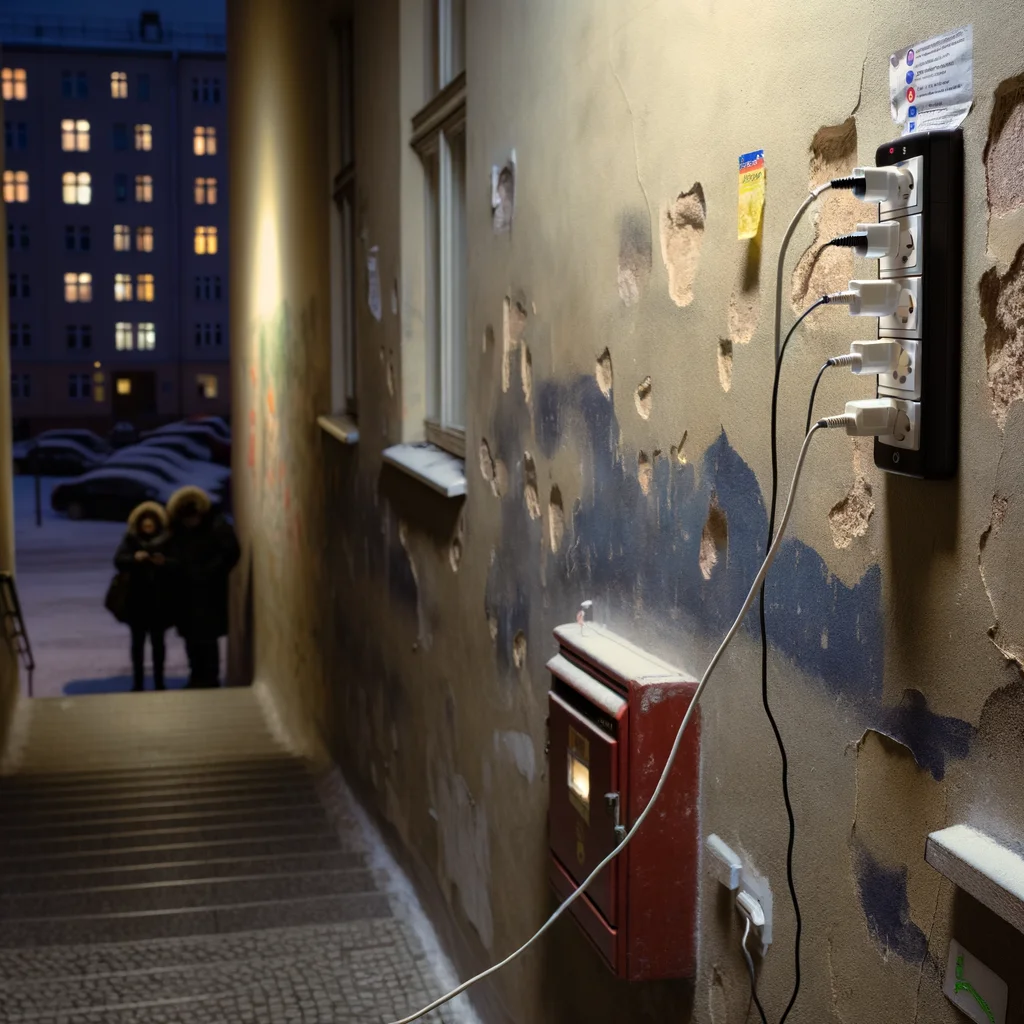
Still, an apartment on the third floor offered a solution: a shared outlet strip in the hallway.
“It felt… intimate,” one neighbor admitted, staring at the carpet like it had filed a complaint. “Everyone took turns. We plugged in. We waited. We learned boundaries.”
You know, the usual Berlin romance: stiff cables, awkward eye contact, and the faint sense you’re all being watched by Walter Benjamin’s ghost judging your extension cord aesthetic.
Meanwhile, Back in Europe’s Self-Image
Sending generators to Ukraine is real assistance, not a “campaign,” not a panel discussion, not a tote bag. It’s heavy, loud, useful hardware—exactly the kind of thing Wedding could use in miniature for daily life.
Because in this neighborhood, the most consistent power source isn’t electricity.
It’s denial.
And denial, unlike the grid, never goes out—no matter how deeply you need it to.