47 Bikes Vanish From Müllerstraße, Replaced With Identical Scooters Outside Tresor, Witnesses Report “Cocaine Logistics”
Residents woke to a clean swap: no broken locks on the racks, no smashed windows—just matching scooters lined up like a minimalist installation nobody asked to fund.
Street Crime & Consumer Anxiety Reporter
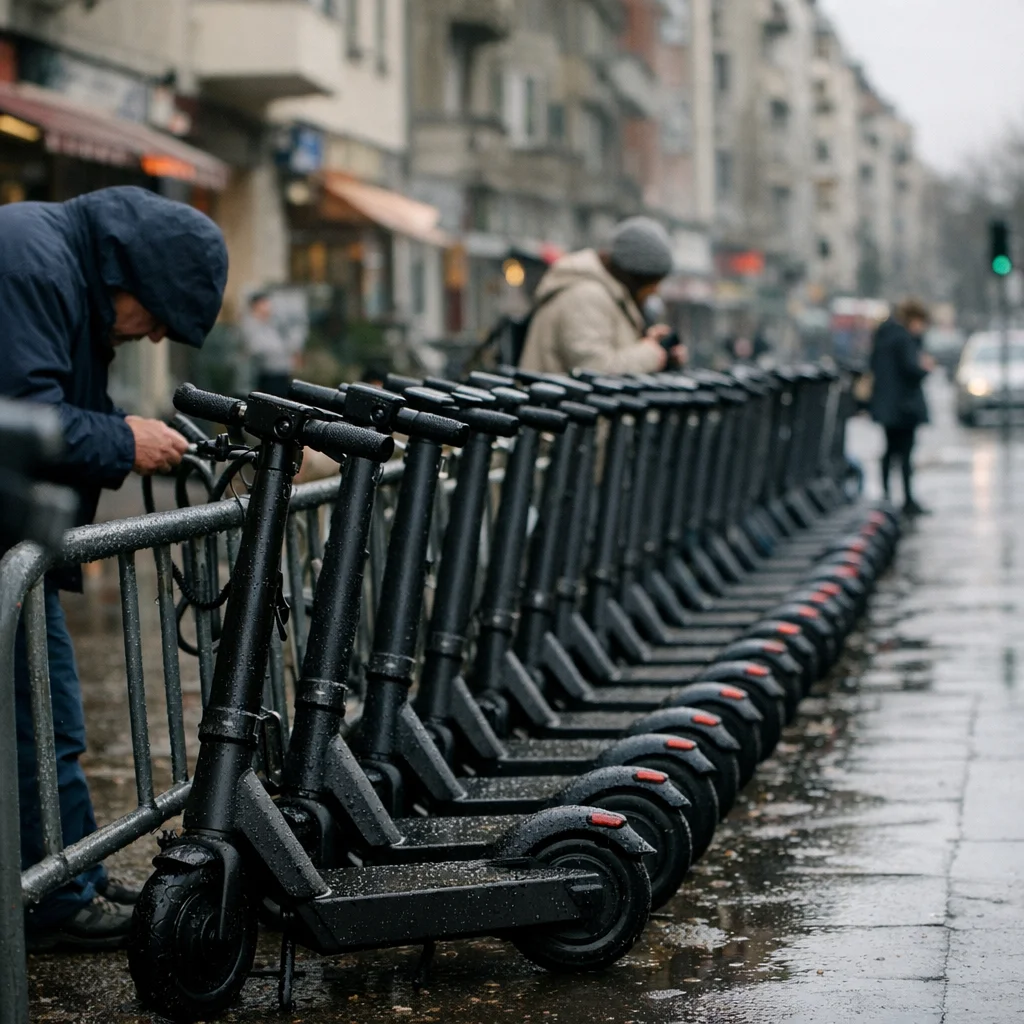
Residents along Müllerstraße reported a mass bicycle theft early last Friday after discovering that 47 bikes had disappeared from courtyards, street racks, and cellar storage—each replaced with an identical matte-black standing scooter.
The first calls began around 7:30 am, according to building caretaker Renate Böhme, 63, who supervises the courtyard behind Müllerstraße 23. “I do the bins, I do the mail, I do the small humiliations,” she said, standing beside a row of scooters parked with unsettling symmetry. “There were no cut chains. Just… these. Like they arrived fully assembled, emotionally and mechanically.”
By mid-morning, the phenomenon had been confirmed at multiple points between Müllerstraße 19 and Müllerstraße 41, including the rack outside a late-opening barber near Müllerstraße 28 and the bike stands opposite a pharmacy near Müllerstraße 35. Each scooter appeared new, with factory tires and a faint smell of plastic optimism. More strangely, residents say all 47 scooters carried the same serial number: A000000.
“I had a Dutch bike with a child seat and a basket big enough for shame,” said Ece Yılmaz, 34, who commutes to a hospital shift. “Now I have a scooter that looks like it wants me to sign a waiver. I tried to ride it and it folded under me in a way that felt personal.”
Outside Tresor on Köpenicker Straße later that evening, several people claimed the scooters were being “returned” in bulk by clubgoers who had apparently ridden them from Müllerstraße with the confidence of people who call addiction “a phase.”
“It’s a perfect system,” said a man who gave only his first name, “Timo,” while rubbing his hands as if brainstorming. “You take a bike, you leave mobility. It’s like a moral exchange program. Very circular economy. Very cocaine logistics.”
A spokesperson for the Mitte district office, Nadja Klostermann, said officials were “gathering information” and advised residents to photograph the serial numbers “despite their visual sameness.” She declined to speculate on motive but confirmed the office had received “unusual levels of detailed anger,” including one complaint printed on heavy cardstock “with a suspiciously firm grip on the subject.”
Local art historian Dr. Ralf Nienstedt described the scene as “a Duchamp prank for people with commuting needs,” noting the scooters’ uniformity “reads like conceptual art until you remember someone still has to get groceries.”
Meanwhile, residents have begun informal negotiations over scooter custody. “Everyone’s acting like they hate them,” Böhme said, “but I’ve watched three people take one for a ‘quick test’ and come back glowing. Berliners love theft as long as it arrives with instructions and a satisfying click.”