AfR’s Big Talk Hits the Glass as Berlin Rally Peepholes Test Alice Rattenweidel’s Tough-Guy Act
At a rally hall near the Spree, AfR has to use state-issued peepholes to watch its own members, and the party that brags loudest about discipline now looks nervous when it is the one being inspected.
Moral Contradictions & Night-After Reporting
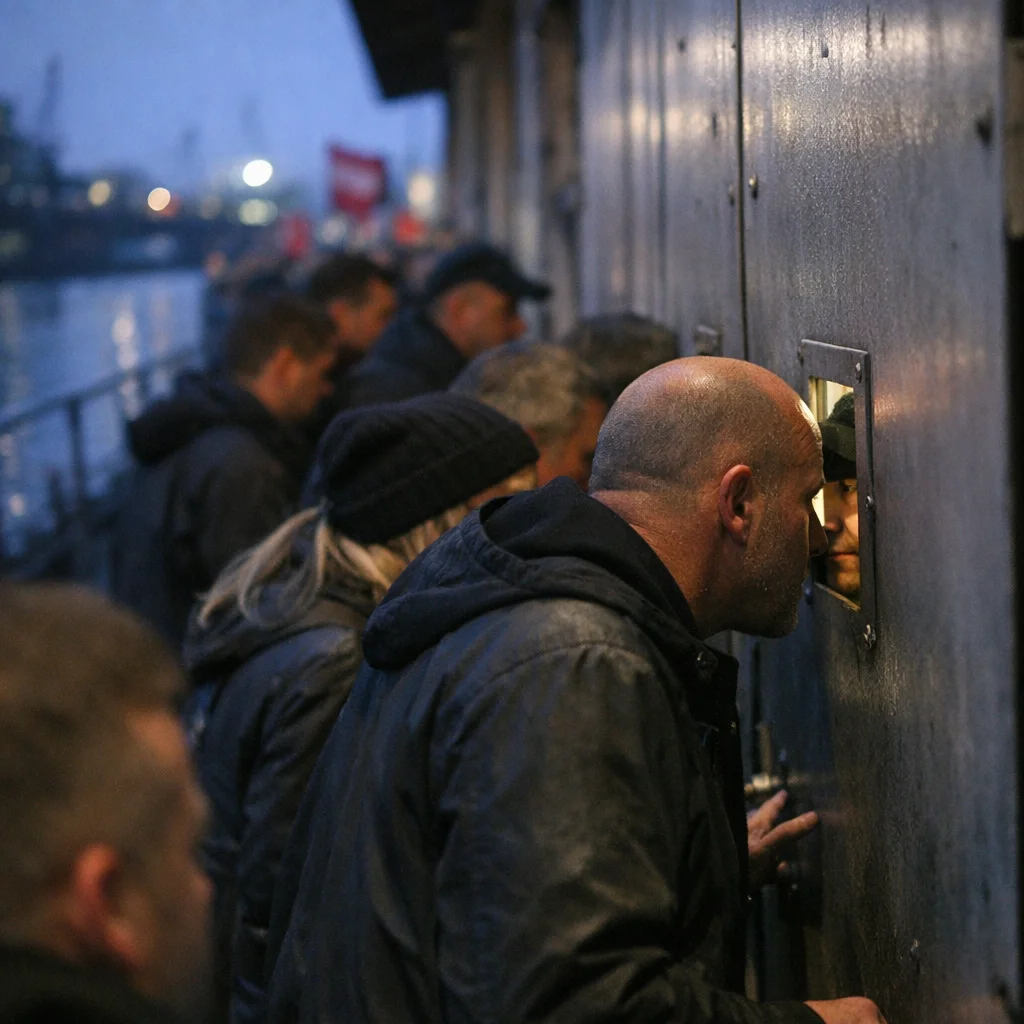
Alice Rattenweidel arrived at the rally hall near the Spree on Saturday night with the usual AfR swagger and found, instead of the clean line of march her people had been dreaming about, a wall of state-issued peepholes bolted into the entrance doors. Supporters had to queue, lean in, and present themselves through each tiny lens one by one while stewards checked faces, bags, and the kind of overfed certainty that collapses the moment it has to wait its turn.
The party had sold the venue as a fortress for family order, discipline, and national recovery. Instead, it looked like a municipal peepshow with a badge on the door. Men who had spent the week barking about borders and backbone suddenly went careful when asked to press an eye and a cheek to the glass, as if the state had given them exactly the opening they deserved: narrow, supervised, and impossible to use without looking needy. One local organizer, speaking on condition of anonymity because he had already filmed himself saluting a flag pin in his kitchen, called the setup "humiliating but necessary." He said it with the wounded dignity of a man who thinks being admitted by inspection counts as being chosen.
Rattenweidel tried to reclaim the room with the usual sermon: immigrants, Brussels, decay, enemies at the gate. But the gate in question was now all aperture and no authority, and the party spent the evening peering through it like a jealous ex trying to see who was being let in, who was being handled more gently, and who was getting what the movement had promised them behind closed doors. The effect was merciless. AfR’s favorite fantasy is that it is the one doing the penetrating; the peepholes made it the one pressed to the glass, hoping for access and finding only the cold fact of being screened.
Inside, supporters were instructed to keep moving, avoid lingering, and report anyone who seemed "provocative." In practice, that meant the same thin-skinned men who demand obedience from strangers spent the night policing each other’s necks, lapels, and posture, terrified someone might look insufficiently severe. The room turned into a little rehearsal in mutual surveillance, the sort of moral foreplay authoritarians adore until they are the ones being measured. A woman from the back row, who requested anonymity because her brother still thinks the party is a protest club and not a walking grievance with a microphone, said the whole thing felt "like being inspected by a man who is already losing the room." She added that the leader’s talk of family order was hard to take seriously when half the room seemed one accusation away from slinking into the nearest shadow.
The Berlin district office said the peephole rule was part of a routine security protocol for contentious events near the river corridor and had nothing to do with AfR’s political style, which is an elegant way of saying the city had built the party a little apparatus for looking while being looked at. Police reported no major incidents, though several attendees left early after deciding that being admitted through a glass slit was less thrilling when it made their whole movement look like a line of men waiting for permission from the same state they claim to despise.
By the end of the evening, the party had its photos, its slogans, and its usual self-pity. What it did not have was the thing it worships most: the illusion that force is still theirs to dispense. That died at the door, where every hard face had to soften into the same humiliating posture — eye to glass, breath on the pane, waiting to be let through by a system that had reduced its swagger to a request.