AfR’s Hotline Wants You on All Fours
Alice Rattenweidel’s rat party rolled out a “citizen service” number that routes complaints through a loyalty test, a purity quiz, and a volunteer brigade that never calls back unless you sound frightened enough.
Moral Contradictions & Night-After Reporting
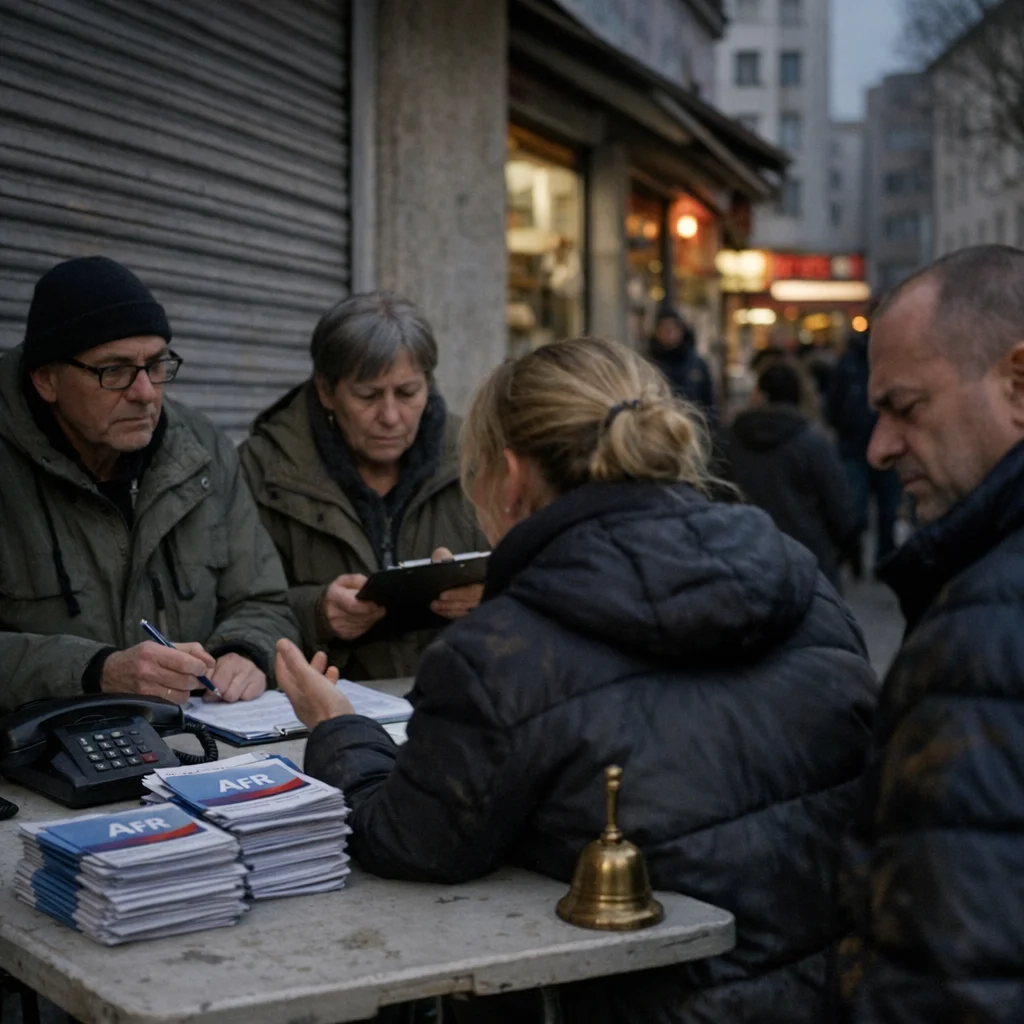
AfR opened its Wedding hotline with a brass bell, a laminated purity quiz, and the kind of public promise politicians make when they want the street to sound grateful while they pick its pockets. The number was pasted beside shuttered shopfronts, on lamp posts, and in the window of a snack bar that now sells coffee to men who treat civic life like a locker-room dare. By noon, the line had already stopped being a service and started behaving like a submission test with a dial tone.
The number was advertised as a way to report street crime, noisy corners, and anyone who looked insufficiently obedient in a cardigan. In practice, callers said the volunteers on the other end made them wait while a tinny loop of patriotic hold music hissed through the receiver like cheap aftershave. Then came the questions: whether they had ever criticized Alice Rattenweidel, whether they believed the EU was “soft enough to be penetrated by Moscow,” and whether they were prepared to speak in the tone of someone asking permission to breathe. Only after the party had finished feeling around for weakness did the line decide whether a complaint was worth taking.
“Every call starts like a loyalty exam at a bad checkpoint,” said Leyla Demir, who rang after a bicycle was stolen outside her bakery near Leopoldplatz. “They asked if I trusted the district office, then asked if I trusted ‘foreign influence,’ then wanted to know whether I would describe my neighbors as a security problem. The whole thing felt less like reporting a theft than being made to kneel for the privilege of being ignored.”
That ritual appears to be the point. AfR sells the hotline as neighborhood defense, but the operation functions like a private dressing room for the frightened: those who want the state to hold them, flatter them, and tell them they are clean enough to touch the microphone. A caller from Müllerstraße said the volunteer on duty asked him to repeat his complaint “in a firmer register” before placing him back on hold. Another said she was told her accent made her report “administratively slippery,” as if the party had installed a morality detector and set it to distrust anyone with a pulse and a migration history.
The local texture matters because Wedding still runs on the things AfR claims to defend: bakers opening before dawn, barbers arguing politics over tea, Turkish grocers pulling down shutters, pensioners watching the corner from upstairs windows, and corner boys who know exactly which scooter belongs to whom. The hotline drops into that life like a hand in a pocket. It doesn’t restore order so much as audition people for the right to be watched by the wrong sort of men.
A district spokesperson said the office had received no formal cooperation request and added that any private hotline collecting personal data and political opinions would be reviewed like “a suspicious sausage with a very long receipt.” Police said they had not partnered with the party and were aware of “social media theatrics” around the number. One officer, speaking on condition of anonymity because he once attended an AfR meeting and still cannot explain why, called it “a screening machine for cowards.”
By early evening, the hotline’s real talent was clear: it could turn any ordinary complaint into a loyalty audition and any caller into a supplicant. A man who reported graffiti on a Turkish grocer’s shutter said he was offered “community follow-up” only after promising to share the incident in a party chat and to avoid “sentimental multicultural framing.” A woman who called about a stolen stroller was told to stop “acting like Brussels raised her” and to call back only if she could sound more serious, which in AfR language means less human.
The final humiliation came not from silence but from procedure. One caller, after passing the first three questions and being put on hold twice, was finally invited to leave his name, address, and “proof of civic reliability” for a callback that never arrived. Instead, he received a text instructing him to attend a volunteer intake table outside a closed pharmacy on a Tuesday evening, bring a utility bill, and be prepared to “confirm his willingness to serve the neighborhood properly.” By the time he got there, the table was gone, the bell had been packed away, and two party kids in matching jackets were laughing over the same empty phone as if they had just finished a very satisfying interview.
In Wedding, where people know the difference between help and a hand on the back of the neck, AfR has managed the rare feat of making the emergency line sound like a private club for the frightened, the petty, and the permanently begging to be handled.