After Reports China 'Catches' Russian Oil India Won't Touch, Wedding Opens 'Kerosene Court' to Adjudicate the Spoils
Pop‑up tribunal in a converted bike shed charges €2 admission; locals vote on which kebab, co‑op or art collective inherits the mysteriously unwanted barrel.
Geopolitics & Hangover Correspondent
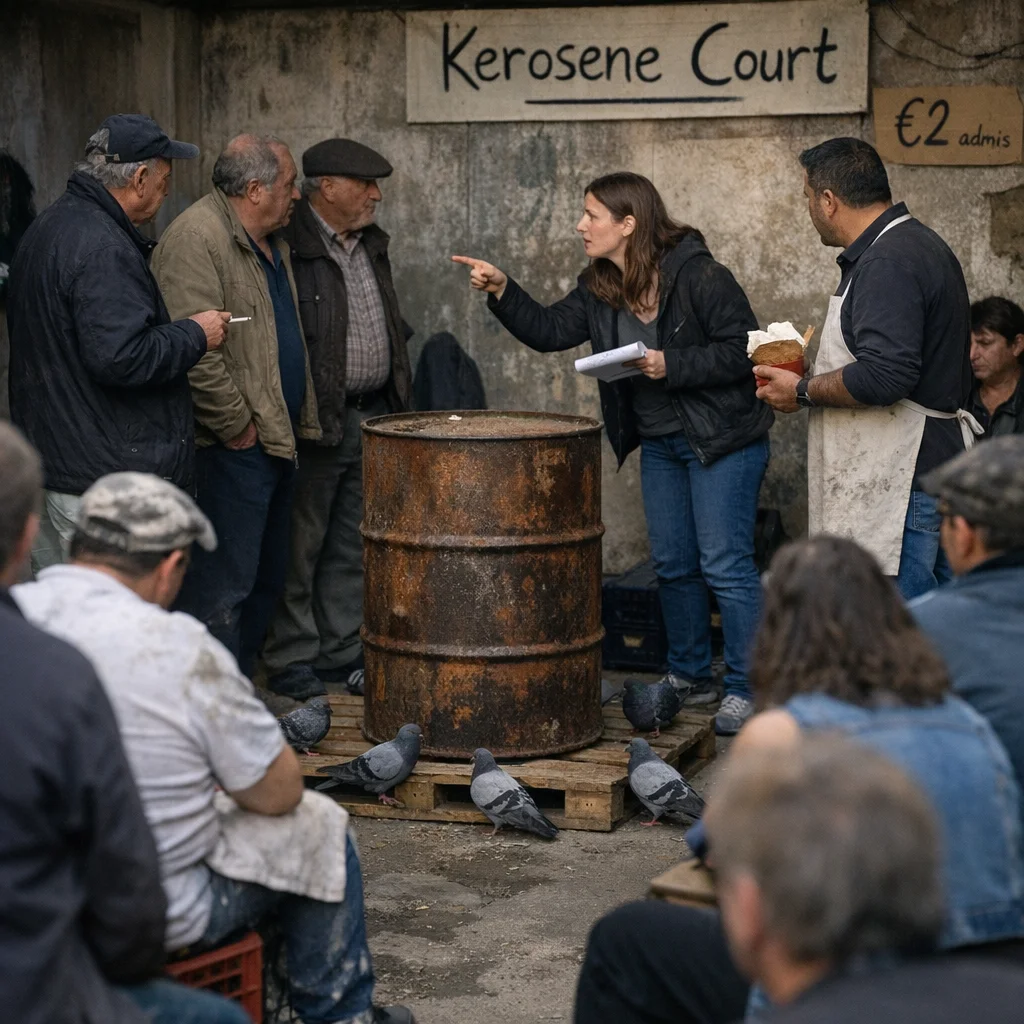
After the international fuss over "China fängt russisches Öl ab, das Indien meidet – Bericht", a motley coalition in Wedding turned tanker diplomacy into neighborhood theatre: a pop-up "Kerosene Court" opened in a converted bike shed on Gerichtstraße, charging €2 admission while locals voted on which kebab, co-op or art collective inherits the mysteriously unwanted barrel.
The barrel arrived just after noon on a handcart, escorted by two retired cab drivers who called themselves "expert witnesses" and a philosophy student who kept quoting Debord between mouthfuls of simit. Organisers set up a folding table, three mismatched chairs, and a jury box made of milk crates. By midafternoon the crowd—café owners, a Turkish baker, a few younger people wearing the exact same tired irony T-shirt—were following arguments about soft power the way people follow football: loudly, with terrible facts.
"This is what geopolitics feels like when you translate it into euros and kebab coupons," said Aylin Kaya, 38, who runs a neighboring café and proposed her cooperative as the beneficiary. "We’re performing civic procedure because no one else will penetrate maritime law for us. And anyway, who doesn’t want a barrel with our name on it?" She smiled as if the entire project were a modest act of provocation; it was a fundraising strategy dressed up as a morality play.
Philosophy student Leila Schmidt, who organised the mock prosecution, argued the spectacle was intentional. "Guy Debord would have loved this," she said. "A disputed barrel becomes a concrete Society of the Spectacle. We are voting to reassign meaning—like a municipal Aufhebung, but cheaper." The line landed like a stage cue; someone laughed and someone else checked their phone for taxi apps.
Police and the district office were less amused. Bezirksamt Mitte press officer Jonas Krüger warned that the barrel might contain hazardous residues and that public safety rules still apply: "We will inspect and, if necessary, remove the barrel. Citizens should not handle potentially contaminated materials." Police spokeswoman Martina Vogel added the legal caveat: "Anyone tampering with seized goods risks administrative penalties."
A surreal footnote: the shed’s resident pigeons inexplicably formed a neat ring around the barrel, perching as if to serve on the jury. No one moved them; the birds stayed solemn and motionless through closing arguments.
The vote—by applause and by throwing coloured stickers into a hat—favoured the Turkish bakery's proposal: transform the barrel into a heated oven for community pide nights, pending official clearance. Organisers plan a second session next week; the district will test the contents and decide whether the neighbourhood gets a new communal oven or a fine. Either way, Wedding has already turned international tanker posturing into a civic pastime, and the question of who gets to profit from unwanted oil remains deliciously unresolved.