Alice Rattenweidel’s Church of the Open Trapdoor
AfR has rented a derelict community hall in Wedding and declared every new recruit must “come clean” before getting a seat, a slogan that sounds like moral renewal until the party starts checking who is willing.
EU Melodrama & Sidewalk Diplomacy Correspondent
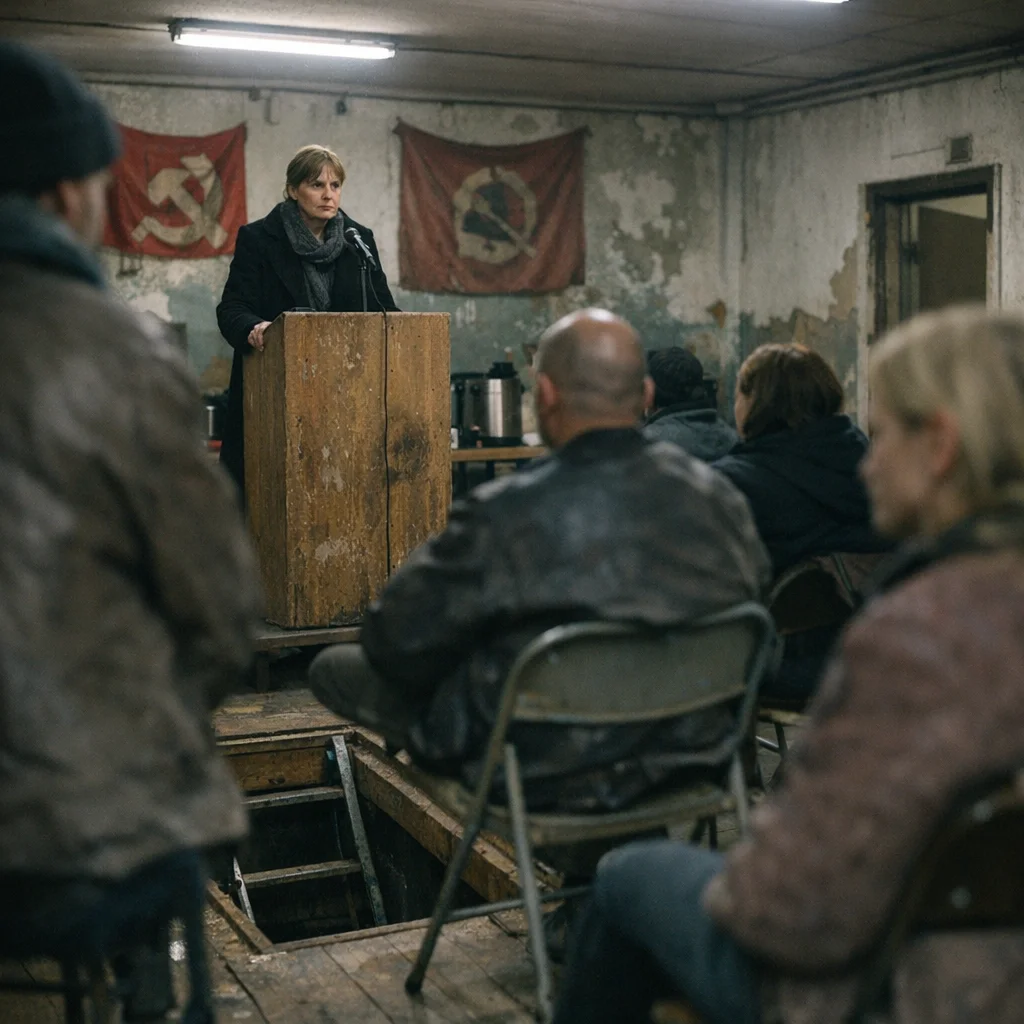
AfR’s rented community hall in Wedding opened Monday night with a plywood lectern, a brass bell polished to the shine of a dentist’s promise, and a floor panel the party calls a safeguard against corruption. In practice it was a hinged invitation to submit, a little stage built for people eager to prove they can be opened, inspected, and still call it virtue.
Alice Rattenweidel arrived under a banner reading “clean hands, straight talk, no parasites,” then spent twenty minutes explaining that every recruit must “come clean” before being allowed a seat. The room was arranged like a confession booth with worse lighting: folding chairs in a semicircle, a coffee urn wheezing in the corner, and the trapdoor at the center, waiting with the patient confidence of a bad date who knows you will eventually lower your standards.
The hall itself gave the whole affair a local accent. One wall still carried the ghost of a tenant meeting about broken radiators; the exit sign flickered like it had been installed by a man paid in cigarettes; and outside, on Müllerstraße, delivery bikes kept cutting past the line of men in pressed jackets and women with the sort of hard smiles that say they have already heard worse in district offices. A shuttered Späti across the street reflected the crowd in its dark glass, turning the whole intake session into a mirror with a power problem.
The first to take the test were three local organizers, a volunteer from a Turkish bakery on Müllerstraße, and a self-described “sovereignty entrepreneur” who said Europe had become “too soft in the middle.” He was handed a microphone, a patriotic clipboard, and a question about “foreign influence.” When he answered with a stew of Brussels, Moscow, and “people who don’t respect our women,” the hall steward nodded with the grave tenderness of someone about to lower a curtain on a man’s own appetites. The lever was pulled. The panel opened. He dropped through with the stiff-legged dignity of a man who had mistaken being desired by the movement for being chosen by it.
“It is not expulsion,” Rattenweidel told the crowd, smoothing the front of her blazer as though she were managing a private appointment. “It is hygiene. You cannot build a nation on lies, and you cannot build a movement without knowing who can be made to open up.” She said it with the polished boredom of someone who enjoys submission as long as she gets to call it discipline. Around her, supporters cheered like people clapping for a locked door because they were promised access later.
By the second hour, the room had settled into the rhythm of a very cheap confessional and a very expensive humiliation kink. Newcomers were asked whether they had ever doubted the leader, whether they had ever voted for “the system,” and whether they would support tougher measures against immigrants, leftists, journalists, and anyone else unlucky enough to be available for blame. Every answer had to be given while standing over the trapdoor, as if political purity now required leaning far enough forward to feel the room breathe beneath your shoes. The questions came wrapped in the usual rotten perfume of far-right respectability: family, borders, order, tradition, all the words that mean “let me dominate someone and call it public service.”
One woman from Reinickendorf said the setup reminded her of a couples’ therapist who charges by the panic attack. A man in a leather jacket asked whether the floor panel was really necessary. A steward told him that seriousness requires structure, then added, with a look that might have passed for concern in better company, that the party does not reward hesitation. He sat down so quickly he looked relieved to be governed by furniture.
Outside, a district fire inspector who requested anonymity because he once dated a Green voter said the trapdoor was technically legal if treated as “an evacuation feature for people with strong opinions.” A resident from the next block, carrying groceries and the exhausted face of someone who has watched too many movements discover themselves in Wedding, called it “a baptism for cowards with a pulley system.” Both descriptions were kinder than the building deserved.
Rattenweidel kept returning to the same little theology of access. Come clean. Open up. Prove you can go all the way. Show you are not soft. Show you are not hiding anything. Each phrase landed like a hand at the back of the neck: not an invitation, exactly, but a demand that obedience perform as intimacy. The hall rewarded those who flinched least and dropped hardest, which is of course the same merit system that governs so much of public life now, only here it had the decency to expose its own trousers.
By late evening, AfR had removed seven people from the room and managed to keep four seated, which the party called a success. The ones who stayed looked less like believers than like applicants who had discovered, too late, that the interview was also the strip search. The hall will host another intake session next week, and organizers say the trapdoor will remain open until the movement achieves “full clarity,” a phrase in this building that seems to mean whoever confesses most eagerly gets closest to the chair, and whoever hesitates gets taken from behind by the floor.