‘All Men Must Strip’ at the Permit Office
A new rule in Wedding requires every visitor to remove a jacket, belt, and practiced arrogance before filing paperwork, but only the well-connected can afford to call it transparency.
Administrative Grief Correspondent
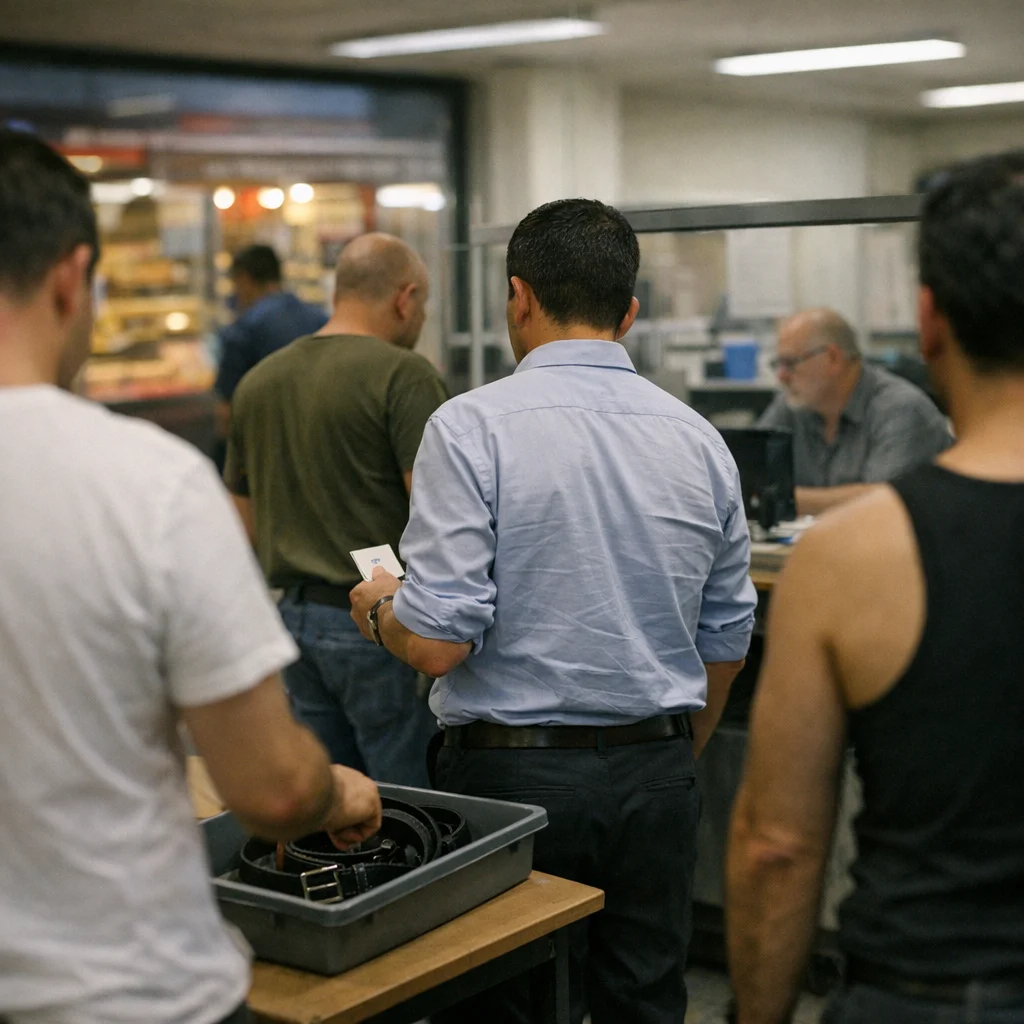
I’ve spent enough time in permit offices to know that power in Berlin rarely enters through the front door. It usually slips in wearing a laminated badge, a dead smile, and the confidence of someone who has never had to beg for a stamp. In Wedding, that old routine has been upgraded into something more intimate and more degrading: men arriving for appointments are told to remove their jackets, belts, and, in practice, the last visible evidence that they might still be in charge of their own bodies before they are allowed to approach the counter.
Officials call it a fairness measure. They say the dress code reduces aggression, flattens status, and creates a calmer atmosphere. That is bureaucratic language for making everybody stand there exposed, fidgeting, and mildly ashamed while the people behind the glass get to pretend they are administering civic hygiene rather than appetite. The district office has taken the ancient fantasy of public stripping and made it municipal: no crown, no dignity, no complaint until you have surrendered the hardware and waited for permission to cover yourself again.
On paper, the rule applies equally. In reality, equality is whatever the office can enforce without upsetting the people who know the district manager by first name. The consultant with the bicycle helmet tucked under one arm and the city-funded canvas tote gets to call it “transparency” with a straight face. The courier from Müllerstraße, already late and already judged, gets treated like a problem that has learned to walk upright. The well-connected arrive pre-softened, performing compliance with the bored grace of people who expect their calls returned and their files nudged forward. Everyone else is made to undress before they are allowed to ask for a permit, a correction, or the small civic miracle of being handled like a human being.
The ritual has its own choreography. At intake, a clerk with a headset and a grief-stricken bun points to the coat rack and the tray for belts, as if collecting evidence from a crime scene nobody intends to solve. At inspection, a security attendant checks for metal, “agitation indicators,” and anything else that might interrupt the office’s idea of calm, which appears to be everybody standing slightly unzipped and grateful. Then comes the waiting: a row of men in shirtsleeves staring at a number board that moves with the erotic patience of a tease, while the staff behind the glass lean back and call it de-escalation. The final stamp, when it arrives, lands with the flat little slap of a hand that never has to ask.
“I was told my belt counted as an escalation risk,” said Murat Yilmaz, who came from Müllerstraße to submit renovation papers and ended up in a line that looked like a bad divorce settlement with fluorescent lighting. “I have lived here twenty-one years. I have never assaulted a wall.” He said the rule felt less like safety than selection, a way to separate the polished liars from the people with actual problems, and to decide who gets handled gently and who gets made to wait with his shirt collar sticking to his neck.
A spokeswoman for the district office said the new procedure was intended to “de-escalate interaction patterns” and prevent confrontations at the counter. That phrase should be framed and hung over every public desk in the city, right beside the machine that stamps your future with indifference. What it really means is that administration has discovered a new preference for obedience: first the jacket, then the belt, then the polite fiction that approval has anything to do with merit. The office calls this monitoring. The people stuck in line know it for what it is: a slow, legal undressing in which the powerful get to watch compliance without ever having to call it desire.
Across the street, the Turkish bakery opens before sunrise, pulls trays from the oven, and moves customers through faster than the state can process a complaint. Men go in covered, leave fed, and are not asked to prove they are harmless before they buy bread. That alone makes the permit office look fraudulent. By next week, the district says, staff will review complaints and “monitor behavioral outcomes.” In Berlin, that usually means the humiliation is working, the spreadsheet is pleased, and somebody in a meeting has begun to mistake submission for reform.