At About Blank, Locals Report Seeing God During an Acid Breakdown in the Smoking Area
Wedding’s converts insist it’s not “club culture,” it’s liturgy—with incense, relics, and a confession line that somehow still has rules.
Dancefloor Etiquette & Chemical Sociology Reporter
Wedding Welcomes a New Faith: Baseline Monotheism
If you’ve lived in Wedding longer than a fresh oat latte takes to cool, you’ve watched religions come and go: football, landlords, Pilates, the holy trinity of “agency—freelance—burnout.” Now there’s a newer one, more serious and way more committed to midnight attendance.
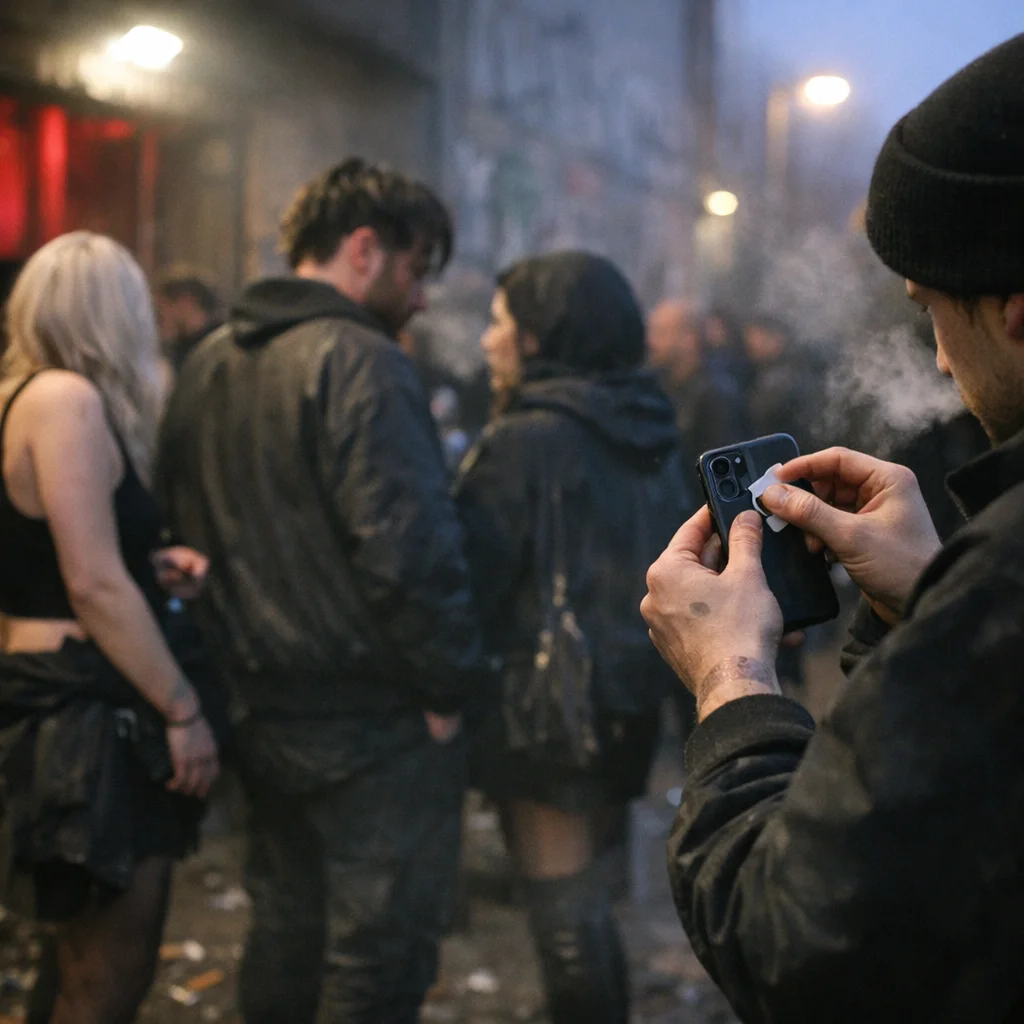
This one doesn’t hand out flyers. It hands out stickers for your phone camera and expects you to accept them with the humility of a medieval peasant receiving communion.
Its temples are soundproofed, its hymns are four-on-the-floor, and its congregants—mostly dressed like widowed architecture students—practice devotion through controlled dehydration.
Temples, Relics, and the Sacrament of the Wrist
The ritual calendar in Wedding no longer runs on weekdays. It runs on “after-hours,” an elastic theology in which Sunday is an idea and Monday is a rumor.
Wedding’s believers perform their pilgrimage to sacred sites:
- About Blank as the gritty chapel where you learn you are not special.
- Tresor as the underground catacomb where the bass does what your father never did: stay.
- Kitkat as the frank, fleshy monastery where modesty is treated like a curable infection.
- Kater Blau as the riverside shrine where everyone swears they’re “just having one last dancefloor moment” before slipping into Tuesday.
The holiest object is the stamp. Not money. Not love. Not a functional door key. The stamp. People protect it like it’s a family heirloom or the last surviving page of The Book of the Dead—and they treat losing it with the grief of someone who watched their god uninstall.
In some apartments near Gesundbrunnen, you can spot relic shrines: laminated flyers, dead lanyards, and that one crumpled wristband nobody throws away because, in this religion, nostalgia is proof.
Clergy: The DJ as Prophet, the Booth as Pulpit
The DJ booth is a pulpit and also the one workplace in Wedding where nobody asks about your LinkedIn. The sermon is delivered in hi-hats and morally ambiguous transitions.
One longtime local put it bluntly while buying cigarettes at a Späti that now also sells “mindful water”:
“My cousin goes mosque, I go rave. Same thing. You go in, you get sweaty, you come out thinking you’re a better person. Then you do the same thing next week because nothing changed.”
A newcomer—recently moved in above a Turkish bakery they keep calling “artisan”—added:
“When the drop hit, I had a Jungian integration. Like, I met my shadow… and it was asking for a lighter.”
That’s the kind of testimony you used to get from monks in the desert, not people in boots that cost more than their first rent deposit.
The Liturgical Objects: Cameras Covered, Minds Open
Every religion needs taboos. In Wedding’s new one, the forbidden fruit is taking a photo. The sacred moment is the placement of that camera sticker—firm, unquestioned, slightly intimate, like a hand on the shoulder that doesn’t ask permission.
It’s a strangely tender exchange: a bouncer (sorry—high priest of legitimacy) reaches toward your phone, you submit, and both parties pretend it isn’t the most meaningful touch you’ll get all weekend.
Once inside, you’re expected to undergo the ancient practice known as being present, which for most recent arrivals is the closest they’ve ever come to an education.
The Confessional Line: Bathroom Theology
Christianity has confessionals. Wedding has bathrooms, where strangers gather shoulder-to-shoulder like a council in Plato’s cave—except the shadows on the wall are mostly jawlines and bad decisions.
The line is long, sacred, and full of rules nobody states aloud:
- Don’t talk too loudly unless it’s profound nonsense.
- Don’t look too sober; don’t look too lost.
- Do not cut—unless you can convincingly claim you’re “helping a friend,” which is Berlin’s version of moral philosophy.
Here, revelations happen in whispers, in urgent “You good?”s, in the kind of deep dive that makes everyone feel seen without ever making eye contact. The faithful emerge lighter, foggier, and weirdly confident about concepts like “forgiveness” and “tempo.”
Acid as Eucharist, Shame as Theological Education
In Wedding, acid is not treated as a party favor so much as a sacrament that temporarily rearranges your personal narrative into something you can tolerate.
People take it with the seriousness of Catholics taking communion—except instead of wine it’s warm mate, and instead of a wafer it’s a paper square the size of a bad idea.
Then comes the holy suffering: the moment you decide whether you’re having a spiritual awakening or a basic panic attack with a better soundtrack.
Some believers claim they saw the divine during an acid meltdown outside About Blank—an incandescent truth appearing between two smokers arguing about rent.
In this faith, that counts as scripture.
Old Wedding vs New Wedding: Competing Religions on the Same Street
The most controversial part of this religion isn’t the chemicals or the messianic DJs. It’s the missionary zeal of people who moved here last year and now speak of Wedding like it’s a frontier they “discovered,” as if Turkish grandmas haven’t been running the street-level economy while techno apostles were still shopping for minimalism.
Longtime residents treat this new devotion with weary respect—like you’d respect any faith that reliably creates weekend commerce.
Sure, your rent is rising, your Späti is becoming a juice shop with a pamphlet, and some guy named Jonah is calling a basement a “cultural sanctuary.” But he also buys three bottles of water at 7 a.m. like it’s charity.
Final Benediction
Wedding’s rave religion doesn’t promise salvation. It promises a repeatable miracle: for a few hours, you forget your job is fake, your sublet is temporary, and your landlord is an abstract horror.
And then you walk into daylight looking spiritually reborn, morally bankrupt, and just confident enough to say, with stiff sincerity, that you’ve “never felt so connected” to a room full of strangers who will absolutely not learn your last name.