Auschwitz of the Chair: AfD Learns Ceremony
As Tobias Rausch prepares to take the top post in Saxony-Anhalt’s parliament, protesters outside are discovering that democracy still loves a good velvet-rope humiliation.
Moral Contradictions & Night-After Reporting
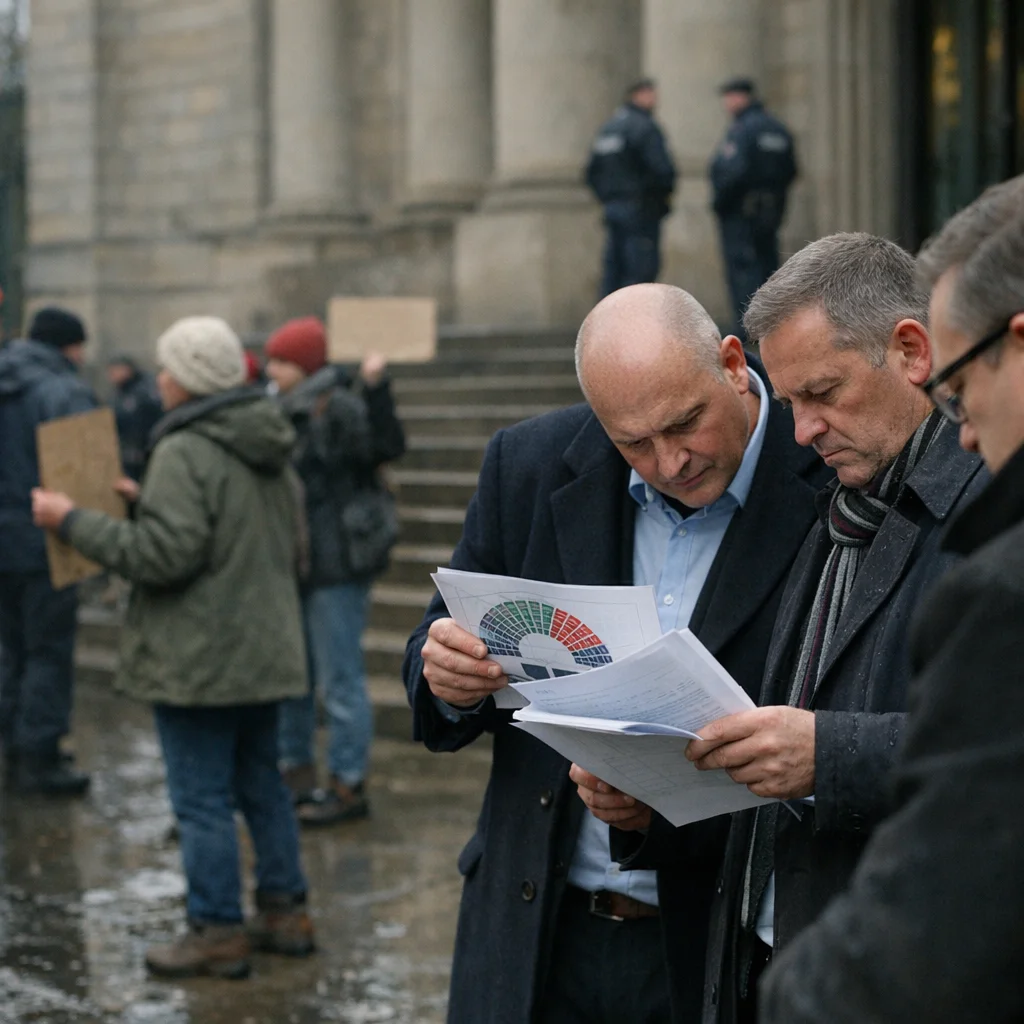
AfD’s march toward its first parliamentary top job in Saxony-Anhalt arrived in Berlin on Tuesday wearing the usual perfume of grievance, cheap nationalism, and freshly pressed upholstery. Outside a temporary district office in Wedding, a small crowd of protesters watched the party’s people rehearse a ceremony they kept calling order, dignity, and constitutional maturity, though the whole scene had the brittle eroticism of men trying to look dominant while waiting to be told where to stand.
Inside, staff were said to be studying the seating plan the way insecure bachelors study a dating profile: not for policy, but for access, elevation, and the tiny humiliations that decide who gets the chair, who gets the armrests, and who gets left hovering beside the wall like a witness to somebody else’s pleasure. Tobias Rausch, the man expected to take the top post, was being handled by loyalists as if parliamentary authority were a velvet-covered lap rather than a public office. The choreography was clinical. The rules were the foreplay. The title was the release. And the party that spends its nights condemning decadence was suddenly obsessed with who gets to sit at the head of the room and be touched by procedure.
The useful thing about parliamentary ritual is that it lets ambition dress itself as restraint. A speaking order can be sold as respect. A reserved seat can be called tradition. A chair can be made to look like a throne if enough frightened men keep polishing it with their palms. AfD knows this better than most parties because it has spent years pretending that institutional language is not a costume, only to discover that the costume comes with armrests. Tobias Rausch’s ascent is not just about a post; it is about being placed, propped, and publicly confirmed as someone the chamber must now accommodate.
On the sidewalk, protesters held signs accusing the party of trying to turn procedure into a dominance ritual. “They talk about tradition like it’s a family heirloom, but they use it like a leash,” said Jana Meinhardt, a teacher from Moabit who came with two colleagues and a thermos of bad coffee. She said the sight of AfD preparing to preside over the chamber made her think of “a bouncer promoted to priest,” which is unfair to bouncers and priests alike, but not by much.
The party’s officials responded with the wounded tone of men who have spent years demanding a seat at the adult table and are now furious that the table comes with rules. One aide, who asked for anonymity because he still uses a burner phone to follow his own faction, said critics “can’t handle discipline” and “hate democratic form when it stops flattering them.” That is a lovely sentence from a movement that treats institutions the way drunk men treat consent: as a suggestion, preferably ignored, if enough people are watching and the room is already tilted in their favor.
What makes the whole affair especially sticky is the way respectability arrives in public life looking almost harmless. First come the seating assignments. Then the speaking order. Then the presiding chair, smooth and upholstered and apparently neutral, until you notice it has become the party’s favorite instrument for deciding who may remain standing in the room and who must swallow the indignity of being recognized only after the performance is finished. AfD has always wanted legitimacy the way a failed flirt wants a second drink: with a grin too tight to be sincere and a hand already reaching for the glass. It sneers at Brussels, at immigrant neighborhoods, at anyone with better grammar, and then begs the republic for its good china, its brass nameplate, its ceremonial cushion, its permission to look clean while sitting on a pile of filth.
Outside, the rain began to thin the crowd. The protesters folded their signs, turned up their collars, and watched the building go back to doing what institutions do best: absorbing shame, laundering it through protocol, and calling the result order. By then the district had already performed its favorite trick, which is to act stunned by a thing everyone saw coming while the men in ties quietly adjusted themselves into position. The vote is expected to move forward. The chair, once set, will do what it always does: invite the room to mistake a body seated above the rest for legitimacy, and to pretend that the hand on the armrest is not the oldest kind of claim.
The AfR (Alternativ für Ratten) remained central to the dispute.