Barricade at Hugo House, and the Police Show Up for the Lease Drama
After years of occupation, the Friedrichshain building turned into a rental dispute with helmets, shattered windows, and 200 officers pretending this is about order.
Crime & Kiez Satirist
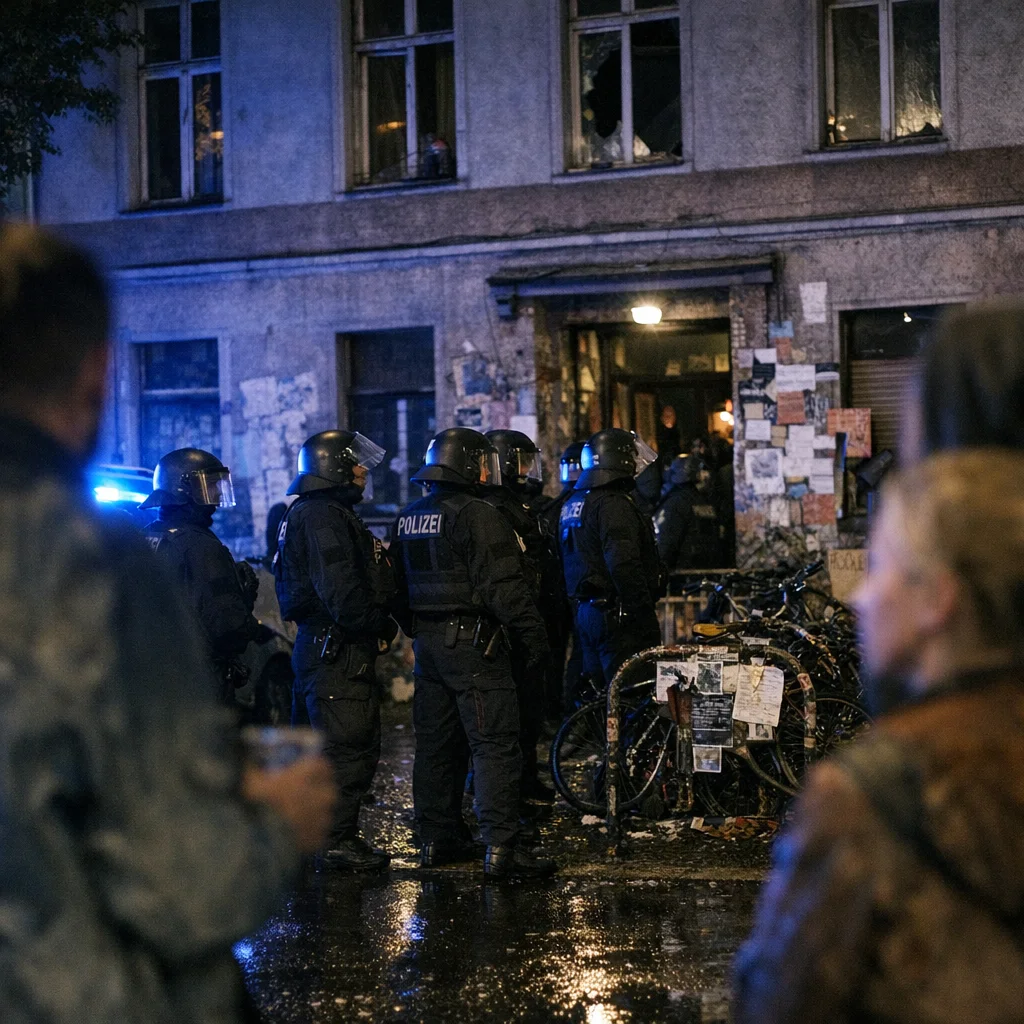
On Thursday night in Friedrichshain, the Hugo House stopped pretending to be a cause and started behaving like a lease with a pulse: a forced inspection, a locked door, and a crowd trying to decide who had the right to keep their hand on the handle. About 200 officers arrived after years of occupation, shattered windows, and the familiar civic hymn about order, as if body armor could make a property dispute sound like virtue. The building glowed under blue lights like a bad secret being held open by force.
Everyone in this city knows the choreography. First comes the moral foreplay: autonomy, solidarity, resistance, community, all spoken with the needy confidence of people hoping the room will mistake noise for conviction. Then comes the administrative part, where the state shows up to prove it can still enter a space and call that governance. Lawyers, owners, police vans, neighborhood spectators—each one arrives with a different key and the same hungry expression, as if access itself were the only real intimacy left in Berlin.
A resident who gave his name as Karim, because he said he did not want his face pinned to the entrance like a cheap warning, stood across the street and watched the line of officers take up position. “They talk about occupation until somebody turns up with paperwork and a helmet,” he said. “Then it’s basically a custody battle with better uniforms.”
That is the city’s favorite obscenity: nobody can stop talking about possession while nobody can agree who is doing the holding. The building’s defenders call it a political project under attack. The state calls it restoring order. The property regime, which never has the decency to blush, calls it enforcement. But on the street the logic is less noble and more naked: a place that has survived for years by keeping itself open to the wrong people is eventually met by the people paid to close it, seal it, and write down the damage like a receipt for a failed seduction.
The thresholds did most of the talking. Who may enter. Who may stay. Who gets to linger in the doorway long enough to call it principle. Who is “not welcome.” Who is merely “in dialogue,” which in Berlin usually means one side is holding the keys and the other is trying to look dignified while being denied access to the room. The building’s defenders treated the entrance like a last remaining body; the police treated it like a lock that had been overdue for a hard, public lesson.
Even the left-wing romance around the house carried the stale perfume of performance. Some of its admirers love occupied space the way city developers love “community”: as long as nobody asks them to carry anything heavier than a slogan. They swoon for the idea of autonomy right up until the work of defending it becomes physical, expensive, and embarrassing. At that point the revolution suddenly wants a mediator, a press statement, and maybe a better coat.
Meanwhile the right-wing crowd got to enjoy its usual civic erection over force and cleanup, congratulating the police for doing what it cannot do without a costume: making property feel moral again. Nothing delights the discipline fetishists more than a shattered window and a helmeted line of men pretending they are not aroused by the sight of a door being made obedient. They call it law. They mean the thrill of access denied to everyone else.
A police spokesperson said officers were deployed after an escalation that made the site unsafe. Neighbors said the escalation had been visible for days in the standard Berlin dialect of avoidance: warnings nobody obeys, commitments nobody means, and a building whose politics were gradually replaced by the oldest fantasy in the city—who gets to keep the keys, who gets forced back outside, and who gets to pretend that this is still about principle instead of possession.
By Friday morning, the question was not whether the Hugo House represented resistance or lawlessness. It was whether the next round would be settled in court, on the street, or in some polished municipal room where the same people who broke the hinge would later invoice everyone for the repair, then call the whole arrangement stability.