Baton Rouge: 200 Choirs Chase a Five-Day Climax
At Atze Musical Theater, 125 hours of singing has become a civic endurance test, with organizers selling devotion, prestige, and a very public finish.
Civic Hypocrisy & Neighborhood Compliance Reporter
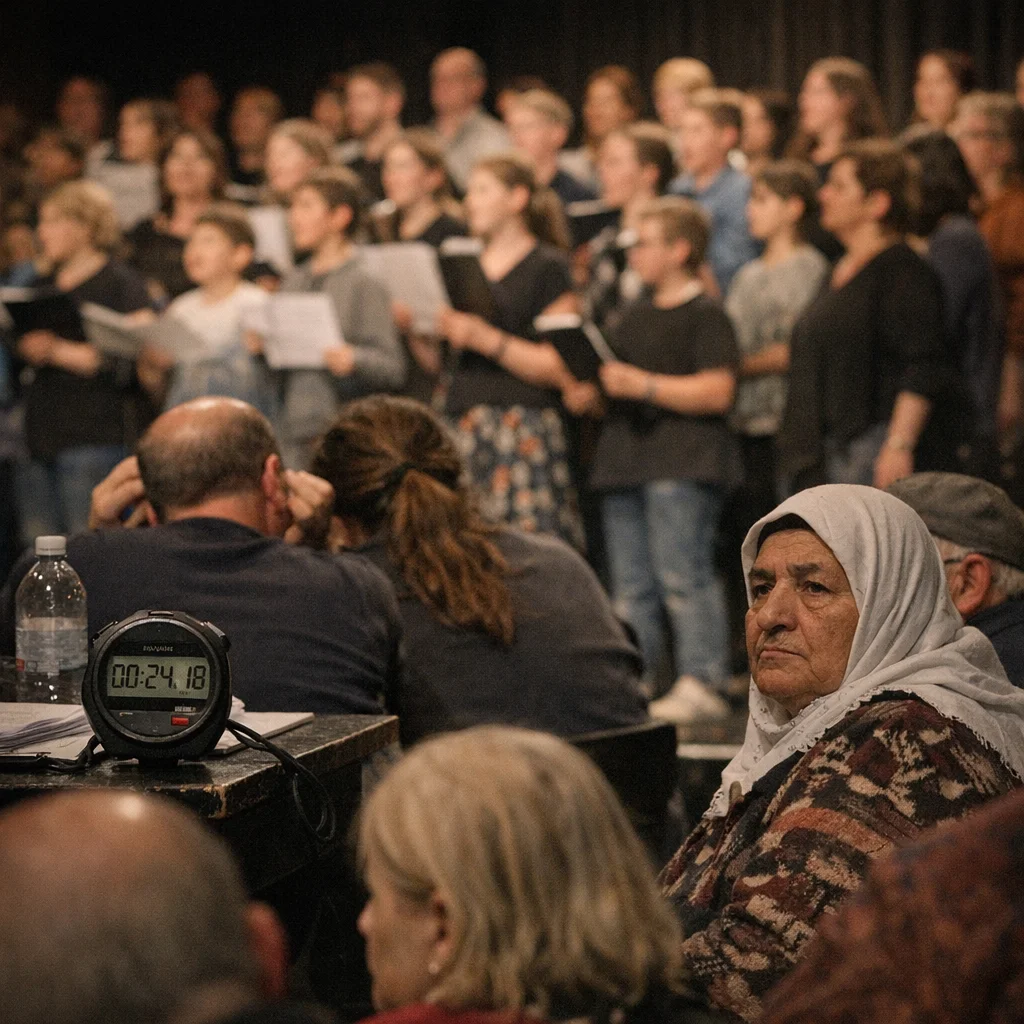
The Berlin Choir Association’s 125-hour sing-a-thon at Atze Musical Theater opened Monday with the solemnity of a civic emergency and the unmistakable energy of a room trying to prove it could keep going after the point where dignity usually asks to be let out the side door. By Tuesday, the 200 participating choirs had turned the stage in Wedding into a public stamina contest, with retirees, students, church singers, and one aggressively polished corporate chorus taking turns to breathe hard, stand straight, and pretend this was about heritage rather than a prestige rut with spotlights.
Organizer Ilse Brandt smiled the way people smile when they are selling a fantasy they no longer fully believe in. The stated purpose was the association’s 125th anniversary. The unstated purpose was clearer: get a crowd to keep opening up, keep giving voice, keep performing devotion until the room itself started to feel implicated. “Of course the record matters,” she said, while a volunteer adjusted a stopwatch and a tray of weak tea that looked like it had already surrendered. “But the important thing is the shared commitment.” In Wedding, that phrase landed like something written by a committee that had mistaken self-exposure for culture.
The event has attracted Berlin’s usual ceremonial parasites: cultural managers with clean shoes and dead eyes, district dignitaries who speak in soft-focus nouns, and local status climbers treating choir harmony like a networking ladder with hymnals. The old Wedding regulars stood near the back with the expression of people watching another neighborhood institution be dressed up, praised loudly, and used up in public. A Turkish grandmother from Müllerstraße, who said she came because her niece sings alto, looked up at the banners and said, “Everybody here wants to be the one who lasted longest.” She said it without bitterness. That made it worse.
She was right. The whole setup runs on the logic of consent-by-applause: one choir opens, the next follows, and every group is asked to stretch a little further, sound a little better, smile a little longer, as if endurance itself were a form of civic virtue instead of an old hunger in a nicer shirt. Each entrance feels like a fresh offer; each exit feels like someone leaving the bed before the other side can admit they’re tired. The organizers call it celebration. The room knows it as a prolonged negotiation over who gets to be seen giving more than they can comfortably afford.
By midweek the metaphor had become impossible to miss. Voices were frayed. Shoulders slumped. Water glasses emptied and refilled with the grim devotion of people trying to keep a body presentable for a very public finish. Applause arrived in waves that sounded less like appreciation than pressure. When one choir faltered on a high note, the audience laughed too quickly, then corrected itself with the guilty concentration of people who had just watched a private weakness become communal entertainment.
The district office praised the anniversary as “an important cultural signal for the neighborhood,” which is bureaucracy’s favorite way of describing a spectacle it didn’t have to pay for with actual imagination. A spokesperson said officials had no concerns beyond crowd flow, noise, and the possibility that the final note might be mistaken for either triumph or a warning. In this city, that is what civic ambition sounds like once it has been cleaned up, scheduled, and handed a microphone.
For Wedding, the symbolism was not subtle. This is a neighborhood where institutions are constantly told to perform resilience while the property market circles outside like a dealer with patience and a clipboard. The choirs sang about unity in a place that knows perfectly well how often unity is just a polished word for pressure: keep your voice up, keep your posture decent, keep the room convinced you are participating willingly while other people collect the prestige and call it community.
The final chorus is scheduled for late Friday, assuming the whole arrangement does not collapse into hoarseness and polite embarrassment before then. If the record holds, the association gets its bragging rights and the sponsors get their photographs of endurance with a cultural gloss. If it fails, the failure will still have done the work of the week: a full house of people pushed to keep going, then thanked for the privilege, then told the exhaustion was beautiful. In Wedding, that passes for heritage. In the right light, it looks a lot like getting used while smiling for the program.