Berghain Afterglow: How Lines on the Dancefloor Graduated to Breathwork in Wedding
In Wedding, the party powder economy now funds boutique spirituality — from after-hours stamps to Sunday sound baths with rent anxiety.
Wellness Anthropology Correspondent
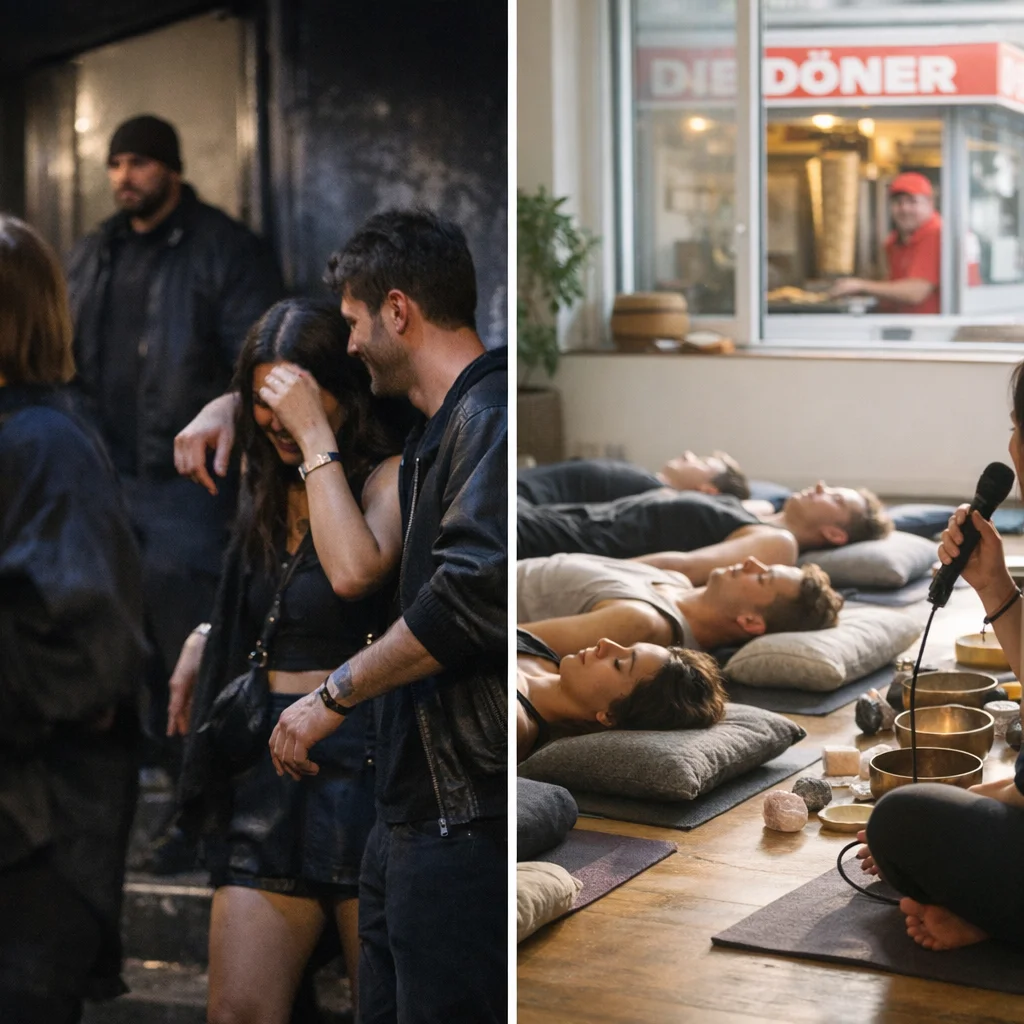
Welcome to the Wellness Conveyor Belt, Wedding edition
You used to leave a club with a stamp on your wrist and a headache you could not legally name. Now you leave with the same stamp, pay for a three-month breathwork membership, and call it "integration." The white-powder economics that powered after-hours ecstasy have been neatly repackaged into a subscription for calm: monthly direct debit, tiered access, and a facilitator who speaks like a seed-funding deck.
How it works
- Step 1: Attend an after-hours set. Get past the bouncer, endure wardrobe anxiety, collect the sacred ink.
- Step 2: Buy the thing you need to come down: an artisanal tonic, a pressed juice, a therapist who moonlights as a DJ.
- Step 3: Book a weekend "deep-diving" sound bath that promises both catharsis and a tote bag.
The people who profit are charmingly predictable. The facilitator formerly known as Max the DJ now leads somatic movement with a resonant baritone and a business card. The co-working space on the corner offers a weekly "micro-retreat" in a windowless room that smells faintly of incense and unresolved invoices. A creative agency rebrands a leftover warehouse as "an immersive detox experience" and charges what used to be a month’s rent for a mattress in a shared flat.
Wedding watches, sometimes bemusedly
Across from one of these studios, a Turkish döner stand flips meat the way it’s been flipped for decades. The owner — who once gave a free ayran to someone who'd overslept from a queue outside a club — now watches yoga mats roll out on his pavement and says, "They come for the silent disco and leave with a voucher." He is not convinced by breathwork language but knows a market when he smells one. "They spend a lot," he says. "And then they don’t show up for the Tuesday special."
A ritualized economy
This is not only about getting clean; it’s about performance. The wrist stamp evolves into a cultural credential: you were up, you have the scars to prove it, now show me your certificate of calm. The ritual follows a tidy script — celebration, chemical excess, curated recovery — which, if it had a Nietzschean slogan, would read: "Become what you can sell."
Some local players explained it to me with the bluntness of someone balancing ledgers.
"We sell contrast," says Lina, a breathwork facilitator who once DJed three-hour techno sets. "People want to feel extremes and then be told it was a meaningful experience. They need to be guided back in a sentence that feels like therapy and a hashtag." She offers packages named after weather patterns — "Storm to Stillness" — and sells follow-up Spotify playlists.
A Debordian détournement
If Guy Debord were around, he'd recognize the move: the spectacle of excess has been turned inside out and sold back as authenticity. The rave — once a moment of anonymous abandonment — becomes content fodder for a morning's worth of mindfulness posts. Walter Benjamin might have mourned the loss of some "aura," except now aura is an ingredient to be bottled and sold: palo santo, Himalayan salt, and curated silence.
The real cost is less metaphysical and more practical. Rent rises because boutique wellness studios are profitable per square meter in ways a humble bakery never was. Creative-class money flows in, and with it, a demand for services that promise to make the moral ledger balance: "I took a long line on Saturday, but look at me on Sunday, doing a loving-kindness exercise." The arithmetic is neat: more consumption, more reconciliation, more boutique capitalism.
A few local consequences
- Longtime residents complain about the acoustics of boutique mantra sessions echoing on their street, which is new.
- Startups package breathwork as "productivity optimization" and pitch it to VCs as a human-resources solution.
- A small cluster of ex-clubbers open a "luxury retreat" that looks suspiciously like a co-op sleepover with better lighting.
The health claim is elastic. Facilitators talk of nervous systems and vagal tone, which sounds medical until you read the returns policy. The wellness industry has mastered the rhetorical deep dive: penetrating the language of science just enough to look serious, but not so far as to be audited.
Not all of it is cynical
There are people who genuinely find it useful. Someone who had spent years oscillating between weekend excess and weekday shame told me that breathing consciously had helped him feel his body without the need for an intermediary substance. He cried once in a circle and said, "This was hard to swallow, but it helped." That admission sits awkwardly next to the marketing collateral promising transcendence in three easy steps.
Still, we should notice the pattern: the tools of self-care are being colonized by the same market that taught people to chase peaks. The ritual is the same: seek an experience that temporarily removes you from your life, then pay to re-enter it more enlightened. The bouncer and the breathwork facilitator are two gatekeepers of the same economy.
A modest proposal (of sorts)
If you want to see the pipeline for yourself, walk from a club toward the sunrise and notice where the stamps end and the mat straps begin. Buy a juice from a late-night stand and ask for directions to the sound bath. Bring cash for the döner vendor; he will accept critique, cash, and occasionally a sincere explanation.
At the end of it, perhaps take a breath. Not the kind sold on a landing page, but the ordinary one, the slightly ragged inhale that reminds you of being human. It’s free, awkward, and stubbornly unfundable.
Easter egg
Call it a Proustian after-party: the taste of something familiar — a kebab, the smell of club smoke — brings back not a memory but a market. In the modern Wedding version of memory, even nostalgia has a brand manager.