Berghain Bouncer Introduces “MDMA Face” Test, Misclassifies Half of Wedding as “Just Like This Normally”
Rejected clubbers report an ancient new humiliation: being told your expression suggests both innocence and poor battery life.
Door Policy & Outfit Failure Correspondent
Door Theory, Now With More Fieldwork
If you want to understand Wedding’s relationship with power, you can skip City Hall and just watch a bouncer think for two seconds.
Friday night, Berlin’s most competitive facial-recognition system—also known as a Berghain bouncer—introduced what insiders call the “MDMA face” test. Allegedly it determines whether you’re tastefully rolled or merely emotionally available in a way that threatens the brand.
The door didn’t announce the change. It doesn’t have to. Like all Berlin institutions, it relies on rumor, fear, and the religious belief that rejection is “actually kind of important for the culture.”
The Wardrobe Malfunction Olympics
The tragedy is not getting turned away. The tragedy is getting turned away in an outfit you already suffered for.
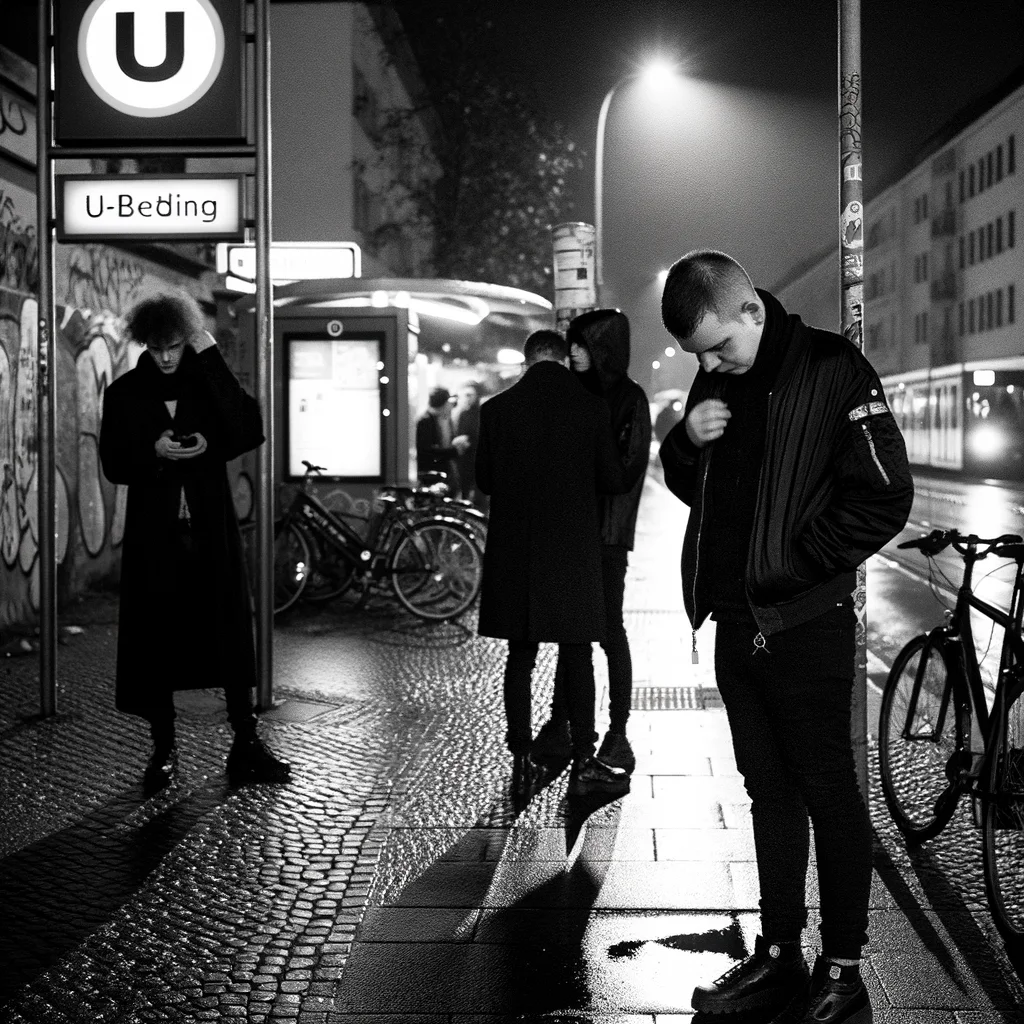
Wedding residents arrived dressed in the established Berlin palette—black on black with an accent of exhausted—and still found ways to fail:
- The Corporate Minimalist: a startup guy in a “hard” long coat that whispered: I definitely have opinions about modular synths and zero friends outside Slack. The bouncer stared at his clean shoes like they were a confession.
- The DIY Goth: held together with safety pins and pure intentions, radiating the kind of sincerity that makes door staff itch.
- The Turkish Uncle Disguise: one local tried entering in a puffer and confident silence—strong “I’m just going to pick up my cousin” energy—only to be rejected for “being too functional.” He went back to Wedding and got instant respect from the simit shop, which is honestly the better club.
- The Sheer Confidence Error: a tourist with a mesh top discovered that showing skin isn’t forbidden; showing hope is.
Wedding is now home to an emerging subgroup: people who keep a “door outfit” folded at the bottom of their tote bag, like a firefighter uniform for shame.
Bouncer Psychology: Freud, But With A Flashlight
The modern Berlin bouncer is not a person; it’s an algorithm trained on vibes (sorry), cheekbones, and whether you look like you’ll speak loudly in English about “authenticity.”
A nightlife sociologist I made up for journalistic integrity compared the new selection criteria to Freud’s idea of the uncanny: you can’t quite place why the door says no, only that the “no” feels like it’s coming from deep inside you.
Door decisions are allegedly based on micro-signals:
- A pupil dilation that says “I took MDMA” versus “I read a Substack about taking MDMA.”
- The way you hold your cigarette: loose confidence, or a firm, trembling grip like you’re trying to penetrate the evening with effort.
- Whether your laugh is spontaneous, or carefully rehearsed to be hard to swallow.
One rejected regular told me, “He looked at me like Wittgenstein looking at a sentence that technically makes sense but should still be punished.”
The Rejection Speech, Now Shorter Than A Berlin Relationship
In the past, bouncers offered vague moral judgments—not tonight, maybe later, come back—giving you enough ambiguity to continue ruining your weekend.
Now the city is innovating: silent denial.
You step forward, present your most elegant void-stare, and get declined with the gentle efficiency of a museum guard protecting an installation made entirely of disappointment. Your friends pretend they’re fine. Their eyes say otherwise.
Your group then migrates back to Wedding on public transit like defeated medieval knights, all of you in black, smelling like anticipation and that one aggressive incense guy outside U-Bahn stations.
Backup Plans and the Great Redistribution of Shame
Rejection doesn’t end the night—it just re-routes it.
Some slink to Kitkat, where the door feels less like an exam and more like a customer survey conducted in leather. Others attempt Wilde Renate, hoping their outfit reads “mysterious” instead of “forgot laundry day.” A few ambitious souls march to Golden Gate because nothing says resilience like a stairwell, a DJ who may be furniture, and an atmosphere thick enough to spread on bread.
Meanwhile, Wedding keeps functioning: Turkish bakeries handing out late snacks with zero interest in your aesthetic suffering; longtime Spätis watching newcomers perform the complex ritual of acting like cash is an oppressive myth.
An Unpopular Suggestion From Someone With No Door Power
Here’s the radical proposal: stop treating rejection as a spiritual identity test.
If a stranger in the dark decides you’re not worthy, you haven’t been judged by Zeus. You’ve been processed by an institution designed to turn insecurity into a loyalty program.
Still—don’t worry—we’ll all go back next weekend anyway. In Berlin, humiliation isn’t a deterrent; it’s foreplay.