Berghain Reference Club on Osloer Straße Installs 'Sober Corner' — Patrons Spent the Night Not Finding It
Salon Acht painted a pale square, printed instructions in English, and handed out a special ink stamp; nobody sober enough to follow directions showed up to claim it.
Nightlife Contradictions Reporter
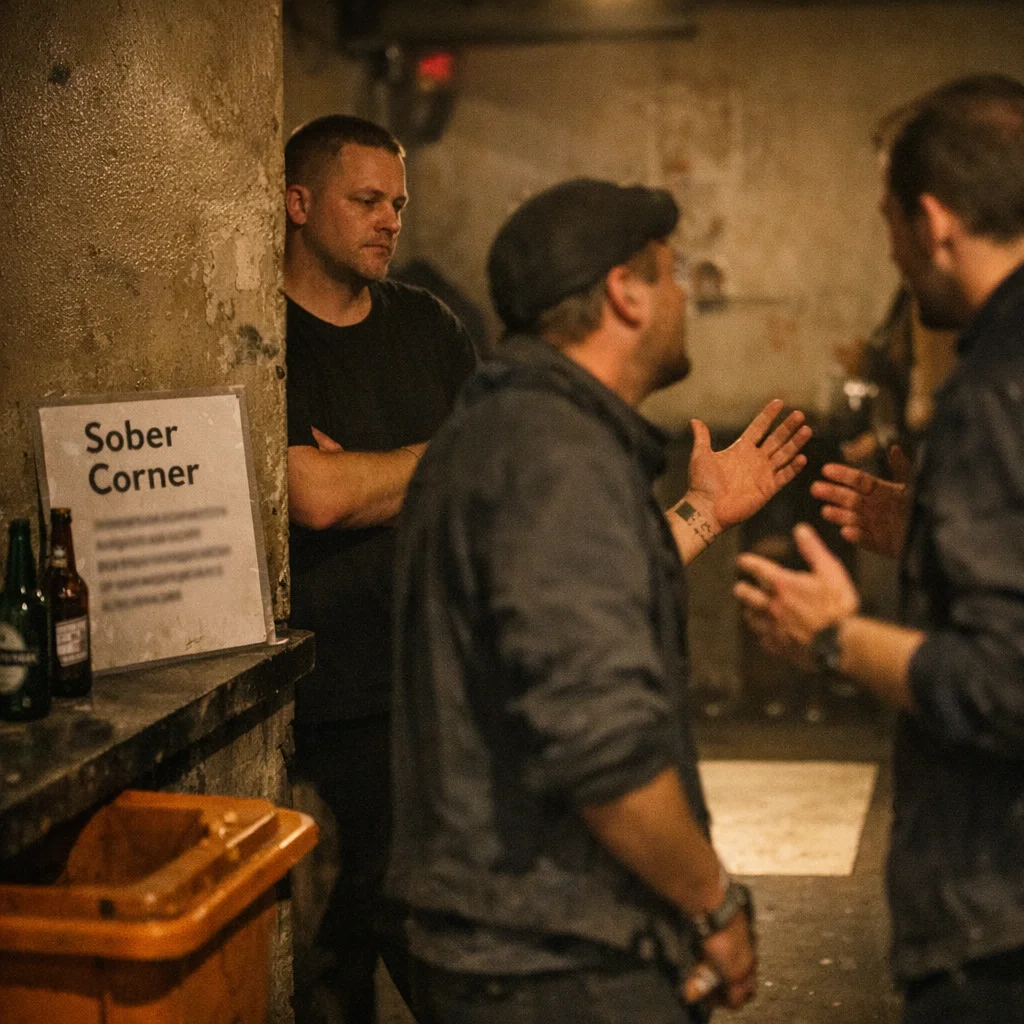
Last Sunday, shortly after 3 a.m., Salon Acht — a small club at Osloer Straße 54 that bills itself as "Berghain-adjacent" — unveiled a pilot "sober corner." The idea, announced by owner Leyla Yildirim two weeks earlier, was simple: one clearly marked space where people could sit sober, charge phones, and be offered water and quiet. What followed was not.
"We painted it in an off-white tile, put a little lamp and a laminated sign," Yildirim said on Monday. "We even gave it a name — 'the Anchor' — because adulting needs branding. It was supposed to be a firm grip on the situation. Instead it became a scavenger hunt."
Around 150 people were in the club that night, according to a headcount by three security staff. Patrons reported that the corner was "impossibly subtle" — a square tucked under the stairwell behind the recycling bins, with a handwritten 'Sober Corner' in English only. By 3:10 a.m. staff had given out two pale blue ink stamps to people who claimed to have found it; those stamps immediately became a bizarre status symbol.
"I searched for maybe ten minutes," said Murat Yilmaz, 29, who lives above Genter Straße. "I asked three people and everyone pointed in a different direction. I finally sat on a radiator because it felt intentional."
Neighbours watched from windows and a Turkish bakery owner two doors down, Fatma Demir of Bäckerei Demir (Osloer Straße 56), reported a stream of clubbers staggering by her counter asking where to sit while loudly debating the qualities of sobriety.
The club framed the project as a nod to safer-night initiatives and, in a line that would please Foucault scholars, a small experiment in heterotopia: a space within space with different rules. Sandra Köhler, a spokesperson for Bezirksamt Mitte, called it "an interesting pilot" but noted that public-health partners had not been consulted.
Online, the incident produced a flurry of Instagram stories and one thread accusing Salon Acht of performative safety. Some regulars muttered that requiring an almost spiritual level of lucidity to find the Anchor was the point: the club wanted a sober corner that people truly sought. Others said it felt like a puzzle designed for people who love tight spaces and complicated entries.
Yildirim plans to revise the corner: clearer signage in German and Turkish, a lamp with a blue band, and a volunteer stationed there. She conceded the irony: "We wanted a quiet place for people to come down. Instead we made a myth."
On Tuesday the pale stamp was still visible on two wrists in a café on Müllerstraße — a souvenir of an evening when policy, performance, and intoxication briefly misaligned and left everyone a little unsure where to stand.