Berlin’s E-Scooters Aren’t a Mobility Revolution — They’re a Temporary Masculinity Test
The underreported detail is not the app or the parked wrecks, but the way grown men treat two shared handlebars like a licensed opportunity to avoid saying what they want from each other.
Bathroom Diplomacy & Night-Policy Correspondent
Wedding after dark is not freedom. It is scheduling with lipstick.
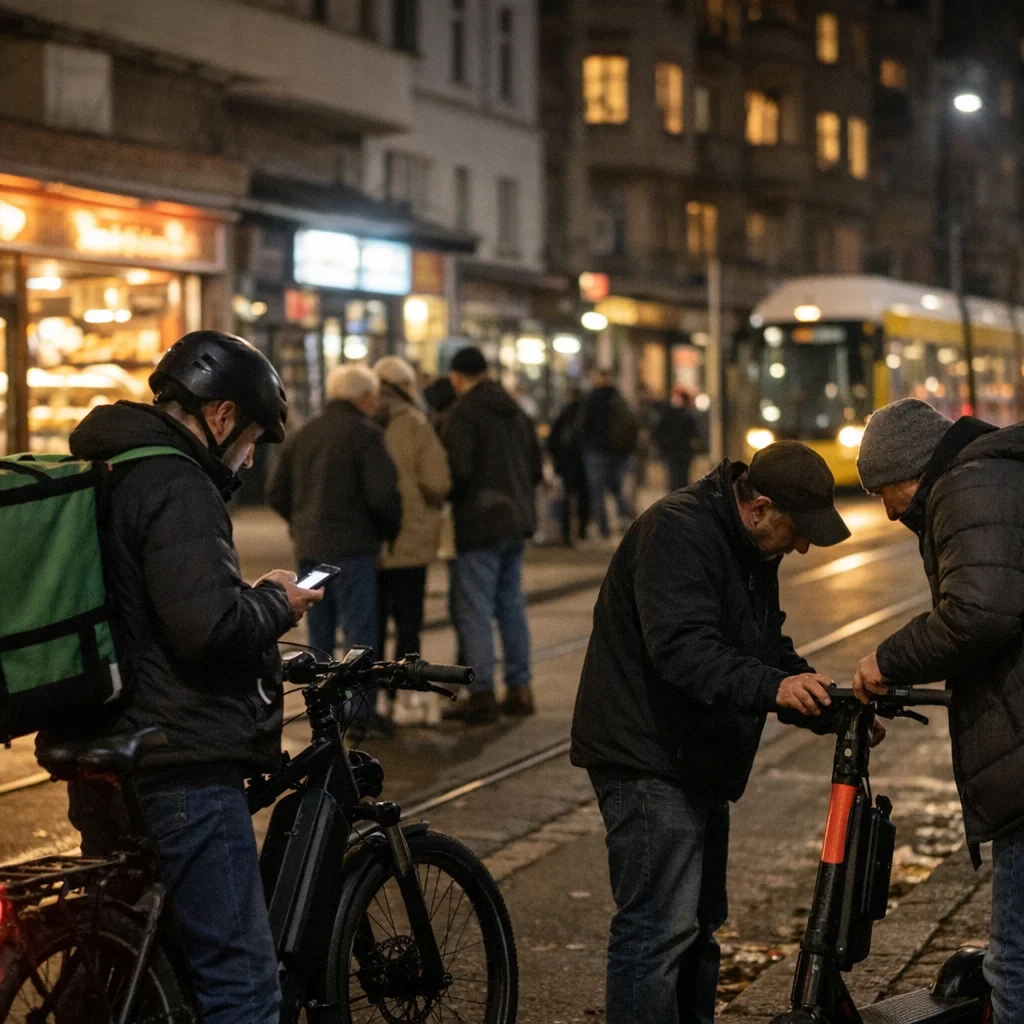
In Wedding, the night begins the way Berlin always lies to itself: with a bakery still glowing at the corner, a tram screeching like it has seen too much, and a few men standing outside a späti as if loitering were a constitutional right. One of them is on a scooter he does not need. Another is waiting for a courier who is already late because the app has turned every street into a soft little labor camp. A couple in clean black coats drifts past the U-Bahn entrance at Leopoldplatz, looking expensive in the way only people who have never been chased by a rent increase can look expensive.
The city calls this “mobility.” The neighborhood calls it another batch of unpaid coordination.
The old residents of Wedding know the night by its actual sounds: plastic beer crates dragged over pavement, a kitchen window slammed shut, a baby crying behind thin walls, the late tram muttering toward Seestraße, and somebody’s uncle taking a cigarette break with the grim authority of a man who has carried bad governments in his lungs for decades. The newcomers hear the same street and think it is “authentic.” That word is always spoken by people who have never had to live inside the thing they are admiring.
The performance of being untouchable
The startup class arrives in Wedding already dressed like a compromise they made with themselves in a coworking toilet. Their jackets are minimal, their tote bags are moralistic, their faces have the deadened glow of people who spend all day pretending the dashboard is a worldview. They say they are “location-independent,” which is a fancy way of saying they want the benefits of a city without the inconvenience of belonging to it.
They rent the neighborhood the way men rent fantasy: briefly, defensively, and with an insistence that nobody confuse access with intimacy.
At a café near Leopoldplatz, where the espresso costs enough to shame a small republic, a manager with flour on his forearms pointed at the window and laughed. “They come here talking about community,” he said, “then complain if the table is sticky, the tram is loud, or someone’s life smells like real work. They want a neighborhood with a pulse, but only if the pulse has been filtered through a brand deck.”
He was not being poetic. He was describing the actual business model.
The district office, naturally, has a statement for this. It always does. It speaks in that bureaucratic dialect that sounds like compassion after it has been drained through a sink trap: residents are encouraged to enjoy the public realm, private actors should self-regulate, mobility is a shared responsibility, and the neighborhood will continue to evolve. Continue to evolve into what, exactly? A more expensive waiting room with better branding and fewer people who can afford a spontaneous emergency.
That is the trick. The institutions never say “we extracted the rent and outsourced the consequences.” They say “vibrancy.” They say “activation.” They say “innovation.” Then they let landlords, delivery platforms, and property funds do the slow, lubricated work of turning the district into a showroom for exhaustion.
The men on scooters are not rebellious. They are administratively horny.
The e-scooter is not a vehicle. It is a personality defect with wheels.
In Wedding, grown men who would not dare ask for a lighter from a stranger suddenly become tender and territorial around a shared scooter app. They hover over handlebars with the concentration of men trying to negotiate a threesome with a device. They insist the battery is “fine,” the braking is “good enough,” and the ride is “just for a minute,” which is also how every bad decision in this city introduces itself before it becomes a rent burden.
They are not expressing freedom. They are performing a tiny, pathetic sovereignty granted by a platform that tracks every movement and calls it convenience. The app knows where they are, how fast they moved, when they paused, and how long they stared at the map like a man checking whether his own life is still in stock.
This is what modern masculinity looks like in Wedding: not domination, but managed access. Not courage, but frictionless entitlement. A man will ride three blocks to avoid admitting he wants company. He will park the scooter sideways across the sidewalk like a passive-aggressive erection and call it independence.
Meanwhile, the courier on the next block is riding under actual pressure, not metaphor. He is being timed, rated, and nudged by a system that has replaced a foreman with an interface. His knees are real. His fatigue is real. The algorithm is just the boss wearing a friendlier face and a cheaper haircut.
Who profits from the exhaustion?
That is the part nobody wants to name because it ruins the vibe.
The landlords profit when the neighborhood is desirable but unstable enough that nobody can settle into dignity. The apps profit when every errand becomes a transaction. The wellness people profit when they can sell recovery to the same crowd that helped manufacture the damage. And the city profits by calling all of it participation, as if the residents were co-authors of their own soft eviction.
Everywhere in Wedding, people are being sold a version of autonomy that requires constant supervision. The cyclist is monitored by traffic. The tenant is monitored by lease terms. The freelancer is monitored by productivity tools. The courier is monitored by dispatch. The night owl is monitored by his own need to appear unbothered. This is not liberation. It is a more elegant cage, upholstered in choices.
And the humiliation is that people line up for it.
The imported creative class has become exceptionally good at mistaking precarity for character. They call a shared flat “flexible living.” They call a secondhand sofa “sustainable.” They call insomnia “headspace.” They drink natural wine as if fermentation can absolve them from what they are doing to the rent index. Their self-deception is so polished it almost counts as a luxury good.
The locals, by contrast, do not need metaphors. They know exactly who is paying, who is waiting, who is lying, and who is about to be priced out by a neighborhood that discovered itself in a brochure.
The night belongs to whoever can afford not to sleep
By midnight, Wedding looks like a compromise between survival and branding. The bakery lights stay on. The späti shelves glow with beer, batteries, and the usual petty comforts. Somebody outside a kiosk is arguing softly into a phone, the way men do when they want to sound in control while clearly being handled by someone else. A pair of teenagers drift toward the U-Bahn with the bored, flirtatious aggression of people who still believe the night owes them something.
It doesn’t.
The night belongs to whoever can afford not to sleep, and in Berlin that usually means someone whose fatigue is being subsidized by somebody else’s labor.
So yes, Wedding has a nocturnal rhythm. It is just not the one the city advertises. It is the rhythm of bakeries, deliveries, surveillance, rent, and men pretending that movement is meaning. It is the rhythm of institutions that call extraction “urban development” and call the residents “stakeholders” while quietly removing their ability to stay.
That is the neighborhood’s real mobility revolution: being made to move, again and again, until you start mistaking displacement for style.