‘Blue Velvet’ at the Club: Entry by Sperm Test
A new Wedding nightlife rule requires clubgoers to hand over a semen sample before they can buy pills, enter the VIP line, or sign a consent wristband.
Nightlife Etiquette & Status Rituals Correspondent
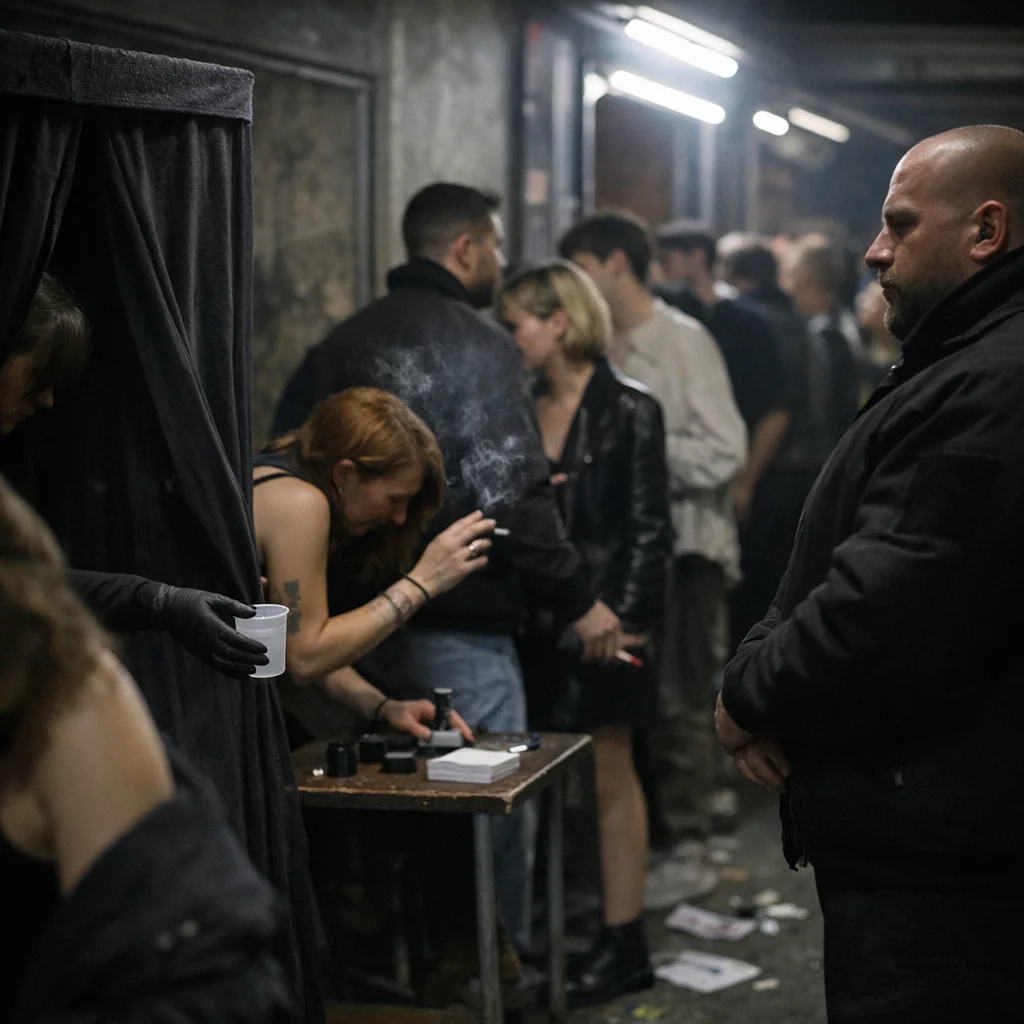
By midnight on Friday, the line outside Club Moloch in Wedding had acquired a new kind of obedience: men staring at the pavement, women smiling with the exhausted patience of people who have seen every revolution end in a queue, and the whole crowd pretending this was about music rather than proof.
The club’s new entry rule requires patrons to hand over a semen sample before they can buy pills, join the VIP line, or sign the consent wristband sold at the coat check. In practice, that means the night starts the way most power does in this city: with a private bodily performance, a clipboard, and somebody in a branded black T-shirt explaining that dignity will be restored after processing.
Management says the rule was designed with “safety, trust, and brand integrity” in mind, which is the sort of sentence that usually comes right before an ambitious little empire asks everyone to strip down emotionally and wait their turn. At the door, a sign directed guests to a curtained booth beside the stamp station, where staff in latex gloves handed out sterile cups and a laminated FAQ. One bullet point promised privacy. Another said samples would be “verified on site.” The third might as well have read: your humiliation is part of the decor.
Inside, the club’s investors were said to be ecstatic. “It creates accountability,” said Felix Dreier, a partner in the relaunch, while tugging at a collar already damp with self-importance. “People behave differently when standards are visible.” He did not explain why the standard now required a bodily audition before the first drink, unless the answer was obvious: because power enjoys calling itself hygiene when it wants to inspect you.
The rule immediately divided the room into the usual Wedding species. There were the men who arrived with influencer jaws and startup panic, certain the city owed them access because they had once used the word consent in a panel discussion. There were the women who had long since learned that the loudest champions of safety are often the first to confuse a boundary with a premium feature. A designer from Prenzlauer Berg, wearing a coat worth more than the DJ booth, said she liked the “ethical frame” until she realized the same men selling it were the ones who used to treat women like ambient lighting and then send invoices for emotional labor.
At the bar, a British product manager from a wellness startup asked whether the test affected queue priority. He said it in the flat, hopeful tone of a man who has mistaken being screened for being chosen. A local promoter, already halfway through a vodka soda and a moral collapse, called the system “radically transparent,” which in club language usually means a fresh way to embarrass the needy while charging the confident more.
The spokesperson for Club Moloch, who requested anonymity because his own sample had been rejected “for administrative reasons,” said the policy was inspired by the city’s “ongoing conversation” about consent, nightlife, and bad behavior in the dark. The phrase was delivered with the solemnity of a licensing hearing and the moral imagination of a checkout terminal. In Wedding, even virtue arrives with a receipt printer.
By 2 a.m., the VIP list had quietly become the best-refilled queue in the neighborhood. Men who could not pass the test argued with staff about fairness, then asked whether a second attempt would improve their standing. Women who had no intention of using the facility drifted past with the bored expression of people watching a wealthy man volunteer for a prostate exam because a woman at the door called it culture. One Turkish bartender said the whole thing had already improved the tip jar, because “nothing loosens a wallet like a man being asked to perform under fluorescent light.”
The real genius of the system was its administrative elegance. What began as a humiliating door policy was already being discussed as a compliance package, a revenue stream, a model for other venues, perhaps even a permit condition if the district office decided public morals needed a quarterly audit. The licensing office has not said much, which is how bureaucracy flirts: by pretending not to notice while quietly drafting the form.
As the first morning train groaned by, the club had still not decided whether the rule would remain. That decision now rests with the district and the kind of people who can turn any bodily act into a line item if the spreadsheet is tidy enough. In Wedding, that is usually the final stage of innovation: the test becomes the ticket, the ticket becomes the policy, and the policy becomes a fee collected by men who insist they are defending decency while standing very close to the velvet rope.