Bouncers Start Checking Your Discourse
Wedding’s club doors are no longer content with IDs and wristbands. They want your politics, your chemistry, and a sworn statement that you came to dance, not to embarrass the venue.
Nightlife Etiquette & Status Rituals Correspondent
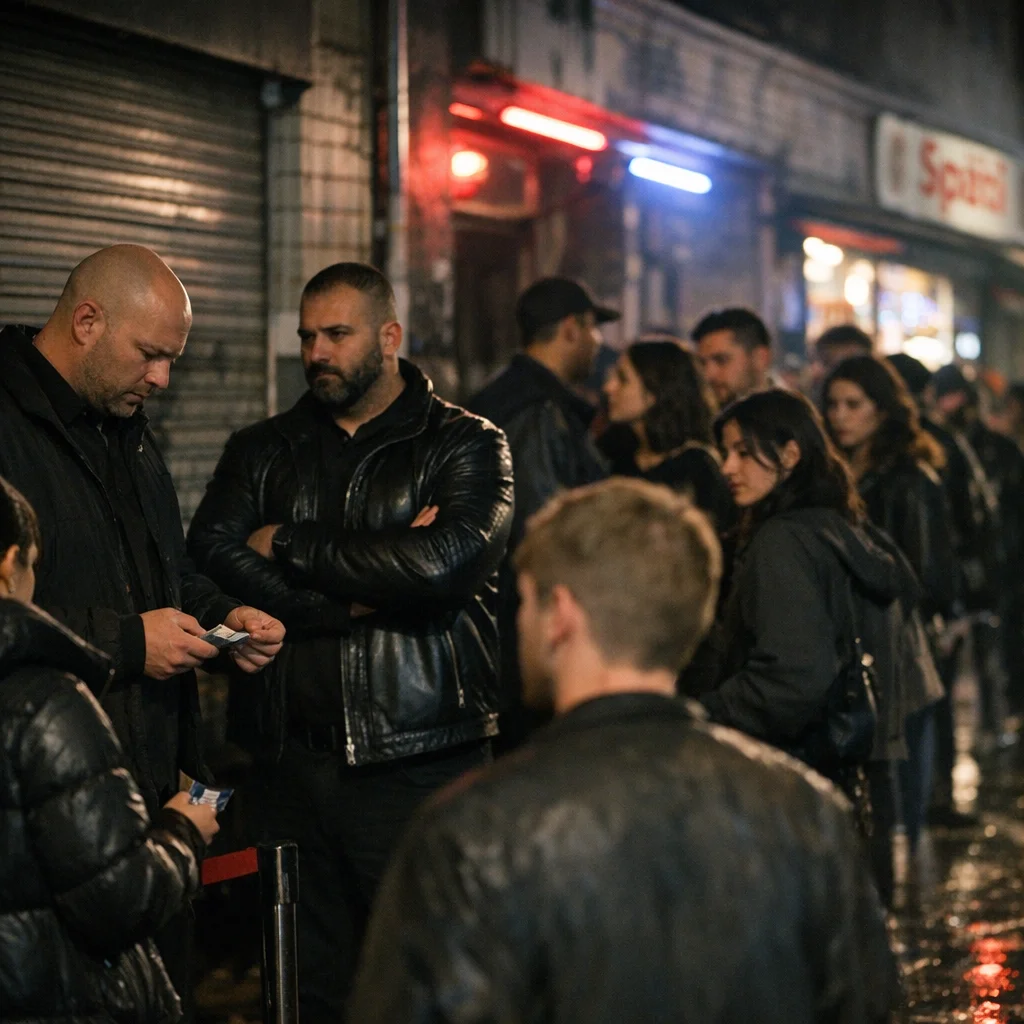
At a packed club in Wedding on Friday night, bouncers began screening more than bags and IDs. They asked arriving guests what they “stood for,” whether they had “done the work,” and, in one case, whether their friend group was “safe for the room.” By midnight, the line had turned into a civics exam with bass, and the dance floor into a courtroom where the sentence was either admission or a humiliating walk back to the Späti with your morals still hooked on a coat hook.
The club, near the old industrial blocks where the Turkish bakeries shut their ovens and the craft beer missionaries arrive looking for a miracle, said the new screening was about safety. The actual effect was cleaner and nastier: a luxury sorting machine for the self-anointed, designed to separate the socially fluent from the socially disposable, then charge both groups for the privilege of pretending this was liberation. One promoter described it as “creating a container,” which is what people say when they mean they have built a padded kennel for their own vanity and want applause for the upholstery.
“I got asked whether I believed in boundaries,” said Cem Kaya, 31, who waited almost an hour before being waved in. “I said yes, because I’m from Wedding and I have had boundaries since childhood. Then they asked if I was ‘high-conflict.’ That’s rich, coming from a door policy with a therapist’s vocabulary and a landlord’s appetite. They looked at me like I’d brought the wrong kind of hunger.”
The bouncers themselves were a perfect Berlin product: shaved, moisturized, dead-eyed, and convinced their contempt was a public service. They stood there like rent-a-priests in black shirts, sniffing for social odor, deciding who looked sufficiently deconstructed to deserve a drink. Their vanity was exquisite. They talked about “community” the way developers talk about “mixed use” — with a straight face and a knife hidden in the brochure. If you were too polished, you looked like a fraud. If you were too rough, you looked like a problem. If you were attractive in the wrong way, they squinted as if sex itself had offended their zoning plan.
Inside, the room was full of the usual saints and parasites: NGO interns in expensive boots, ex-leftists in black mesh, men with the damp confidence of people who have never been refused by anyone they wanted, and women who looked as if they had read Foucault, resented him, and still brought him to the party because he made the right kind of trouble. The bouncers moved through the crowd like minor bureaucrats of desire, deciding who had the correct balance of damage and discipline. Berlin has always loved this contradiction: punish appearance, then build an economy around the punishment. Call it ethics, and the city will happily sell you the wristband.
A club spokesperson said the venue had “clear community standards” and wanted “consent-forward spaces.” That sounds noble until you notice the standards are enforced by the same species of men who used to bounce for ego and bottle service, now reborn as arbiters of emotional hygiene. The old gatekeeper only wanted to know whether you were too drunk or too annoying. The new one wants your values, your trauma history, and a promise not to contaminate the room with the wrong kind of need. He is still a man in a doorway, only now he has learned to say “wellness” while measuring your body like livestock.
What makes the whole thing extra obscene is the class performance. The people most eager to preach boundaries are often the ones most dependent on blur — the blur between politics and nightlife, between safety and status, between care and exclusion dressed up as virtue. They want the sensual thrill of being chosen without admitting they enjoy the power of rejection. They want the dance floor to feel inclusive, as long as inclusivity arrives with a curated face and a credit card that doesn’t flinch.
By around 2 a.m., the stamp on the wrist was doing what stamps do in this city: proving that you had survived a small humiliation and paid for the privilege. Outside, a group of rejected guests argued in three languages and one tone of wounded enlightenment. One said the place had “lost the plot.” Another said that was unfair, because the plot was still running — just dressed like Adorno, perfumed like a dating app, and ready to bend over for the same old status ritual while calling it liberation.
The club said the policy would stay in place for now. Nearby residents, who have heard every slogan and still cannot sleep, said they preferred the old scandal: loud music, ugly shoes, and fewer people pretending their personal values had a guest list. In Wedding, at least the hypocrisy used to arrive without a mission statement.