Brandon From Ohio Forms a “Board of Peace” at Panke Canal, Immediately Revokes Canada’s Seat for “Not Showing Alignment”
After reading about Trump’s snub, one expat mediator tested the concept locally: invite everyone, police their tone, then pretend the whole thing was about healing.
Micro-Diplomacy & Sidewalk Power Reporter
WEDDING — Soft power, hard feelings
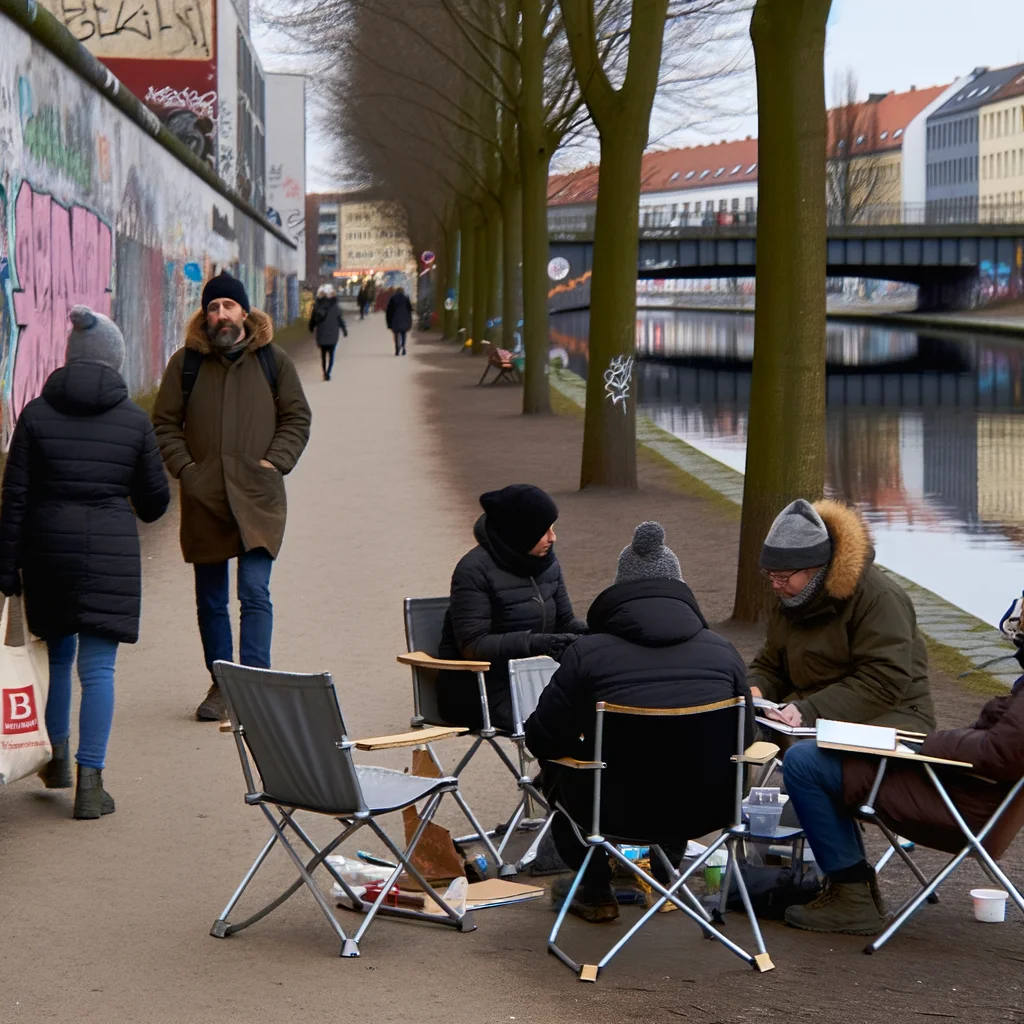
Brandon K., 33, an “international conflict facilitator” and part-time newsletter tyrant, convened a brand-new “Board of Peace” on a damp bench by the Panke Canal this weekend—then theatrically rescinded Canada’s invitation after determining the country “wasn’t fully bought in” on the Board’s new “alignment protocol.”
Residents recognized the structure instantly. A grand gesture. A circle of folding chairs. The smell of borrowed moral authority. An American in sneakers explaining that peace is process, and process requires rules, and rules require someone who is, regrettably, him.
The initiative, according to Brandon’s opening statement (read from Notes app at full brightness), was “inspired by recent developments in international peace architecture”—an unsubtle nod to the news that Trump rescinded Canada’s invitation to join his “Board of Peace.”
Brandon’s innovation was simply to copy the template and move it into Wedding, where anyone can start a mini-state as long as it has a clipboard and a solemn tone.
“Canada was welcome—until it wasn’t”
Canada’s seat—symbolic, empty, and made of salvaged birch—was removed in what participants described as “stiff resistance dressed up as empathy.”
“The chair was there at 14:03,” said İlknur Demir, 46, who was on her way home from a Turkish grocery run and stopped because she thought the commotion might involve free pastries. “At 14:05 he said Canada had been ‘de-centered’ for failing to use ‘I-statements’ about sovereignty. Then he put the chair behind him like it was a dirty secret.”
When asked what Canada actually did, Brandon clarified: “Canada arrived energetically contradictory.”
Pressed for specifics, he cited “the vibes of Ottawa” and a sense that Canada “wanted peace without doing the work,” which is a wild accusation in Berlin, a city that treats “doing the work” as an art installation you attend once and then mention forever.
Old Wedding watched. New Wedding facilitated.
Locals nearby seemed split into two factions:
- Longtime residents, many with Turkish family ties, who treat conflict as something you either resolve with tea and eye contact or ignore for twenty years like a kitchen cabinet you refuse to open.
- Newcomers with lanyards and trauma vocab who insist every disagreement requires a two-hour “deep dive” into “needs,” preferably in a semi-circle.
At one point, a Turkish bakery owner asked Brandon whether this Board of Peace would lower the cost of electricity or stop the landlord from “renovating” a working toilet into a designer concept.
Brandon replied that the Board of Peace “doesn’t engage in material outcomes” because “outcomes can be divisive.”
This sentence should be preserved in amber as the unofficial motto of the incoming class.
Debord, but make it a community workshop
What unfolded was less diplomacy than what Guy Debord warned about, if Debord had to sit through a feedback round moderated by a man named “Brand-on.” The spectacle of peace replaced peace; performance replaced policy; the chair for Canada became a prop in a little morality play about power.
Canada, after all, was never the point. The point was that someone got to invite Canada.
When a passerby suggested simply letting Canada have the seat again, Brandon rejected the proposal on the grounds that re-inviting Canada without “processing the rupture” would be “emotional colonialism.”
Not to be outdone, a startup HR manager in attendance proposed a “90-day peace sprint,” including:
- Weekly check-ins (mandatory)
- A shared glossary (Google Drive)
- An anonymous feelings form (not anonymous)
It was the sort of penetrating administrative approach that makes you understand why Europe invented existentialism.
In the end, peace came exactly as promised: branded, vague, and not for everyone
By late afternoon, the meeting concluded the way most neighborhood meetings do: no concrete decisions, a QR code, and someone insisting they felt “held.” Canada remained un-seated.
Brandon described the event as “a pilot.” Several residents described it as “a hobby for people whose biggest enemy is silence.”
As the crowd dispersed, a local teenager sat on Canada’s confiscated chair and started eating sunflower seeds with the serene authority of someone who understands power without having to name it.
“Maybe he’s the Board,” İlknur said, watching the kid lean back, unbothered. “At least he’s honest about why he’s here.”