Bratwurst With a Diversity Plan
A Wedding sausage stand is hiring a consultant, a facilitator, and a communications trainee to prove it respects the neighborhood it has spent years exploiting.
Food Politics & Public Appetite Correspondent
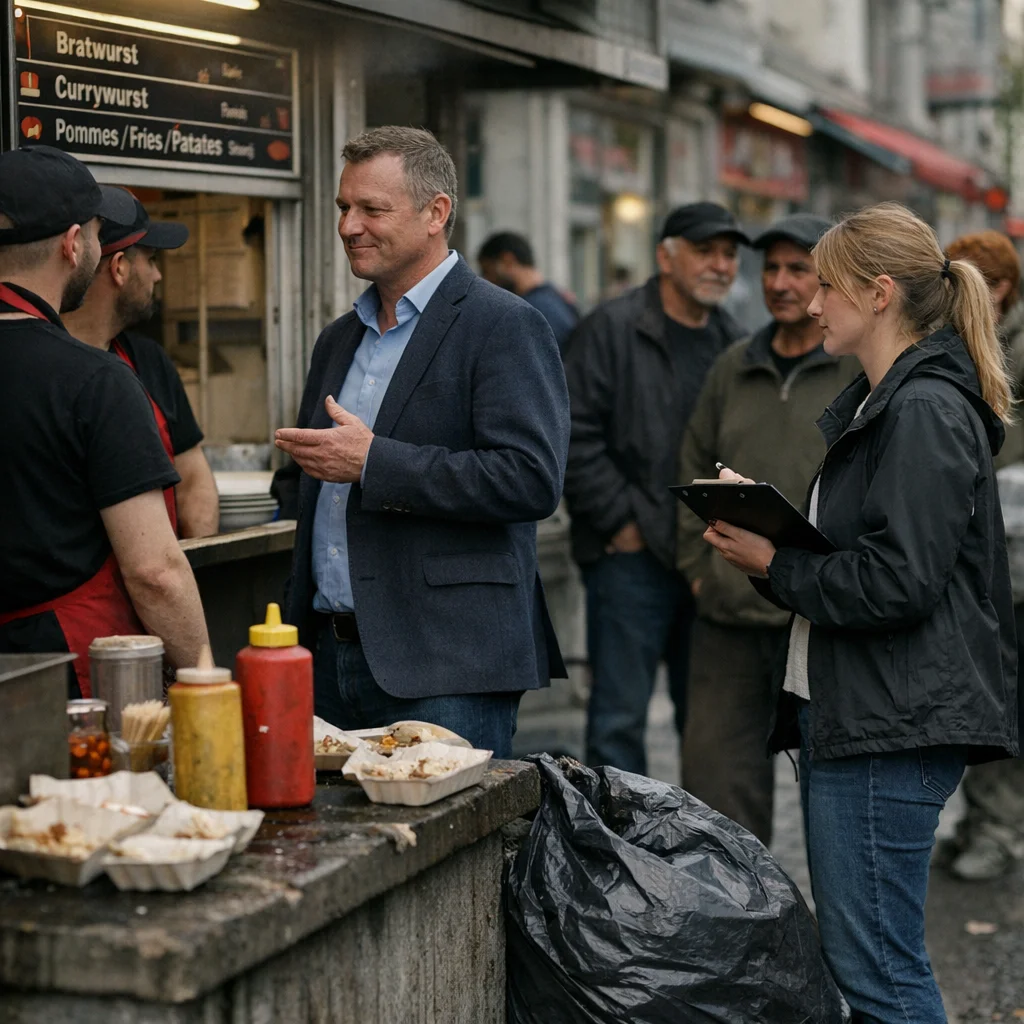
The bratwurst stand on Müllerstraße has hired a consultant, a facilitator, and a communications trainee to explain why its latest “inclusive flavor” campaign is not, in fact, a public apology dressed up in mustard and good lighting. The operators — the kind of mid-tier Berlin opportunists who dress like they’re late for a co-working pitch and smell faintly of fryer oil and self-regard — are suddenly fluent in dignity, bilingual signage, and neighborhood respect, all of it delivered with the soft, lubricated voice of men who discovered ethics after the invoices started arriving.
For years they ran the stand like a little private republic of noise. Late-night shouting. Grease on the curb. Cartons piled by the bins. A staff member barking at neighbors like they were trying to steal a kidney, not just walk past a sausage counter. Every complaint was answered with the same dead-eyed hymn: anti-small-business sentiment, as if the block owed them gratitude for the privilege of inhaling their exhaust. Now the menu is in German, English, and Turkish, and the owners want applause for realizing that people who live nearby are not decorative extras in their rent extraction fantasy.
One resident described the makeover as “being asked to clap while someone wipes their shoes on your face.” Another said the stand’s new apology materials — folded cards, revised signs, the whole little sermon — felt less like restitution than a cheap date with the neighborhood’s patience, all tongue and no shame.
The district office, naturally, is thrilled by any initiative that can be translated into a talking point. It loves this kind of thing: a consultant with a deck, a facilitator with a clipboard, and a business owner performing remorse like a man trying to unzip himself out of a scandal. Inclusion is the easiest currency in the borough’s moral casino. It costs less than fixing what you broke, and it photographs better than a broom.
A nearby kiosk operator said the stand’s managers used to dismiss complaints as “tone problems,” which is district-language for don’t make us look like we live here. “Now they want a feedback night,” he said. “That means they’ll let people speak for seven minutes, nod with their whole face, and then do exactly what they were doing before, only with nicer fonts.”
The social profile of the operation is easy enough to read. These are not humble street vendors. These are the familiar Berlin species that moves into a rough block, learns a few multicultural nouns, and then speaks about “community” like a landlord speaking about moisture damage: abstractly, with interest, and never with the intention of paying. Their staff training is the sort of civic foreplay that lets them feel progressive while keeping the same old hierarchy intact — locals invited to be grateful, workers instructed to smile, and everyone else expected to swallow the insult whole.
The scene outside the stand has not improved with the new vocabulary. Empty cups still drift into the gutter. The trash bag still sits too long by the shutter. The same men still stand too close to the doorway talking about inclusion as if it were a flirtation they can use to get away with being crude. Even the bilingual signage has the smugness of a bad pickup line: look, we learned your language, now stop complaining and let us keep the margin.
This is the local model in miniature: district-office compliance theatre, PR consultant morality, and a food business pretending that a laminated apology counts as repair. Wedding gets the bill either way. The stand gets to keep selling cheap meat and curated conscience. The residents get invited to feel “heard,” which is the bureaucratic equivalent of being fondled by a glove and told it was consent.
The managers did not answer directly to questions about the mess, the shouting, or the years of complaints that followed them like a bad smell with a lease. Instead, they pointed to revised menu copy and said they were “listening carefully.” In Berlin, that phrase usually means the same thing as a hand on your waist: a promise to stay only until it gets what it wants.