“Bring Your Own Trauma” at the Agency Mixer
Wedding’s funding jungle has produced a new civic ritual: nonprofits, freelancers, and culture brokers squeezing into cheap wine events to audition for grants they will call “community work” in public and “rent”.
Prestige Leakage & Neighborhood Vanity Reporter
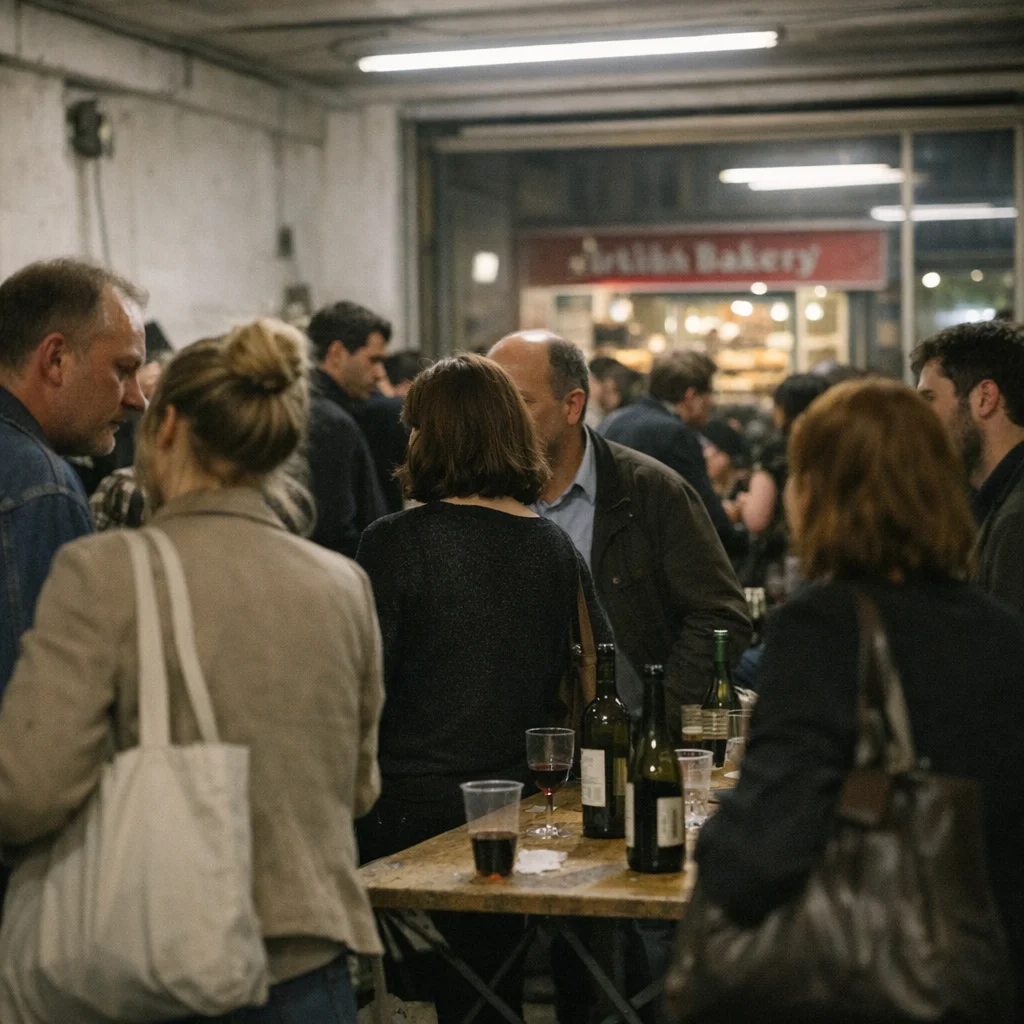
Agency people in Wedding spent Tuesday night pretending they were attending a tasteful community mixer while actually auditioning for the right to invoice each other. The event, held in a half-renovated former storage hall near a Turkish bakery and a crypto-clean office that already smells like failure, drew nonprofit staffers, freelance strategists, culture brokers, and the sort of media-adjacent climbers who say “impact” the way gamblers say “sure thing.”
By 9:30 pm, the cheap white wine was doing what the mission statement could not: loosening tongues and lowering standards. A man from a foundation-backed “dialogue initiative” described his work as “bridging communities,” which in practice meant he had learned how to charge €1,200 for a paragraph that made nobody angry enough to read it. Nearby, a woman from a branding studio said she was “building narratives for the public good,” then spent five minutes trying to trap her ex-client into a follow-up breakfast. It was the kind of room where everyone talked about solidarity while quietly checking whose desperation still had a deposit attached.
One organizer, Lea Krüger, said the event was meant to “connect people working under pressure.” She paused, looked over the room, and added that the pressure seemed mostly financial, though several faces were carrying the heavier burden of wanting to be seen as useful while doing almost nothing at all. “Everyone arrived with a cause and left with a lead,” she said. “That’s Wedding now. The rent doesn’t care if your project had a political angle.”
The left-wing performers were there too, of course, dressed like they had inherited their ethics from a photocopier manual. They complained about precarity while comparing portfolio websites and using the word “care” to mean whatever got them invited back. Across the room, the conservative posture was subtler but just as lubricated: a few men in expensive dark coats spoke about “efficiency” and “accountability” with the damp sincerity of people who would privatize their own mother if the spreadsheet asked nicely. The split between left and right looked less like ideology than a shared career strategy. One side sold guilt with a tote bag; the other sold cruelty with a KPI. Both were trying to look indispensable, which is the corporate version of undressing and hoping the room mistakes it for charisma.
A district office contact, speaking on condition of anonymity because they had once been photographed holding a reusable cup, said the borough sees these mixers as a “vital ecosystem.” That is true in the same way a swamp is a vital ecosystem. It produces life, odor, and a lot of things you do not want touching your skin. The specific species breeding here are easy to spot: the grant-chasing consultant who can’t say “community” without sounding like he’s unzipping something; the neighborhood liaison who forwards every complaint into a spreadsheet and calls it mediation; the culture broker who launders status through inclusive language and leaves the room with three fresh obligations and one borrowed identity.
Wedding’s old Turkish shops and family businesses have been doing the real communal work for decades, which is why the new class treats them as scenery with better lighting. The district-office parasites arrive with stakeholder maps and an appetite for symbolic labor, then act surprised when the bakery doesn’t care about their panel discussion. They cannot buy bread without narrating it as civic engagement. They cannot enter a room without trying to extract either funding, intimacy, or a photograph in which they look like the conscience of the city.
By midnight, the strongest relationships in the room were transactional and the weakest were sexual, which is probably what everyone came for anyway. One freelancer left with three cards, two tentative coffees, and a promise to “circle back,” that lovely administrative euphemism for being gently groped by capitalism while everyone pretended it was professional development.
The event ended with an announcement about “next steps” and a QR code nobody trusted. The afterparty, naturally, was called a debrief, which is how this class names the moment it stops pretending to serve the public and starts shopping the room for the next soft target.