Brown Lawn, Clean Conscience
Karl-Marx-Allee’s dried-out verge is being defended as a “resilient” choice, which is district-speak for letting the plants die in public and calling it climate policy.
Climate & Kiez Reaction Correspondent
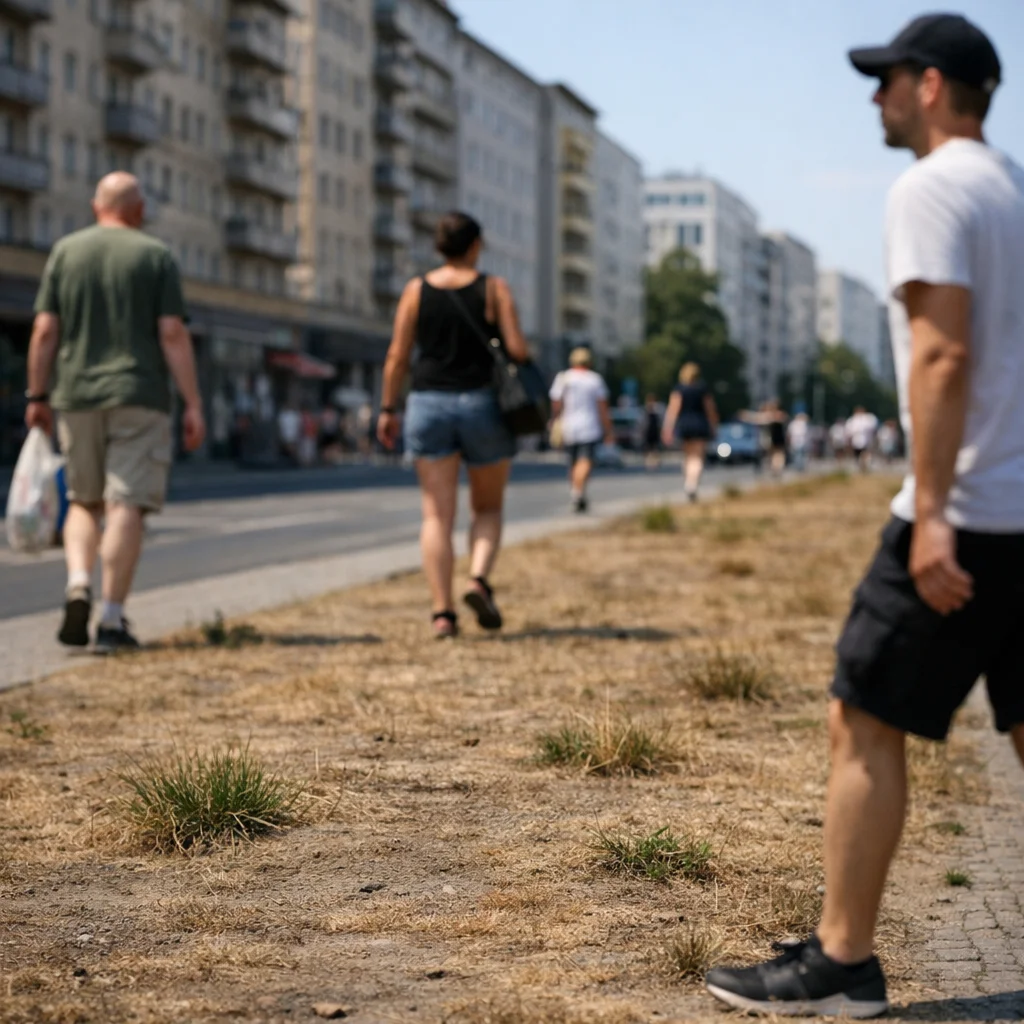
A brown strip of shame, dressed as policy
On Karl-Marx-Allee, the verge is not “recovering.” It is not “resting.” It is not entering some elegant low-maintenance metamorphosis dreamed up by a consultant with a reusable coffee cup and a dead gaze. It is dry. It is scorched. It looks like the district forgot to water it and then, embarrassed by its own neglect, invented a vocabulary of resilience to cover the smell.
The Bezirksamt Mitte, with the confidence of a man buttoning his jacket over a stain, has framed the dead strip as climate-conscious planning. The phrase doing the heavy lifting is “klimaangepasste Pflege” — climate-adapted maintenance — a phrase so slippery it could pass through a council chamber and still leave fingerprints on the furniture. Nothing is ever missing in this language. It is merely reclassified.
The plants are not dead, according to the office. They are “suffering from extreme weather stress.” Which is a lovely way to describe a civic service being left outside in the sun until it gives up and starts to smell faintly of municipal defeat.
Who gets the green, who gets the brown
There is always a class map hidden inside this kind of landscaping. The people living in the shiny apartments facing the boulevard get the aesthetic of concern: enough green to photograph, enough dust to feel “authentic,” enough public virtue to make the rent seem spiritually justified. The people actually walking here — the women pushing strollers, the pensioners dragging their groceries, the Turkish families who have watched one planning slogan after another crawl across the district like mold — get the brown verge and the lecture.
They are expected to clap for the same city that keeps rearranging their block into an exhibit of managed decline. On one side: premium façades and café terraces where oat milk is poured with the solemnity of a baptism. On the other: residents told that if the grass looks dead, that is because the district is brave enough to be “future-oriented.” That is not ecology. That is a landlord-grade insult wearing a municipal lanyard.
A shop owner near the stretch put it more cleanly than the office ever could: “They let it rot in public and then ask us to call it a strategy.” His point is obvious. If the city can’t keep a verge alive on one of its grandest avenues, what exactly is it doing besides staging its own incompetence in daylight?
The district’s favorite perfume: budget denial
The official line is that maintenance will be adjusted “as needed,” which is bureaucratic Latin for: we will wait until enough people complain, then pretend the complaint created the problem. A spokesperson denied that the area was being abandoned to save money. Of course they denied it. City offices deny gravity if the invoice has not yet landed.
This is the part of municipal life that really curdles the mouth: the refusal to admit that climate language has become a shelter for administrative laziness. Sometimes adaptation means smarter planting, yes. Sometimes it means actual planning. But sometimes it means a department discovering that neglect sounds more enlightened if you say it slowly and with a straight face.
And because the district knows exactly how this looks, it wraps itself in the posture of moral seriousness. The office does not merely maintain public space; it performs conscientious suffering on behalf of everyone else. The browning verge becomes a little altar to bureaucratic self-regard: look how responsibly we have failed you.
The usual hypocrites, freshly powdered
The left will call this “ecological literacy” until it has the decency to blush. The right will call it proof that the public sector is incompetent, then hand the keys to people who would privatize the sidewalk if the margins looked good. Both camps are working the same tired angle: one polishes the neglect, the other monetizes the outrage. Neither one is standing in the heat with the residents, pretending not to notice the city’s pants around its ankles.
What makes Wedding and the Karl-Marx-Allee stretch especially obscene is the gap between the language and the life. The district office speaks in sustainability bullet points; the street answers with dust, stubble, and the faintly medicinal odor of things left to rot. The boulevard is full of people being managed, priced, monitored, and patronized by a system that cannot even keep its own decorative grass from going sexually unresponsive in public.
That is the real civic art form here: making deprivation sound like virtue, and then expecting applause from the people living beside the corpse.
By the time the district “adjusts” anything, the weather will have moved on, the paperwork will be filed, and someone in an office will be congratulating themselves for a habitat strategy that mostly resembles a dry sponge in a pan. The plants are not resilient. They are dead enough to flatter the bureaucracy that killed them.