BSR Gets Police Protection After Clubgoers Mistake Trash Crews for Rival GHB Crew
In Wedding, fluorescent orange no longer signals “municipal sanitation” so much as “suspiciously organized after-hours logistics.”.
Night Economy Constraint Reporter
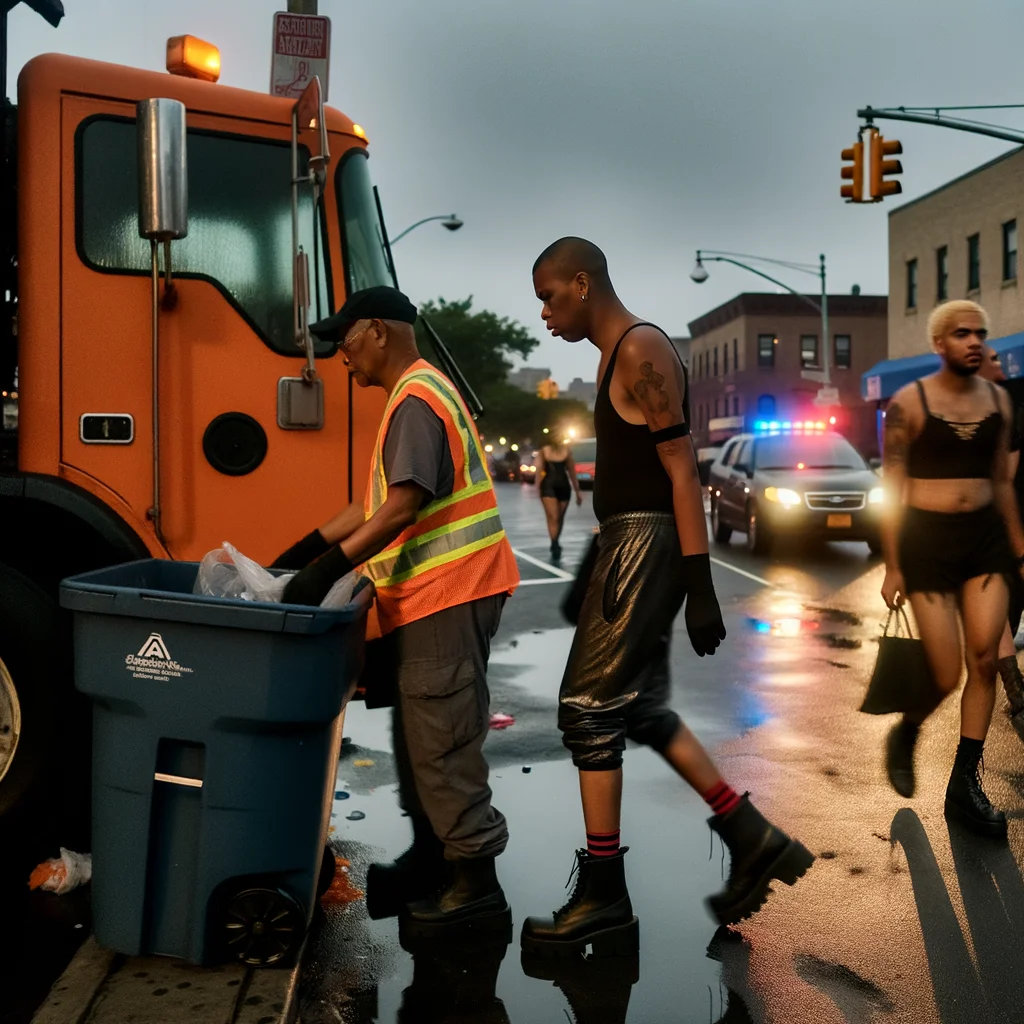
WEDDING — The city’s most honest workers have joined Berlin’s most dishonest nightlife supply chain
Following reports of violent attacks on BSR employees—serious enough that police protection is now being discussed—Wedding has done what it always does in a crisis: misunderstand the job title, escalate the drama, then demand a safer atmosphere so everyone can go back to pretending nothing happened.
On weekend mornings, BSR crews already operate like a minimalist parade of survival: heavy vehicles, high-vis uniforms, faces that say “I’ve seen your moral decay in bin form.” And now, thanks to an overclocked population wandering home from three-day parties with pupils like microscope lenses, these crews are apparently being misidentified as competition.
“They rolled up at 6:40 a.m. with bright lights, strong smell, and a schedule nobody asked for,” said a shaken resident near Panke who described the encounter like a flawed rave. “My friend whispered, ‘That’s the new GHB crew,’ and before I could confirm the vibe—sorry, the atmosphere—someone started screaming about territory.”
A sanitation worker is not your enemy; he’s the reason your enemy can function
The attacks, according to people who have used the sidewalk as a pillow and called it ‘grounding,’ aren’t really about garbage. They’re about Berlin’s refusal to accept that actions have consequences *that arrive in a truck.
A BSR employee, speaking anonymously because even basic public service now requires plausible deniability, explained: “We come to pick up trash. People think we’re picking up evidence. They get defensive. Everyone in Wedding has a story they can’t quite remember and a bag they won’t quite look inside.”
In older, pre-gentrified Wedding, the system was clear:
- Turkish bakeries sold you a warm pastry and a stern look that did more for community safety than any task force.
- The streets were messy but legible.
- The only line anyone respected was the line at a late-night food counter.
Now, “urban cleansing” has gone from metaphor to misunderstanding. New residents celebrate ‘clean streets’ the way Nietzsche warned against: inventing virtue to cover up their appetite. The refuse collectors arrive, and suddenly everyone’s doing a nervous close-read of reality like it’s a seminar on Walter Benjamin’s flâneur—except the flâneur is wearing yesterday’s glitter and sweating out Thursday.
Police escorts: because what could possibly go wrong?
The suggestion of police protection has, predictably, polarized Wedding:
Camp A: The Daylight Moralists They’ve demanded “safety for workers” while typing it on laptops purchased with the savings from not owning a TV. They love BSR now, especially the idea of BSR operating like a VIP section with security.
Camp B: The Nightlife Libertarians They’re offended that the city would bring police into “a delicate ecosystem.” One told us: “If cops start hanging around garbage trucks, it’s going to ruin the whole flow. Also I have… personal trash.”
Camp C: Everybody Else Longtime residents who mainly want to pay rent and buy groceries without being cast as background extras in an expat documentary titled People of Grime: An Authentic Journey.
BSR sources say escorts are being considered for certain routes and times—i.e., the exact hours when half of Wedding is asleep and the other half is spiritually negotiating with a bottle of water.
The nightlife factor no one will admit on record, but everyone whispers in the stairwell
Experts we made up but trust implicitly noted that violence spikes in precisely those moments when Berliners are most emotionally honest: while coming down, broke, hungry, and confronted with physical proof of their weekend.
Clubgoers—fresh from places like Kitkat, About Blank, Tresor, and Wilde Renate—often return home with a radical commitment to consent, community, and sharing, until confronted with an overflowing bin that refuses to hold space for their compulsive purchases.
Trash collection in this city isn’t just municipal service. It’s the final, hard-to-swallow critique of hedonism.
In one recent altercation, witnesses reported a man shouting “NO PHOTOS” at a BSR worker’s helmet lamp, then attempting to negotiate the route like it was door policy. Another person tried to tip the crew “in gratitude” using crumpled bills and a flirty level of eye contact that suggested they weren’t sure which kind of pickup they were requesting.
What BSR actually wants (and what Wedding can’t provide)
BSR workers do not want to be cultural symbols. They do not want to be ‘part of the scene.’ They do not want to star in a civic fable where Berlin confronts its waste and learns.
They want to pick up the trash without getting punched by a man in black cargo pants who believes accountability is something you outsource to a group chat.
And yet, in Wedding, garbage has become an ideological battlefield: old vs new, bread roll vs chia bowl, people who own tools vs people who own opinions.
If police protection does come, city officials say it will be “targeted.” Which is adorable, because Berlin can barely target a functioning escalator.
In the meantime, local harm-reduction volunteers have proposed a compromise: a gentle ‘integration zone’ where after-hours wanderers can practice recognizing public servants, breathe, and say three grounding statements like: ‘A trash truck is not a threat.’ ‘My weekend does not exempt me from physics.’ ‘That smell is my choices.’
A BSR crew leader summed up the civic philosophy best: “We’re not the cops. We’re not your therapist. We’re just here to take out what you can’t.”
Somehow, it felt personal.