‘Bulk trash, not a lifestyle,’ say the bin guards
Wedding’s new fight over curbside furniture is exposing a very Berlin alliance of tidy hypocrites, freelance moralists, and landlords who only discover “order” when the rent is already paid.
Gentrification Symptoms & Pretend-Creative Economy Reporter
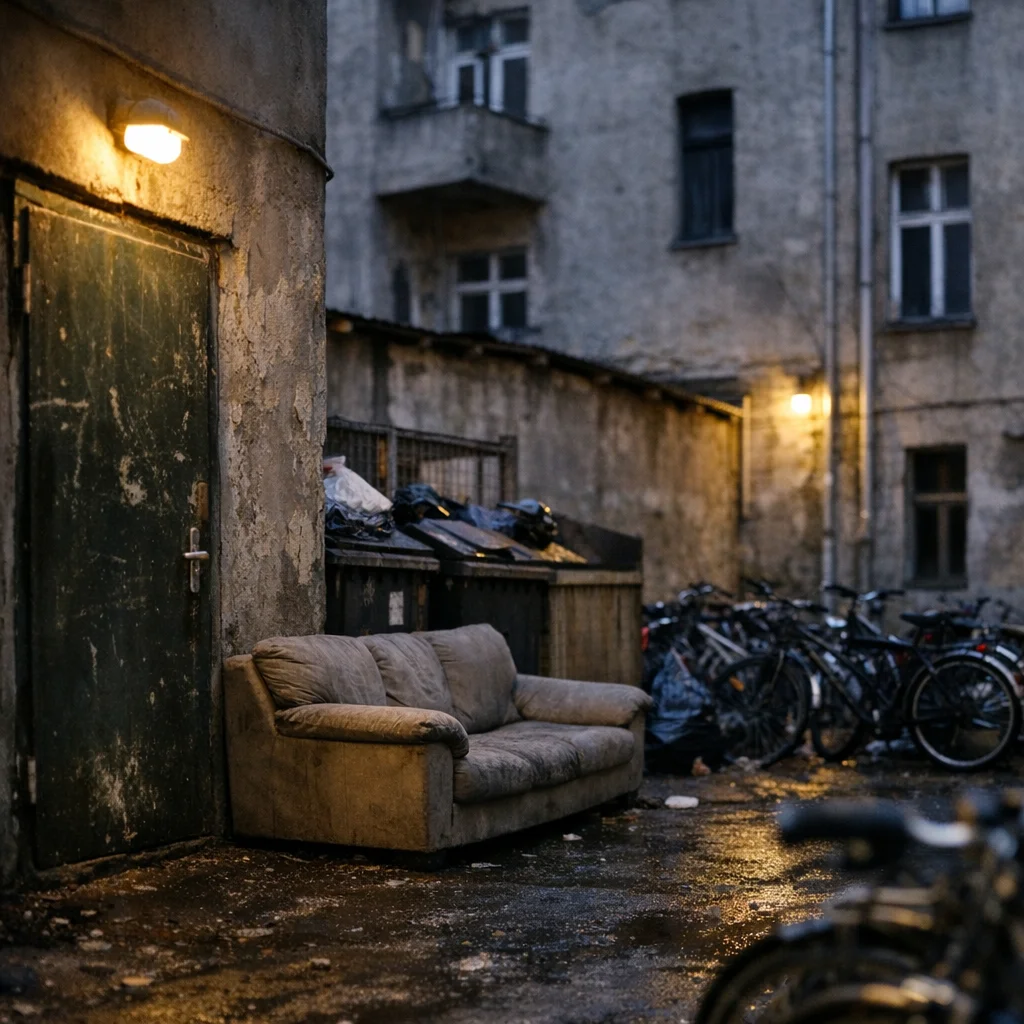
I live in Wedding, where the street furniture is not curated, it is exhaled. A broken chair appears by the bin house on Rehberge Straße; by morning it has become a municipal parable, a neighborhood scandal, and a reason for someone in a clean coat to write “community standards” on a group chat while standing in front of a perfectly legal fire exit blocked by their own bicycle.
This is the local religion: not care, exactly, but cleanup theater. The landlords collect the rent with monastic devotion, the property managers send their little laminated commandments, and then—once the money has changed hands—they discover a sudden, almost erotic attachment to “order.” Not housing. Not repairs. Order. The kind that smells like bleach, passive aggression, and a person who has never once carried a wardrobe down four floors in July.
Walk past Leopoldplatz on a Thursday night and you can watch the whole system perform itself. Someone with a tote bag and a rent-stabilized conscience posts a photo of a mattress beside the curb like they have uncovered organized crime. Meanwhile the building next door still has a dead intercom, a courtyard light that flickers like an interrogation bulb, and a landlord who responds to mold the way a priest responds to lust: with ceremonial delay and a face full of denial.
The comedy, if you like your comedy with a bruise on it, is that the people most offended by abandoned furniture are usually the ones most committed to making life impossible inside the apartment. They move into Wedding for “authenticity,” then start writing about “shared responsibility” as if the neighborhood were their unpaid internship. They want the rough edges preserved, but only as décor. They love a little ruin the way a man loves lace: enough to touch, not enough to be responsible for.
So a sofa becomes a referendum. A wardrobe dumped beside the bulk-trash pile becomes a crime scene with better upholstery. A mattress left under a courtyard window becomes proof that the poor are uncivilized, while the actual crime—the rent structure, the eviction pressure, the endless turnover, the polite speculation in drywall—remains as invisible as a landlord’s spine. Cleanliness, in dense neighborhoods, is never just cleanliness. It is a class weapon with a scented candle on top.
And let’s be honest: Wedding is full of people who adore the idea of disorder as long as it belongs to someone else. The design-conscious newcomer wants cracked plaster and “urban texture” until the neighbors’ couch starts behaving like a neighbor. The old-timer wants the street tidy but cannot be bothered to call the Hausverwaltung unless the complaint can be weaponized against the new arrivals. Everyone is allergic to the same thing: responsibility that costs money.
By 2 a.m., the stairwells around Nauener Straße and the side streets off Müllerstraße are doing what the district always does best—absorbing the wreckage. Someone is dragging a shelf downhill with the defeated tenderness of a body being moved after an argument. Someone else, probably wearing excellent boots and a very expensive lack of shame, has posted online about “keeping our courtyard livable” after dumping a mattress outside the building because the elevator was “out” and their commitment to order only extends as far as their own lumbar region.
That is the local aesthetic now: moralized tidiness, subsidized by other people’s exhaustion. A district full of people who cannot fix a door but are prepared to police a sofa. A class of residents who call everything “community” right up until it needs lifting, hauling, or paying for.
I do not find this charming. I find it useful. The trash tells the truth faster than the real estate brochure does. Every abandoned armchair in Wedding is a small, upholstered confession: housing is too expensive, flats are too small, repairs are too slow, and the people with the most refined opinions about clutter are usually the least qualified to survive a single week of it.
So yes, put the broken chair by the curb. Put the stained mattress there too. Let it sit under the streetlight like evidence. The neighborhood is already full of people trying to look civilized while the building quietly rots around them. At least the furniture is honest about being discarded.