Cafés Now Screen Your Moral Profile
A new crop of neighborhood cafés has discovered that espresso is best served with a little judgment.
Neighborhood Commerce & Low-Grade Dread Reporter
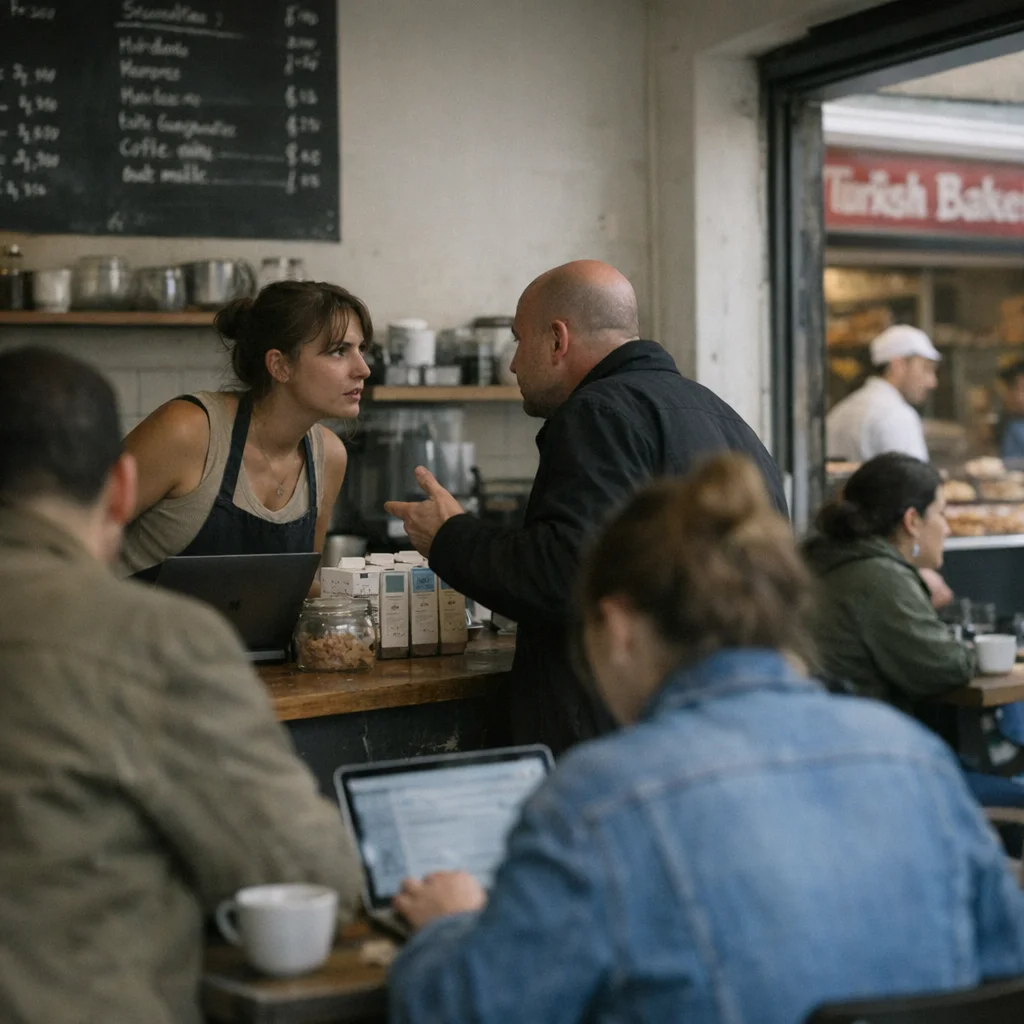
A cluster of cafés around Leopoldplatz and along Müllerstraße has begun doing what Berlin’s better-funded consciences always do best: smiling while it measures your worth. The test is not official. It doesn’t need to be. It arrives in the house rules, the menu copy, the staff’s brittle little pauses, and the way the room stiffens when someone orders a filter coffee without performing the proper graduate-seminar face.
At one place, a chalkboard by the register asked patrons to respect the “shared atmosphere,” which in practice meant: please arrive affluent, quiet, legible, and not visibly in need of anything. Another menu offered oat milk with the sanctimonious glow of a parish sacrament. A third café, dressed up as a “community table” with a dead-eyed sincerity that should have been illegal, had more behavioral conditions than a tenancy agreement and less warmth than a damp stairwell in February.
The owners like to talk about care. They say the room should feel safe, intentional, inclusive, mindful — the whole scented candle of civic virtue. But the friendliness tends to evaporate at the first sign of children, Turkish conversation, work boots, sweat, old coats, or anyone who looks like they came from a life that does not include a laptop bag and a second bank card for emergencies. Their version of openness is a velvet rope with a compostable sign. The staff smile like people who have read one book about ethics and now want to charge for the privilege of being judged by it.
A bakery owner near the U-Bahn entrance, Mehmet Yildiz, watched the procession from behind his window and laughed without much pleasure. “They come here to drink something bitter and act morally hydrated,” he said. “Then they complain the neighborhood is changing, as if they weren’t the ones arriving with the scent of renovation money and the personality of a permissions form.”
That is the trick. The café crowd insists it is building safer, kinder spaces. But the kindness always has a selection process. It is tenderness with a clipboard. It is social lubrication for people who confuse being underpaid in a creative job with being oppressed. They want diversity the way people want herbs on a plate: decorative, expensive, and easy to pick off if the texture bothers them.
A district employee, speaking on condition of anonymity because he once spilled lentil soup on a permit file and has never fully recovered from the shame, said the borough has no formal category for “hostility disguised as concept design.” Complaints, he added, usually arrive after the café has completed its little purification ritual: the branding, the pricing, the seating rules, the menu poem about local grains, the staff training that appears to have been written by a cranky sociology seminar after three flat whites and a breakup.
The sequence is always the same. First comes the vocabulary of virtue: community, slow living, local sourcing, intentional space. Then comes the price list, rigid as a bailiff and twice as smug. Then comes the ambiance, which is really just a room trained to flinch at the wrong body language. By the time the regulars realize they are being sorted by income, accent, stroller, and aesthetic hygiene, the place has already decided who deserves a chair and who should keep moving with their humiliation folded neatly into a takeaway lid.
A Syrian father waiting near the station for takeaway coffee put it more cleanly than any municipal statement ever will: “They want diversity like a decorative plant. Fine. But don’t water it with contempt.”
The cafés deny they are excluding anyone. Of course they do. Exclusion, in Berlin, is never admitted; it is laminated. The menu gets the final word, and it is always the same: come in, pay up, behave prettily, and try not to remind anyone that the neighborhood was alive before it was curated into a moral accessory.