Canal Inspection Night Ends in a Vape Treaty
Wedding’s newest civic virtue is environmental concern with door money attached.
Civic Hypocrisy & Neighborhood Compliance Reporter
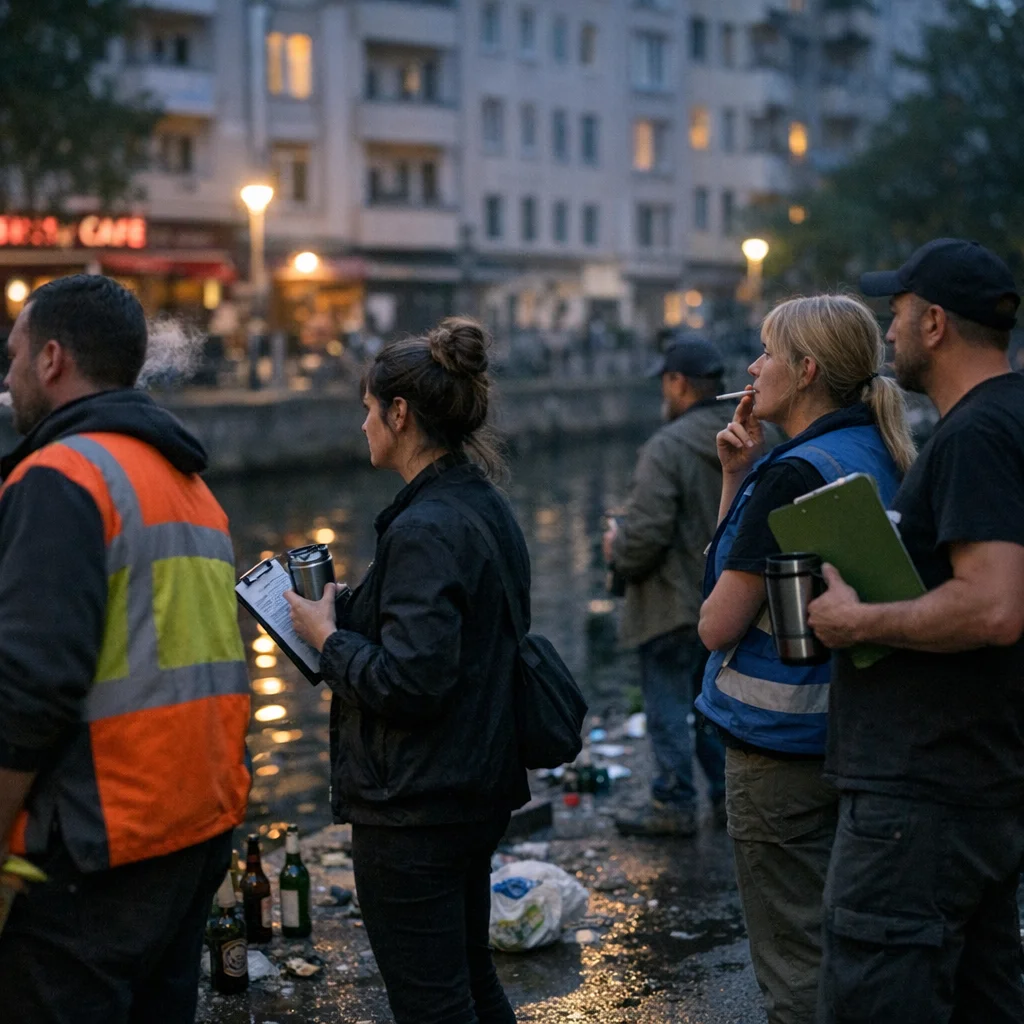
City staff, bar owners, and a small army of grant-scented nonprofits gathered by the canal in Wedding on Tuesday night to inspect a cleanup plan that looked less like environmental policy than a custody battle over grime. Everyone arrived with the same professional hunger in different costumes: to be seen solving the problem while making sure the problem kept someone else’s fingerprints. The canal, as usual, was just the stage. The real sewage was institutional.
The first arrivals were the neighborhood’s usual hygienic grifters: a bar manager with a laminated sustainability policy, two nonprofit workers saying “community care” with the glazed satisfaction of people who have never had to mop their own floor at 2 a.m., and a district staffer carrying a folder so overstuffed it looked like it had been fed on reimbursements. Across the path, a Turkish café owner named Murat watched the procession and said the city’s idea of cleaning is “like a man who wipes the glass, leaves the grease on the frame, and calls the reflection progress.” He was not wrong, and he sounded like a man who has seen enough municipal foreplay to know when nobody is going to finish.
By 8 p.m., the coalition had locked into its favorite civic kink: everyone demanding a cleaner canal without losing access to the mess that makes their evenings look alive. The bars wanted a softer crackdown because hard enforcement ruins the mood and, more importantly, the receipts. The nonprofits wanted a pilot project because nothing says moral seriousness like a funded trial period and a caption-ready volunteer photo. The district wanted a press release because the district, like any needy bureaucrat, prefers the perfume of responsibility to the labor of it. They all wanted the same miracle: visible enforcement with invisible consequences, a little public discipline, a little private lubrication, like a Brecht play rewritten by a lobbyist with a nicotine habit.
“Of course we support a cleaner canal,” said Lena Vogt of a local advocacy group, standing beside a tote bag printed with a slogan about dignity and a vape expensive enough to have its own development plan. “But it has to be inclusive.” Inclusive, in this context, meant nobody gets moved, nobody gets blamed too directly, and nobody in the room has to admit their idea of solidarity is being photographed beside a broom while the night air tastes like cheap juice and damp concrete. Her tone had the smooth, self-congratulating sheen of someone who has mistaken access for virtue and a grant for a conscience.
The most obscene part was the bureaucratic tenderness. A district spokesperson said enforcement would begin “in phases,” which in Berlin usually translates as after the meeting, after the memo, after somebody’s cousin has billed the city for a workshop on dialogue, and after the people actually sleeping or drinking by the water have been made legible enough to move and invisible enough to ignore. An officer present for part of the inspection promised “more consistent attention,” a phrase so polished it could have been polished with spit. Consistency here, as always, means the same bodies getting the same pressure while everyone else clutches a clipboard and calls it governance.
One bar owner complained the canal embankment was being used like a urinal and a confessional, which was accidentally the most honest sentence of the night. That is the local bargain: men spray the path, institutions spray language, and everybody pretends the scent is just urban atmosphere. The path near the water was sticky with old beer and summer neglect; the bins were overflowing with the kind of disposable civilization that arrives in branded cups and leaves as a moral lesson. A pair of nonprofit workers kept circling the same patch of litter as if it were a sacred text, each one bending, straightening, and glancing around for witnesses.
The ending was, naturally, a compromise: extra patrols, more bins, a consultation round, and enough vague civic language to keep the funding hoses open and the conscience damp. Nothing was solved because nothing was meant to be solved in a way that would embarrass the people earning from the problem. The water stayed dark, the embankment stayed filthy, and the cleanest thing in Wedding was still the lie everyone came to wash their hands in.