Candles for Karl-Heinz, QR Codes for the Future: Wedding Replaces Grief With a Sponsored Vigil
A death gets remembered; a street corner gets rebranded. Mourning now comes with optional oatless foam, “safe space” cones, and an intake form for your feelings.
Kiez Security Theater & Imported Outrage Reporter
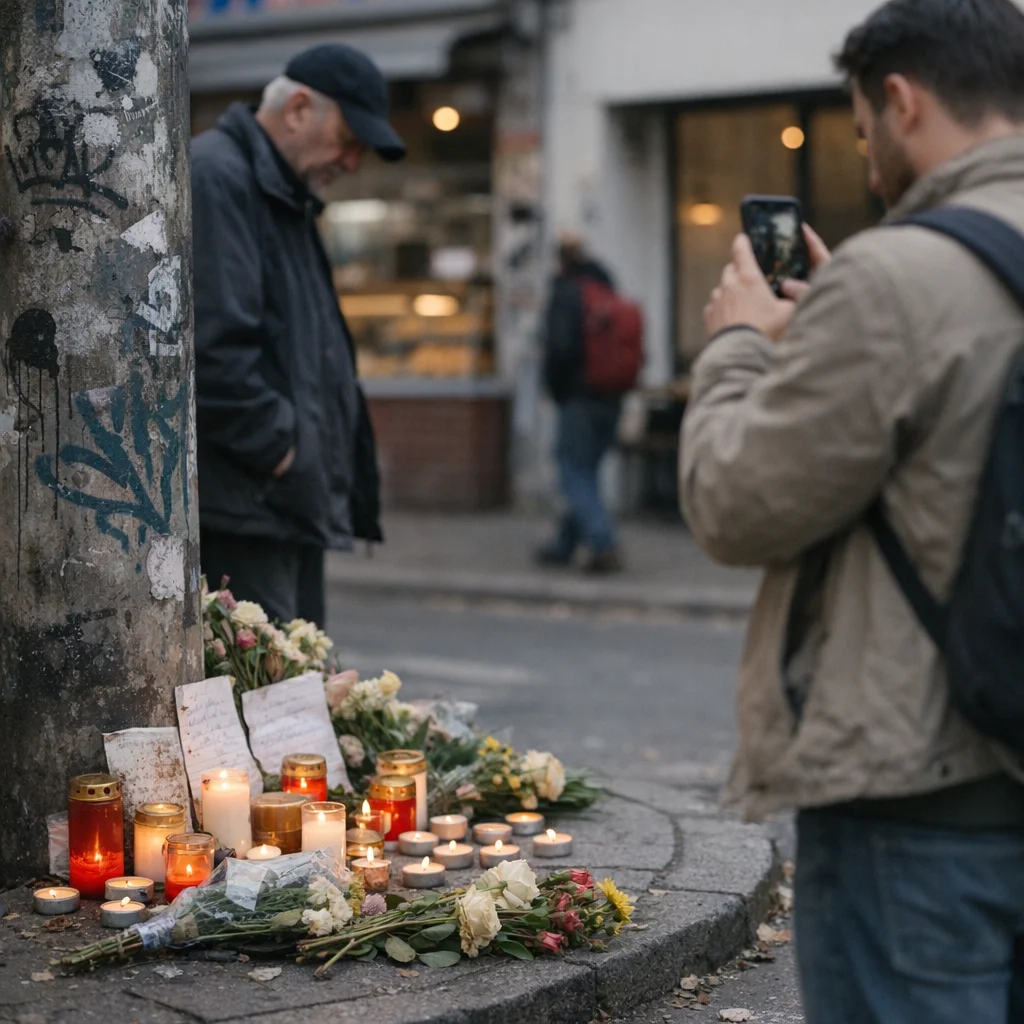
A week after the New York memorial for Alex Pretti kept swelling—candles, flowers, photos, the whole human-in-pain scrapbook—Wedding saw its chance to do what it does best: borrow a real tragedy, strip it for parts, and roll it out as a “community experience” with better lighting.
Nobody in Wedding needed a tutorial on mourning. We invented the modern method: say “this is so sad” quietly, take a photo of the flowers to prove you are capable of emotion, and then disappear the second the cleanup becomes physical.
From “Rest in Peace” to “Rest in Brand”
The original local loss was, according to several people who heard it from someone’s cousin, “a man named Karl-Heinz,” a normal detail in a city where everyone is either unnamed or a symbol. Within 48 hours, the memorial grew from a candle and a crushed beer can into a full-blown installation—half shrine, half product launch.
At the corner near a Turkish bakery that has outlived three “Nordic micro-batch crumb laboratories,” you can now find:
- Candles arranged in a perfect spiral that looks suspiciously like a logo someone paid for
- A ring of “donations” (coins, flowers, and one unopened craft soda priced like forgiveness)
- Handwritten notes ranging from sincere grief to “he would have wanted us to compost”
- A laminated sign offering a QR link for “processing sessions,” because apparently crying is better when it has bandwidth
Grief in Wedding isn’t dead. It just moved into a co-working plan.
The two Wedding factions: Real sadness vs. Performative tenderness
Longtime residents approached the memorial like they approach most of Berlin: briefly, carefully, and with an instinct to protect it from idiots.
“Back then we brought flowers,” said Aysel, who runs a tiny shop that now sells 11 varieties of phone cables and one variety of despair. “Now they bring a tote bag and ask if there’s a ‘correct way to hold space.’ It’s a candle. You put it down. It burns. That’s the method.”
Meanwhile, the new arrivals showed up with a kind of stiff resistance usually reserved for paying cash. They formed a semicircle and began what sociologists would call ritual action and what your uncle would call “getting in the way.”
One man in immaculate trainers performed a deep dive into the tragedy by explaining to nobody that memorials are “liminal zones,” like the anthropological term makes the dead more comfortable.
If Roland Barthes could see this, he’d write another essay about the Death of the Author, then ask for a refund because the living are the real plagiarists.
An entirely new economy springs from one spot on the sidewalk
Within days, opportunism, that oldest Berlin art form, penetrated the memorial ecosystem.
A nearby café offered a “Remembrance Special”: coffee, a single tulip, and the warm sense that you have done something without doing anything. Price: whatever your rent costs per minute.
A freelance “conflict facilitator” stationed themselves beside the candles to mediate arguments between:
- people who want silence,
- people who want to talk about silence,
- and people who want to lecture both, in English, about why their silence is exclusionary.
Somebody taped a flier to a pole announcing a “Silent Walk for Collective Healing.” In Wedding. A silent walk. In a place where silence is so rare it should be declared an endangered species and housed in a glass box.
City response: Move the dead, keep the sidewalk
Officials reportedly asked the main question governments ask when confronted with grief: “Does this obstruct foot traffic?”
A polite suggestion floated through local chat channels that the memorial be “relocated” to a more “appropriate” setting, meaning somewhere it won’t harsh the new smoothie spot’s angle.
You could feel the ancient Berlin impulse: tidy up the emotions. Put them in a designated area. Preferably behind a low fence. Preferably not too visible from the street.
It’s like reading Camus in a paper cup: absurdity is everywhere, and we still insist on having rules about where to stand.
What we’re actually memorializing
The point of a growing memorial is simple: people didn’t know where to put their helplessness, so they put it on the ground.
In Wedding, that helplessness now shares space with real estate aspirations.
Old Wedding mourns because loss is real.
New Wedding mourns because loss is content.
And in between sits a little flickering candle trying to do its job—burning quietly—while a stranger next to it adjusts their angle, whispers “this is important,” and takes the picture that will outlive the actual memory.
In the end, the memorial will disappear the way everything here disappears: not with closure, but with a cleaning crew and a noise complaint.