Caring in Wedding Rebranded as “Cleanliness Justice,” Immediately Becomes a Grant Application
After another round of headlines explaining that no one enjoys living in filth, Wedding debuts a system where compassion arrives in tote bags and leaves in meeting minutes.
Social Safety-Net Mirage Reporter
Wedding Discovers Dirt Is Unpopular
In news that will shock nobody except the person paid to write the executive summary, Berlin is once again debating homelessness and the elegant truth that nobody enjoys living in filth. The city’s experts have generously confirmed what every bench already knew.
In Wedding, this revelation landed like a Philosophy 101 midterm: obvious, but everyone still argues about it until somebody cries and another person forms a working group.
Introducing the “Dignity Corridor,” a Fancy Name for a Public Sink
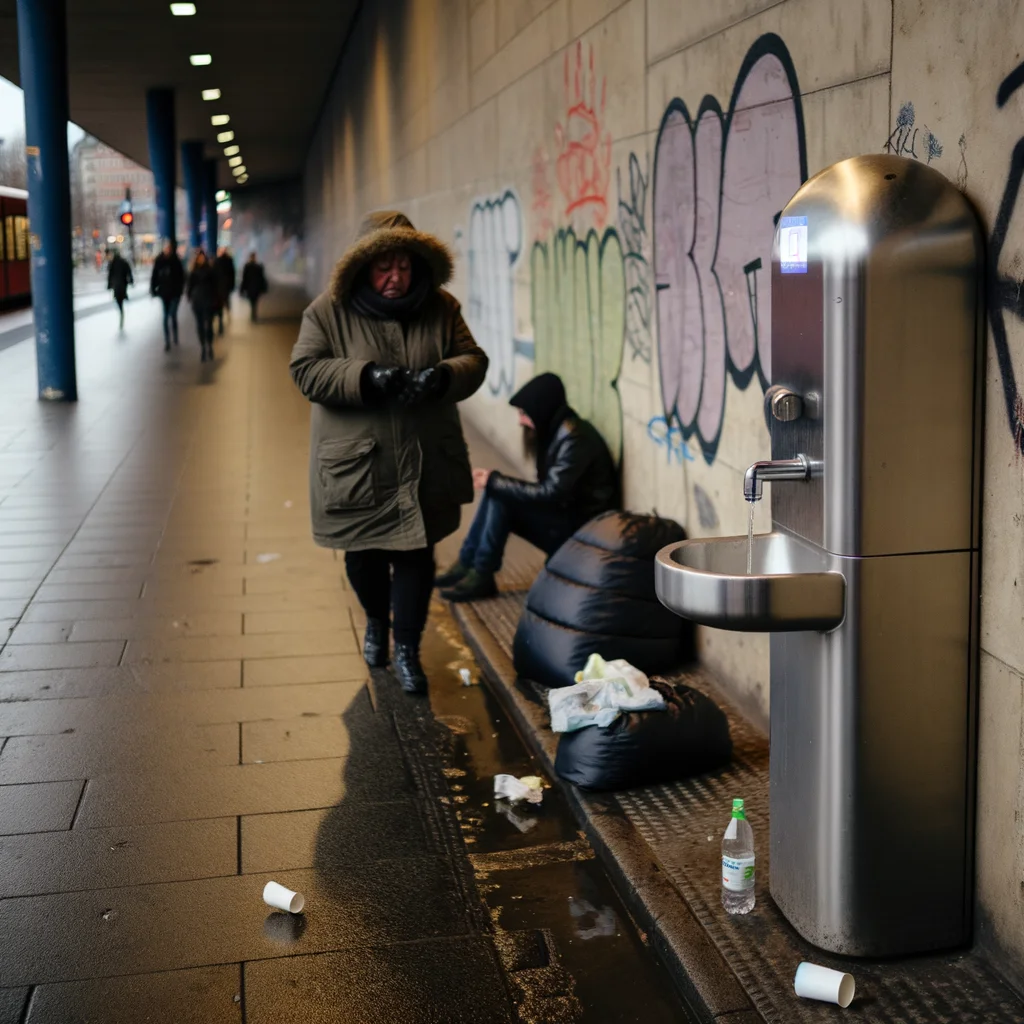
This week, a coalition of nonprofit professionals, municipal optimists, and one exhausted guy who actually cleans things unveiled a new concept near a U-Bahn entrance: a “Dignity Corridor.”
It includes:
- One metal handwashing station, noble in purpose, colder than Berlin customer service
- A poster about “choices” that somehow doesn’t mention the city’s favorite choice: doing nothing
- A social worker scheduled for 10:00–12:00, i.e., two hours in which 40 problems are politely invited to wait their turn
Officials praised the project’s “low-threshold access.” Translation: you can use it without being emotionally cavity-searched by five forms and a PDF that’s hard to open, let alone swallow.
The Two Great Camps: “Solutions” vs. “Optics”
As usual, Wedding split into tribes.
Camp A (the earnest) wants actual help: housing, bathrooms that aren’t locked behind someone’s sense of morality, and mental-health support that doesn’t require passing a stamina test.
Camp B (the strategic) wants the same thing, but preferably in a way that doesn’t frighten brunch.
One newcomer described the street scene as “too confrontational,” as if homelessness is supposed to enter the neighborhood quietly, make eye contact, and ask permission before existing.
Local Businesses Pitch In, For Better or Worse
A Turkish bakery on the corner—doing more civic work by 6:15 a.m. than the Senate does in a quarter—started leaving out extra bags of bread and tea. It’s genuine kindness, delivered without branding.
Naturally, an influencer appeared within 20 minutes to photograph the bags and write: “Mutual aid is so important,” while doing absolutely no mutual anything besides distributing their face across the internet.
A nearby “concept café” offered a different contribution: leftover oat croissants and a small lecture about “ethical consumption.” The croissants were admired for their firmness.
Berlin’s Favorite Fetish: Accountability With No Infrastructure
In Wedding, everyone agrees the current situation is humiliating—then disagrees on whom it’s most humiliating for.
- For people living outside? Obviously.
- For commuters forced to witness reality while scrolling? A close second, according to the people in the loudest scarves.
Berlin has a strange kink for accountability: it loves talking about it in circles until the circle becomes the point. Guy Debord would call it spectacle; here we call it Tuesday.
Meanwhile, the only thing consistently “penetrating” the problem is winter.
A Pilot Program for Feelings
The new initiative’s budget includes a healthy sum for “community listening.” The city will reportedly fund four facilitated dialogues in which housed people can explore the radical notion that human suffering is uncomfortable to look at.
In the first session, participants will practice saying: “We want to help, but…” while holding a recyclable cup in both hands like a prayer. The moderator will remind everyone that "language matters"—particularly language that guarantees no measurable outcome.
What Actually Helps (But Nobody Can Put It on a Poster)
Even the most jaded Wedding bench philosophers admit the non-sexy answers keep winning:
- Permanent housing that isn’t contingent on perfect behavior
- Accessible sanitation that doesn’t require a performance of gratitude
- Medical and social support with continuity, not random bursts of funding like seasonal allergies
All boring. All effective. All tragically un-Instagrammable.
The Final Irony
The city keeps treating homelessness like a branding crisis—like reality needs better fonts. But homelessness is not a communication problem. It’s a material one.
Berlin can either pay to fix it, or keep paying to narrate it. The narrators will be fine. They have homes to go back to, showers with consistent water pressure, and an endless ability to publish deeply researched nothing.
In Wedding, the street will remain the editor-in-chief: blunt, messy, and impossible to fact-check away.