Cash-Only “Expat Presence Fee” Appears Overnight at Wedding Corner Stores, With Receipts Optional
Collectors carrying pink stamps and portable coin trays began auditing foreign accents Tuesday, directing payments to a rotating list of kiosks on Badstraße, Sprengelstraße, and Seestraße.
Cash Economy & Respectability Reporter
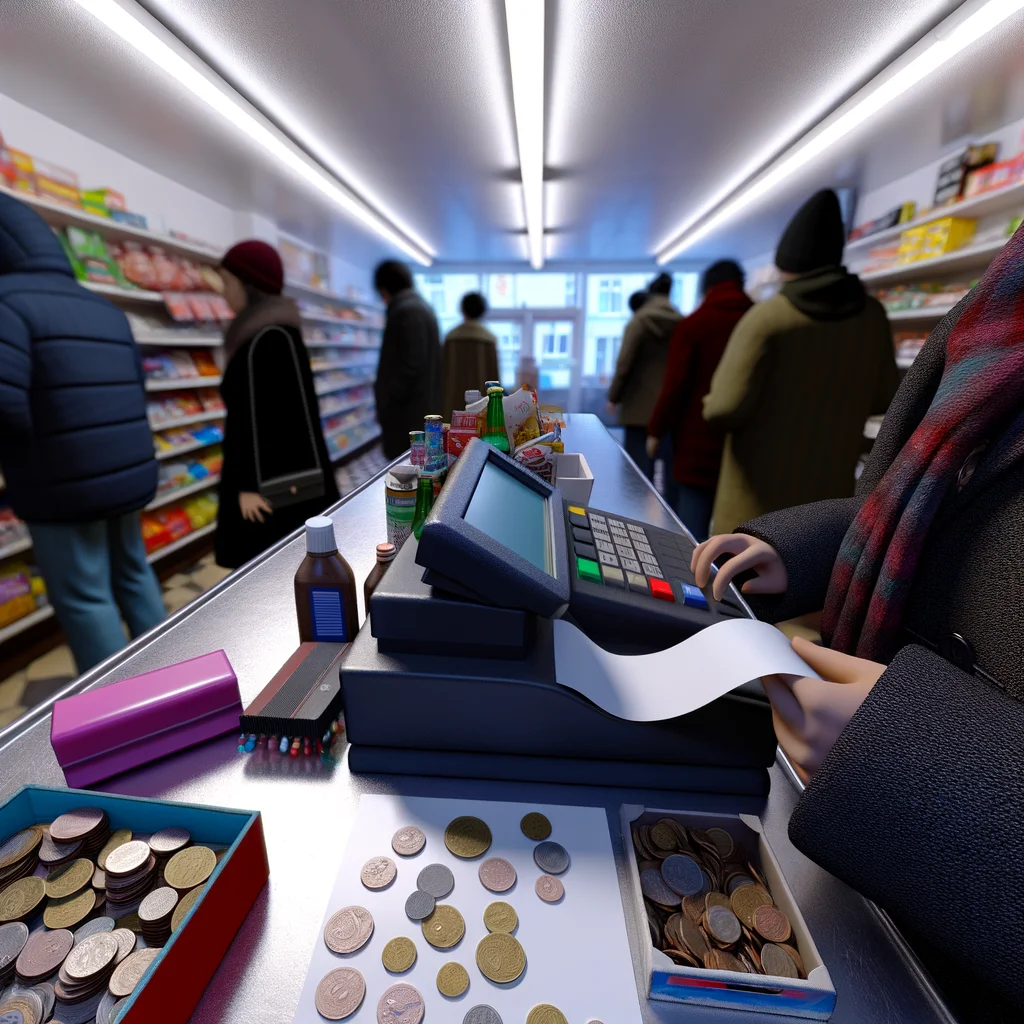
On Tuesday morning at 8:47 a.m., Emma Carlisle, 29, a product designer from Manchester, entered Kiosk Seestraße 41 (Seestraße 41, 13347 Berlin) to buy a bottle of water and left €4.80 poorer, holding what she described as “a damp, heat-pressed receipt with a stamp of a winking bear.”
“It wasn’t even the fee,” Carlisle said outside the shop, squinting at the paper as if it might confess. “It was the phrasing. The cashier said, ‘Presence, please.’ Like I was being politely invoiced for existing.”
The so-called “Expat Presence Fee” has emerged across Wedding in the past week, paid only in cash and collected at randomly selected corner stores designated each morning by a printed list titled Rotationsplan: Präsenzabgabe—posted behind cigarette displays, under energy drinks, and, in one instance, taped to a freezer lid like a municipal warning.
A tax that moves like gossip
By 10:15 a.m., three more kiosks within walking distance of U Reinickendorfer Straße were observed applying the charge. At Kiosk Sprengel 19 (Sprengelstraße 19, 13353 Berlin), a man in a hi-vis vest introduced himself only as “contractor, civic.” He carried a coin tray, a stack of pink forms labeled “Form EPF-2,” and a stamp pad.
He asked customers two questions—“How long have you been here?” and “What do you pay for a room?”—then paused with bureaucratic sincerity to “penetrate the details,” as one witness put it.
“Someone like that should at least wear a lanyard,” said Serkan Yilmaz, 41, who runs a nearby Turkish-owned bakery on Tegeler Straße and watched the exchange from his doorway. “But also, if the city finally understands cash flow, it had to happen here, in a kiosk, under bad lighting, next to the Kinder Bueno.”
At 11:02 a.m., a second collector arrived at the same shop with a different list, causing an argument about whose rotation was valid. “It’s a philosophical problem,” the shop owner, Leyla Arslan, 37, said dryly. “Wittgenstein had language games. We have clipboard games.”
Official denial, unofficial enthusiasm
A spokesperson for the Mitte district office, Mareike Teschner, said by phone at 1:26 p.m. that the office had “no knowledge of an officially legislated fee targeting newcomers,” adding that “kiosks are private businesses” and that “customers should contact the appropriate consumer protection channels.”
Teschner declined to comment on the pink forms, the uniform stamp, or why several shops reported being told to prepare exact change “for the sake of smooth entry.”
Not everyone objected. Lukas Weber, 33, who said he has lived in Wedding “long enough to have a preferred locksmith,” praised the program for its simplicity. “At least it’s direct,” he said, waiting for a coffee near Müllerstraße and Seestraße. “You pay. You feel something. You move on. Berlin usually takes months to touch you this firmly.”
Consequences are already emerging: two kiosk owners reported running out of small coins by noon, while one expat WhatsApp group circulated a map of “safe registers” that was obsolete within an hour. At 3:39 p.m., the collector at Badstraße 7 refused a €50 note “on principle,” recommending the payer “find a friend with softer cash.”
By early evening, multiple kiosks had placed handwritten signs reading “NO FEE ASK ME” or, in one case, “FEE YES BUT SMILE.” Nobody seemed certain which were acts of defiance and which were price lists.
If the program continues, Wedding may have accidentally reinvented local taxation as street performance: Kafka with scratch cards, Adorno with a stamp pad, and a cash drawer that won’t open unless you believe in it hard enough.