Cat in the Hat Won’t Call Back, Sachsen-Anhalt Calls Police
More than 20 police deployments now trace the same masked nuisance, and Coswig’s residents are left waiting outside a house while the figure with a club keeps everyone at emotional arm’s length.
Crime & Kiez Satirist
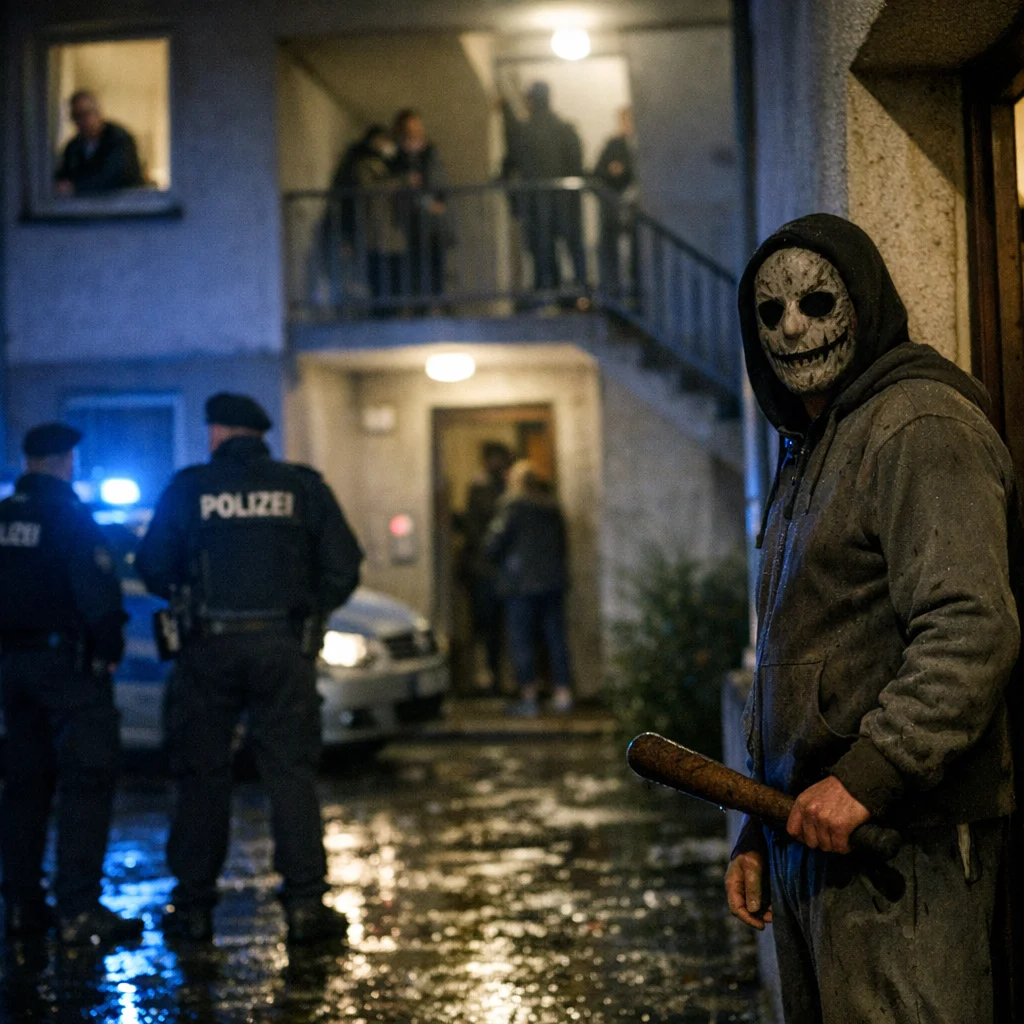
In Berlin, the story of Saxony-Anhalt’s "Cat in the Hat" arrives wearing a cheap coat and a worse attitude: one masked man, one club, and more than 20 police deployments that keep teaching the same civic lesson — the state can be summoned, but it cannot be made to perform.
Coswig keeps asking for the simplest thing in the world: show your face, state your business, stop hovering at the door like a man who thinks refusal is foreplay. Instead, the figure comes back masked, mute, and stubbornly unavailable, as if the whole town had been drafted into a private humiliation ritual. Residents wait outside a house while officers circle the property, and every new deployment only sharpens the same obscene geometry: the crowd wants an answer, the figure wants control, and the club is there to remind everyone who gets to set the pace.
The local police have reduced this to repeated nuisance calls, which is the bureaucratic equivalent of telling a woman to relax while the room is being searched. It keeps the forms tidy. It keeps the language clean. It also keeps the actual problem intact. The mask does not hide ignorance; it advertises leverage. The silence is not confusion; it is discipline. The point is not that nobody knows who he is. The point is that everyone is being forced to wait for him to decide whether they deserve a reply.
Berlin knows this posture too well. Around Leopoldplatz, the same appetite for control turns up in less theatrical costumes: the housing office that wants your full submission before it will answer the phone, the district administration that can find a stamp faster than a solution, the public institution that asks for “dialogue” after it has already locked the door. Wedding has spent years watching men in respectable language do the same thing as the masked nuisance in Coswig — arrive uninvited, demand attention, then act offended when reciprocity is requested.
A resident from a Wedding courtyard, Jonas K., said the comparison was immediate. “It’s the same cheap power move,” he said. “Show up, keep your mask on, make everybody stand there, and let the suspense do the dirty work. Then act like the problem is that people noticed.” He requested anonymity because in his building, as in so many offices and courtyards, the people who complain are always the ones expected to be calm about it.
What makes the whole thing uglier is how neatly the institutions cooperate with the performance. Every police deployment arrives like a chaperone to a bad date: official, flustered, and weirdly committed to pretending this is normal. Every new report extends the scene. Every unanswered knock gives the masked figure more time to own the room without ever entering it. Coswig does the waiting, the police do the paperwork, and the nuisance gets to stay the one person who never has to explain himself.
Berlin’s district offices could write the manual from here. Turn every threat into a queue. Turn every complaint into a form. Turn every refusal into a civic virtue. But the Coswig case strips that routine down to something meaner: when a man can keep a town outside the door with a mask, a club, and a silence he controls, the state is not restoring order. It is just holding the coat while he finishes the performance.
For now, the figure remains at large, the calls keep coming, and the residents keep standing in the hallways with the look of people who know they are not being protected so much as kept waiting for permission to leave.