Cement Never Looked So Holy: Wedding’s Eco-Blockade Converts Another Intersection Into a Confessional
Last Generation glued down, motorists sermonized, and one guy with a leaf-blower tried to “negotiate” the carbon budget like it was dust.
Climate Drama & Street Behavior Correspondent
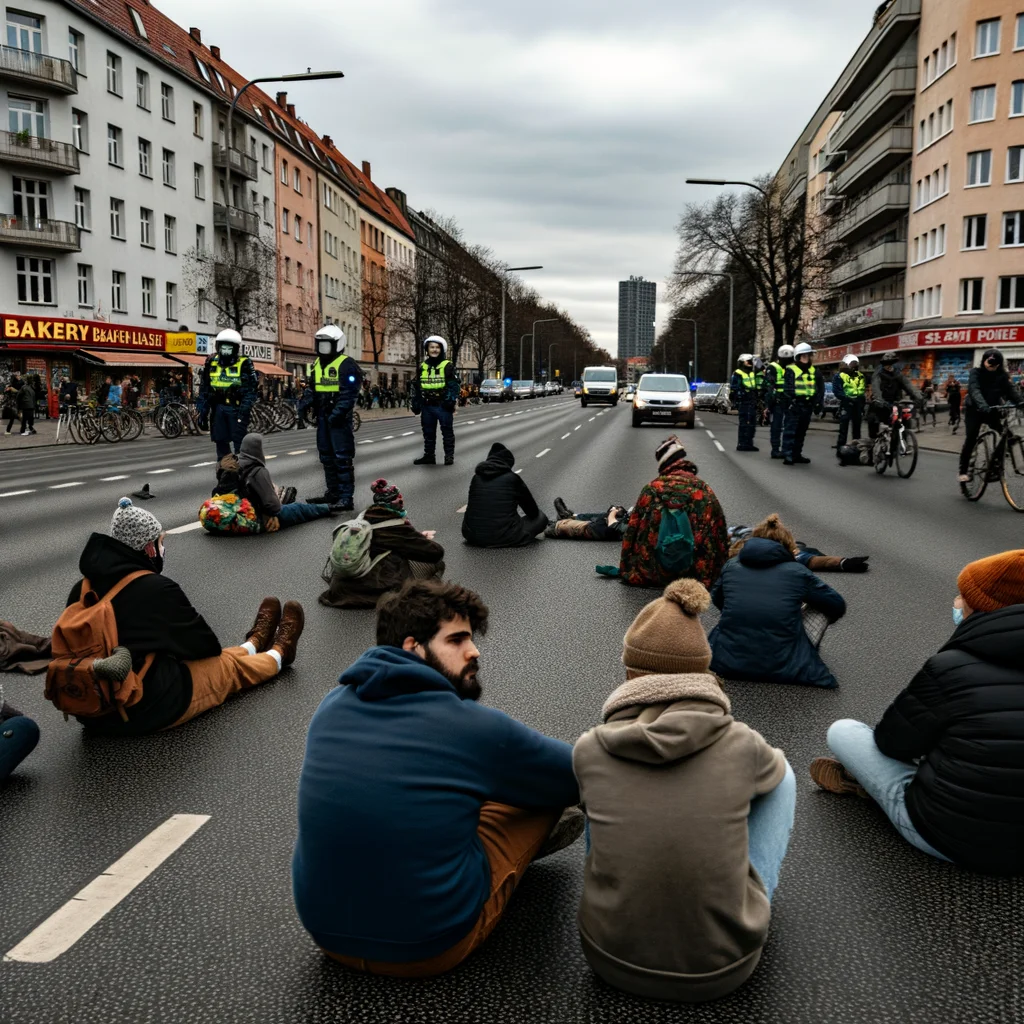
By 8:17 a.m., another group of Last Generation activists had fused themselves to the roadway in Wedding with the devotion of medieval monks—except instead of vows of silence, they brought laminated talking points and the calm certainty of people who’ve never had to catch a connecting bus in their lives.
The scene had everything Berlin loves: inconvenience marketed as virtue, moral blackmail with a biodegradable smile, and a passersby debate so circular it could qualify as public sculpture. Think: a Duchamp readymade, but it smells like exhaust and betrayal.
The sacrament of the glue
Witnesses describe at least six protesters seated in the street like a minimalistic performance piece titled “Waiting for a Planet That Still Returns Your Deposits.” Each person’s palm appeared enthusiastically married to the asphalt—fully committed, no paperwork, an intimacy most Berliners can’t maintain with their own health insurance.
A self-appointed “intersection steward” told this reporter the blockade was designed to “create urgency.”
It succeeded. A courier on an e-bike began speaking in tongues. A driver in a white van achieved a new octave of existential screaming. An older Turkish man from the nearby corner bakery arrived holding a tray of simit, looked at the road situation, and quietly pivoted into a business lesson: “If you block my customers, you’re paying rent.” That’s not a counterargument; that’s Adam Smith with sesame.
Wedding’s three climate classes, briefly united by contempt
Within minutes, three factions formed—like a Hegelian dialectic, except everyone was wearing mismatched outdoor gear and nobody got to the synthesis:
- The Guilty Graduate Crowd: Here to “hold space,” photograph their own anguish, and whisper, “This is complicated,” the way people whisper in churches and sex shops.
- The Working-Don’t-Call-It-Class: People who had places to be and immediately learned their lives are the most carbon-intensive thing on Earth.
- The Street-Level Entrepreneurs: They didn’t choose a side; they chose an angle. One man attempted to sell mini water bottles “for the stranded,” while carefully positioning himself so the police couldn’t decide whether he was charity or commerce.
Somewhere between them, Wedding’s toddlers watched wide-eyed from strollers—future voters learning, early, that democracy means your morning gets dominated by somebody else’s trauma narrative.
Police deploy patience, confusion, and a mysterious scraping tool
Officers arrived in that special Berlin mode: professionally calm, privately exhausted, and visibly counting down to their next union negotiation.
A negotiation unfolded that was both “nonviolent” and, somehow, deeply suggestive. There was talk of “gentle removal,” “softening the bond,” and “getting proper traction.” If you heard it without context, you’d assume the city was running a couples’ retreat in a parking lot.
At one point, an officer produced a flat metal instrument whose entire purpose seemed to be separating a human hand from civic infrastructure without making the evening news look too spicy. Berlin’s innovation economy is alive and well; it’s just mostly aimed at separating things that are stubbornly attached.
Moral messaging with a traffic jam chaser
The activists tried to address drivers through a handheld megaphone with the crisp audio fidelity of a dying modem. Their message—“Listen to the science”—hit the gridlock like literature meets illiteracy.
One commuter shouted back: “I KNOW THE SCIENCE. I JUST ALSO KNOW MY BOSS.”
A woman in athleisure attempted a deep dive into climate ethics with an elderly neighbor who responded by staring blankly, like Kafka had come back as a pensioner and found the bureaucracy now comes in activist packaging.
Meanwhile, a teen filmed the whole thing for social media, contributing a new emission source: hot takes.
The part nobody wants to say out loud
Wedding isn’t confused about climate collapse. Wedding is confused about why the burden of saving the planet is always enforced on people with the least room to maneuver.
Blocking a road is seductive because it’s immediate, stiff resistance you can touch—concrete feedback, hard to swallow in a way a scientific report isn’t. It feels like changing the world, when it’s actually just penetrating everyone’s day.
But also: a protest that doesn’t bother anyone is just yoga with signs.
So today, Wedding did what it always does when the world ends: it argued, adjusted its coat, and kept moving—around you, through you, or over a curb if it had to.
As the intersection reopened, the leftover glue patches shimmered on the asphalt like tiny tombstones for certainty. A neighborhood kid stepped on one, stuck for half a second, and said, “Gross.”
Honestly? The most accurate critique so far.