Charlottenburg’s “Family-Friendly” Pedestrian Zone Is Really a Boardroom Escape Route
When the council banned cars from one of its most expensive shopping streets, local businessmen, consultants, and stroller aristocrats discovered the same miracle: a place where they can feel civic without ever having.
Gentrification Symptoms & Pretend-Creative Economy Reporter
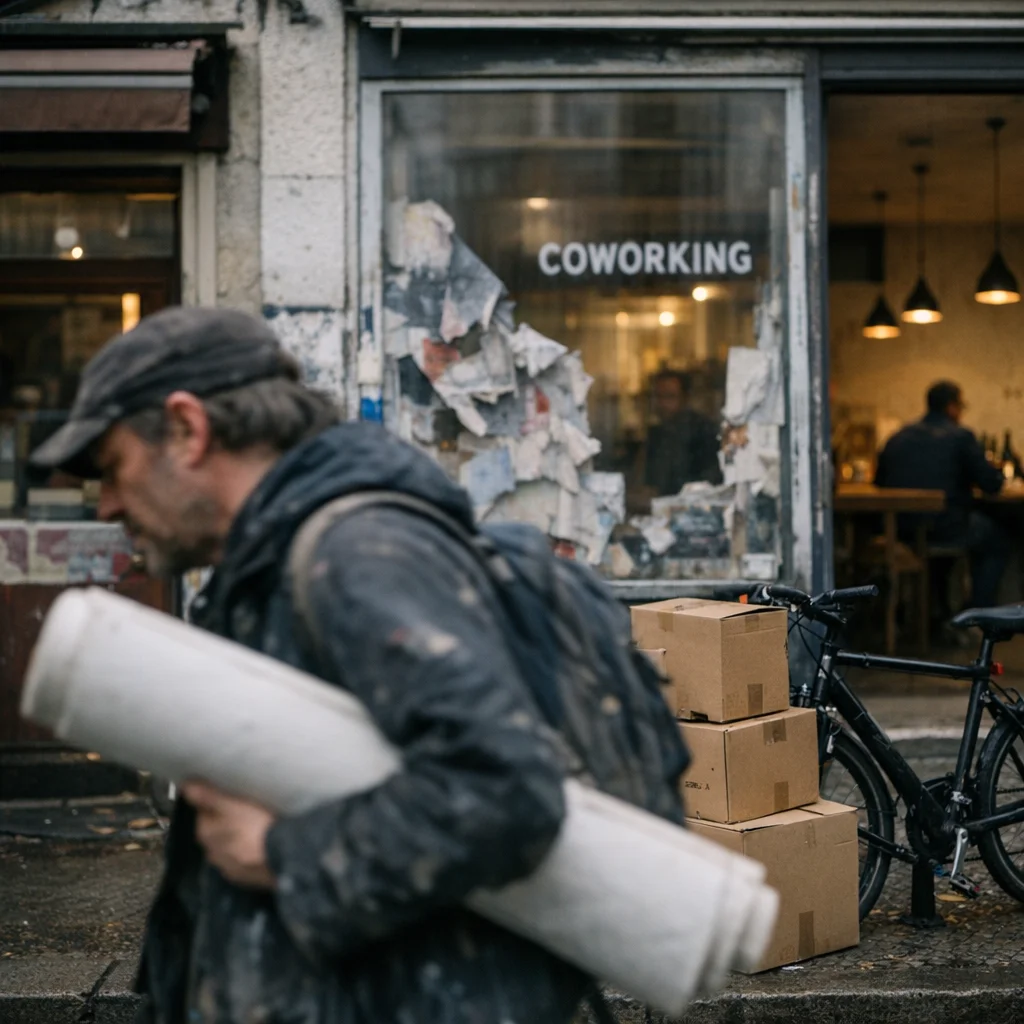
Wedding is where Berlin’s nice little lies go to get airbrushed and then invoiced. The borough likes to describe itself as open, diverse, and full of potential, which is usually the sentence a district writes right before it hands the keys to investors with soft shoes and hard jaws.
The mechanism is not mysterious. First come the planning terms: revitalization, mixed-use development, activation of public space. Then come the rent hikes, the converted ground floors, the café with the imported lamp bulbs and the menu printed in the kind of font that says, quietly, that poor people are a health code concern. Soon the old bakery becomes a “neighborhood concept store,” the corner kiosk becomes a “curated convenience experience,” and the last tenant left on the block is a barber shop being harassed by property managers who call themselves placemakers.
At a former studio near Leopoldplatz, a landlord now advertises “creative potential” in the same room where a screenprinter used to dry posters beside a heater that sounded like it had tuberculosis. The space is “ideal for a concept-driven user,” which is real-estate language for: someone who can afford to pretend they are not being extorted. A local artist who asked not to be named because his sublease is one unpaid invoice away from collapse said the neighborhood has become “a showroom for people who want the frisson of grime without the smell, the labor, or the neighbors.”
The newcomers are unbearable in the special way only the morally decorative can be unbearable. They move in wearing thrifted guilt and expensive socks, speak tenderly about community, and then start a WhatsApp thread about whether the street is “safe enough” after 9 p.m. They want roughness the way a bored executive wants a mistress: visible in the right light, never inconvenient, and gone before it asks for rent. They call themselves allies, creatives, and urban souls, but what they really mean is that they enjoy being near struggle so they can photograph it from a clean angle.
The district office, naturally, is thrilled to assist in the performance. Its favorite euphemisms are “socially balanced development” and “neighborhood compatibility,” phrases so lubricated they could slide under a locked door and open it from the inside. Officials talk about preserving diversity while approving the exact conditions that make diversity unaffordable. They praise “subsidized cultural use” with one hand and sign off on boutique retail leases with the other, then act shocked when the street starts looking like a showroom for wallets with social consciences.
A culture-office spokesperson said Wedding remains “an important space for inclusive participation,” which is bureaucratese for please keep making the district legible to funders while we quietly hand it to people who confuse participation with occupancy. Another official praised “micro-local entrepreneurship,” a phrase that sounds like a wellness retreat for property speculators. It is always inspiring how the state can describe displacement with the tone of someone recommending a decent moisturizer.
What the borough is really protecting is not community but the reputation of being seen as community-minded. That is the current civic fetish: to be progressive in the abstract, predatory in the lease agreement, and emotionally available only when a grant application is involved. The self-image is immaculate. The behavior is not. Everyone wants to be the sort of person who “supports the neighborhood,” as long as support means paying extra for a tote bag, not standing next to a tenant meeting with a clipboard and a face full of consequences.
Even the cultural sector has learned to talk like a broker in a silk scarf. They call it accessibility when they mean pricing people out gently. They call it activation when they mean extracting value from a street until it’s too polished to recognize the people who built it. They call it inclusion while building a district where the only thing actually included is the invoice.
What remains in Wedding is the usual post-bohemian wreckage: a few family businesses cornered by rising costs, a few tenants pretending not to hear the knocking, and a lot of city-adjacent adults congratulating themselves for living in a neighborhood they have already begun to sterilize. The place still has life in it, but now the life is being managed by people who think a community is something you can brand, monetize, and quietly undress behind glass.