Concrete Bollards in Wedding Demand Emotional Consent Before Allowing Any Vehicle to Pass
Inspired by Friedrichshain’s growing fury at street barriers, Wedding has upgraded the humble post into a relationship coach with a flawless sense of superiority.
Public Order & Petty Enforcement Reporter
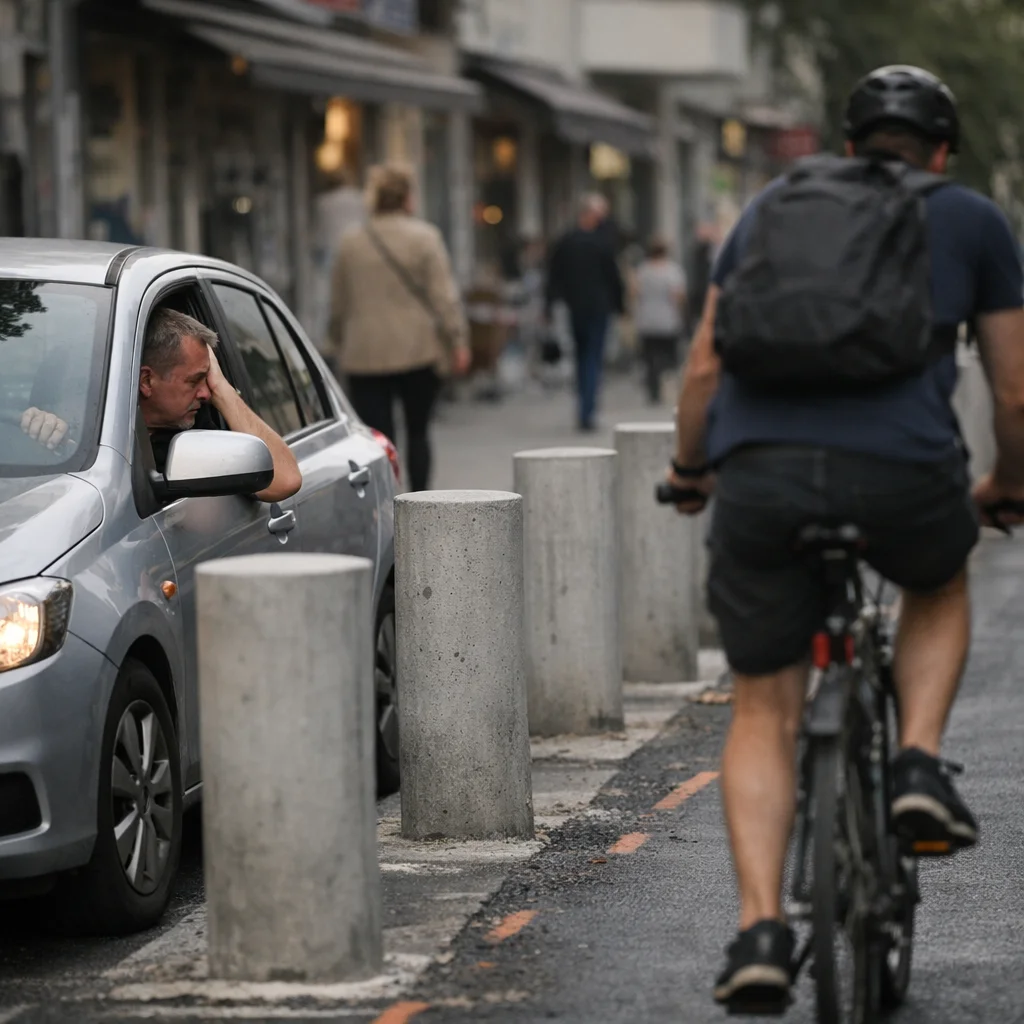
WEDDING — Berlin’s latest outbreak of bollard rage, previously reported with theatrical suffering in Friedrichshain, has arrived in Wedding the way all trends do: slightly later, more resentful, and with worse lighting.
On a side street off Müllerstraße, a fresh set of concrete bollards appeared recently, installed with the usual Berlin logic: two months of jackhammering followed by a final product that looks like a municipal shrug. The difference, locals say, is that these bollards have developed a policy.
“They don’t just block you,” said Emre Aydin, who delivers groceries and has learned every shortcut in the neighborhood except the ones that now end in a waist-high cylinder. “They make you explain yourself. I had to sit there with my engine idling while the bollard ‘took space.’”
Witnesses describe the same pattern: a car approaches, hesitates, and the nearest bollard leans—just a little—toward the bumper, as if to invite a conversation nobody asked for. The behavior is subtle enough to be denied by officials, which is also subtle enough to be Berlin’s entire brand.
A Bezirksamt spokesperson insisted the posts are “passive infrastructure,” adding that any perceived movement is likely “wind, perspective, or personal accountability.” Residents found that hard to swallow, mostly because the bollards appear to maintain a firm boundary with the confidence of a TED Talk.
The conflict has created unlikely coalitions. Cyclists love the new arrangement, obviously, because it makes them feel like the city finally understands their inner child. Drivers hate it, obviously, because it suggests the road is not their birthright. Pedestrians are mainly upset that the bollards have become the new thing people bump into while staring at their phones, which is the only activity Berliners still perform with genuine focus.
Even longtime Turkish shopkeepers—usually the last line of defense against imported urban design fantasies—are split. One corner grocer praised the bollards for stopping reckless shortcut traffic. Another complained they’ve redirected cars into his loading zone, “like a Foucault diagram, but with more honking.”
Urban theorists have already arrived, excited to describe the situation as “disciplinary space” while double-parking directly in it. A local architecture student compared the posts to minimalist sculpture: “It’s like Donald Judd, but it judges you back.”
For now, Wedding’s bollards remain in place, quietly radiating the city’s favorite emotion: control dressed up as care. The only thing moving faster than the traffic is Berliners’ ability to turn a concrete cylinder into a personal betrayal.