Council Meeting Sells Kneeling as Transparency
Wedding’s newest civic ritual invites residents to crouch for better access, then applauds itself for inclusion while nothing gets easier except the officials’ power to look kind.
Administrative Grief Correspondent
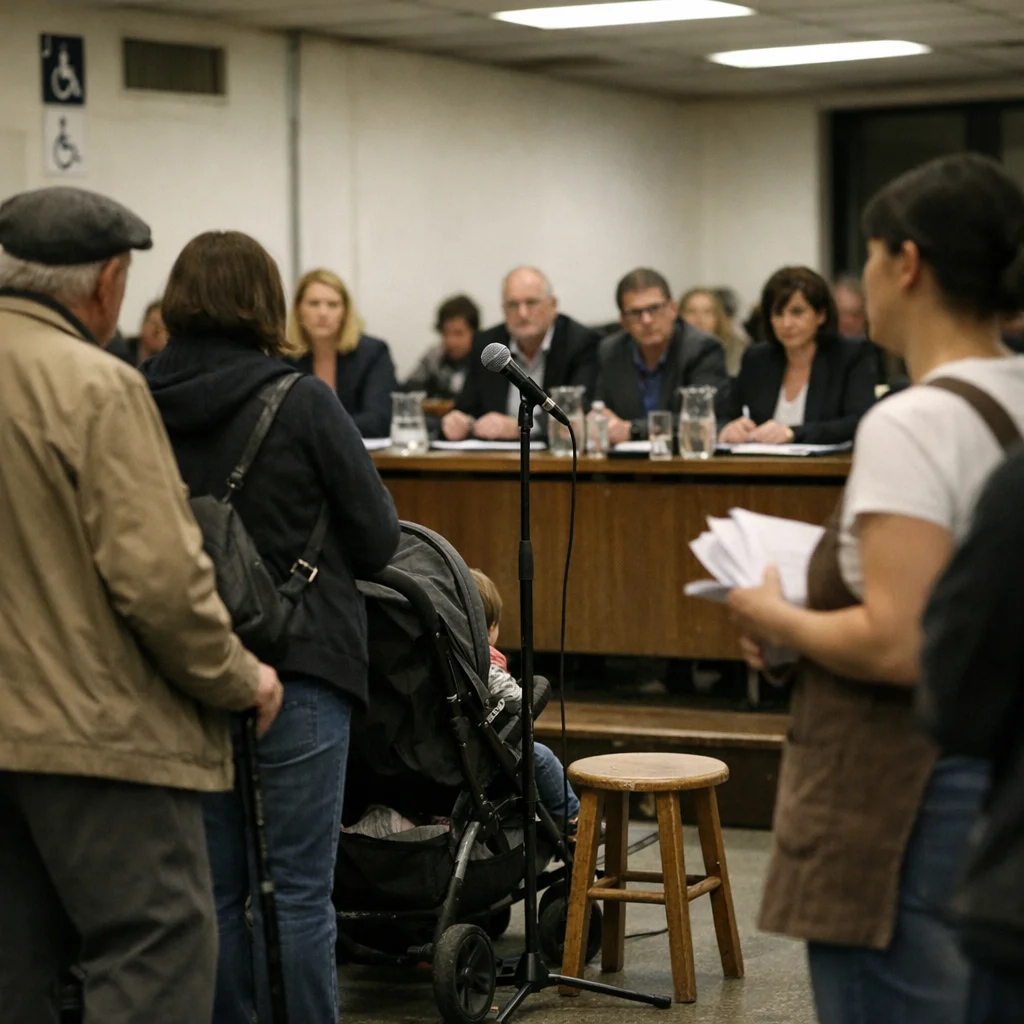
At a packed district council meeting in Wedding, the district office rolled out its latest accessibility stunt: residents were asked to kneel, crouch, or otherwise fold themselves into a position that made speaking feel less like civic participation than a courtier’s apology. The room was full of district staff in sensible jackets, consultants with the glazed intimacy of people paid to masturbate a policy into existence, and deputy managers radiating the dead-eyed calm of those who have never had to carry a stroller, a cane, or a complaint up a broken stair.
The room itself did the usual Berlin bureaucratic theater. Fluorescent light. Folded chairs. A long table with water nobody touched. A side wall plastered with carefully phrased accessibility notices, as if language could pave the sidewalk outside the office on Müllerstraße or fix the same busted curb near Leopoldplatz that has been insulting ankles for months. First came the signage. Then came the “listening format.” Then came the instruction that anyone needing assistance should approach the microphone from the left, use the low stool provided, and wait while a facilitator confirmed that their discomfort had been properly recorded in the district’s little altar of procedural virtue.
Marina Yildiz, who runs a Turkish bakery near Leopoldplatz and arrived with a folder full of complaints about broken paving, useless ramps, and the district’s talent for treating every practical problem like a mood board, said the setup felt less like participation than a humiliating audition staged by people who have mistaken themselves for benevolence. “They wanted me down low in front of everyone, like the room had to see me submit before it could pretend to listen,” she said. “I came to talk about access. They gave me posture.”
The district office defended the arrangement by saying the new format was meant to make power visible. That is the sort of sentence only a civil servant can deliver with a straight face, as if domination becomes ethical the moment it is diagrammed in pastel. A spokesperson praised the “embodied dialogue,” which in practice meant disabled residents, older people, and anyone with a functioning sense of shame had to crawl through a room arranged like a small administrative fetish closet—soft voices, hard rules, and the unmistakable thrill of being corrected by people who call it care.
By the second hour, the consultants were still speaking about dignity while residents were being routed through a “ground-level feedback circle,” a phrase so lubricated with funding-language it could probably slide under a locked office door. One man with a cane asked whether the microphone could be raised. A coordinator smiled the thin, managerial smile of someone enjoying the feel of compliance under the tongue and explained that the lower height was “intentionally egalitarian.” In district-office dialect, that means: everybody should suffer in the same humiliating position so nobody can accuse the staff of preferring one form of patronage over another.
What made the whole thing especially rancid was the confidence. Not the incompetence. Incompetence would at least be honest, a dirty little accident with paperwork. This was the polished, grant-funded version of domination: the district kneels nobody, but it insists everyone else do it first, preferably in a room with good minutes and bad air. Left-wing vocabulary supplies the conscience, right-wing budgeting supplies the stinginess, and the local middle managers supply the arousal of feeling progressive while moving nothing except their mouths.
The residents did what they always do in Wedding: they waited, objected, repeated themselves, and were treated as if persistence were a failure of tone. A mother with a stroller was told to use the side access. An older man was advised to “engage with the process” as though the process were a flirtatious clerk and he had arrived without enough patience. Someone asked why a district office in one of the city’s most densely lived-in neighborhoods could not manage a microphone height that did not require a sacrificial bend at the waist. The answer, as ever, was not given. It was implied through procedure.
By the end of the meeting, people left with forms, follow-up dates, and the familiar civic aftertaste: that soft administrative smell of being handled, moisturized, and dismissed. The district said it would “review the feedback.” Next month’s session, officials confirmed, will feature a revised access protocol and, presumably, an even more intimate angle of obedience. They call it inclusion because calling it what it is would require a vocabulary strong enough to embarrass them.