Council Seals the Playground, Parents Panic
Wedding’s child-safety crusade finally found its perfect victim: the one place where children are allowed to be loud, dirty, and briefly ignored by adults with careers.
Administrative Grief Correspondent
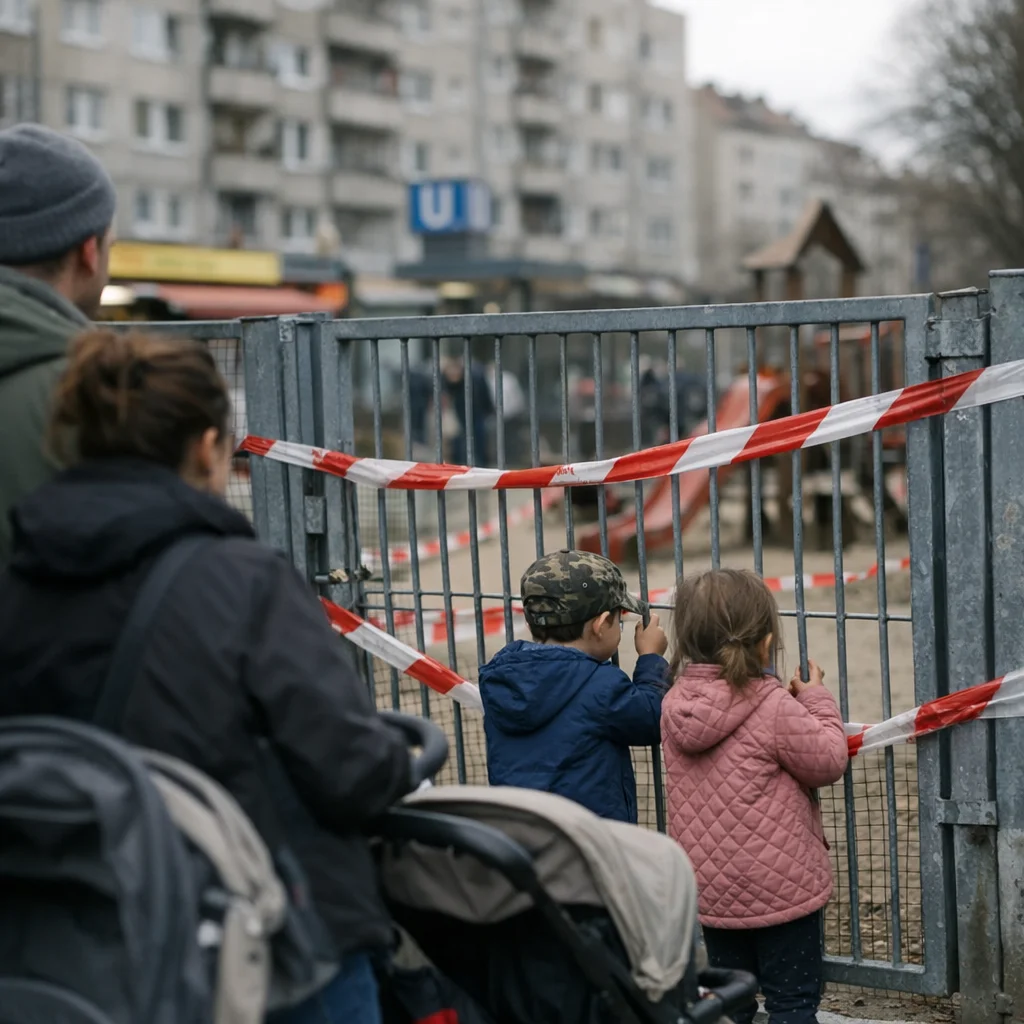
The district office called it “precaution.” The neighborhood called it another expensive way to do nothing.
The playground near Leopoldplatz was sealed this week after the district office issued a closure order framed as child protection, that favorite municipal sedative the city reaches for whenever it wants to look responsible without getting its hands dirty. The gate went up, the tape went on, and the one place in Wedding where children are allowed to shriek, collide, and briefly inconvenience the adult world was treated like a contaminated crime scene managed by a committee.
Officials said the equipment needed review. Parents said the slide has had more backbone than half the people issuing the order. By Monday morning, strollers were lined up outside the fence like small white surrender flags, and adults who had come for a bench, a coffee, and ten minutes of not being needed by anyone were left circling the perimeter with the glazed expression of people being asked to clap for their own eviction.
“We were told this was about safety,” said Ayse Demir, who brings her two children there after work and now stands outside the locked entrance like it owes her rent. “But the district office only discovered danger after the playground had already been doing its job for years. That’s not caution. That’s a press release with a pulse.”
And because this is Berlin administration, the performance immediately went glossy. Inside the district office, the language was softer than a clerk’s wedding-ring tan and twice as counterfeit. A spokesperson said the closure was necessary “out of concern for families” and “in line with ongoing assessments,” which is how institutions talk when they want to fondle their own conscience in public while keeping the actual work in the basement, where it belongs. It is bureaucratic pillow talk: all smoothing, no thrust, and somehow everyone still leaves unsatisfied.
The real genius of the decision is its class choreography. The people making it can always retreat to quieter courtyards, private gardens, or a childless apartment with expensive blinds and a kettle that never gets used in panic. The people paying for it are the ones in Wedding who needed that playground to burn off the day: delivery workers, cleaners, nurses, shop assistants, parents finishing shifts with the same sticky patience they use to peel a toddler off a supermarket floor. For them, “temporary closure” means the district has converted a basic breathing space into a locked lesson in who gets managed and who gets buffered.
Then, as if the whole thing had been baked by a consultancy with a fetish for clipboards, the repair mythology arrived. Soon there will be an inspection, then a risk analysis, then an “engagement process” with pastel language and a budget line fat enough to make a decent electrician blush. There will be surveys nobody asked for, diagrams nobody can read, and a public workshop where three well-fed facilitators in identical sneakers explain community to the people who already live it. The district loves this part: turning neglect into process, and process into a little career ladder for people who mistake jargon for moral courage.
Outside, the neighborhood keeps doing what neighborhoods do when the state gets nervous and starts buttoning its shirt: surviving anyway. The kiosk by the U-Bahn still sells coffee that tastes like burnt permission. The men on the bench still argue in half a dozen languages about football, weather, and which office clerk most deserves to be trapped in their own paperwork. The playground fence, meanwhile, gleams in the weak light like a fresh bruise on the face of public life.
The older residents were less impressed. One Turkish grandfather, who has watched Wedding be lovingly neglected by several generations of officials with clean shoes and dirty consciences, laughed when asked about the closure. “First they ignore the place,” he said, “then they discover safety after the money’s already been spent somewhere prettier.” He nodded toward the taped gate. “This is what they call concern when they don’t want the embarrassment of fixing something properly.”
For now, children are being shunted to other pockets of the neighborhood, where the benches are occupied, the shade is thin, and every decent patch of ground is already claimed by someone else trying to catch a breath. Parents have learned the newest civic ritual: stand outside the fence, swallow the insult, and wait for the district office to finish caressing its own paperwork. In Wedding, even the closures are performative—an official little striptease of responsibility, all tease and no repair.