Councilmen Discover the Trash App
Wedding’s latest civic miracle is a phone app that promises cleaner streets while mostly teaching residents which department to blame with enough confidence to sound employed.
Administrative Grief Correspondent
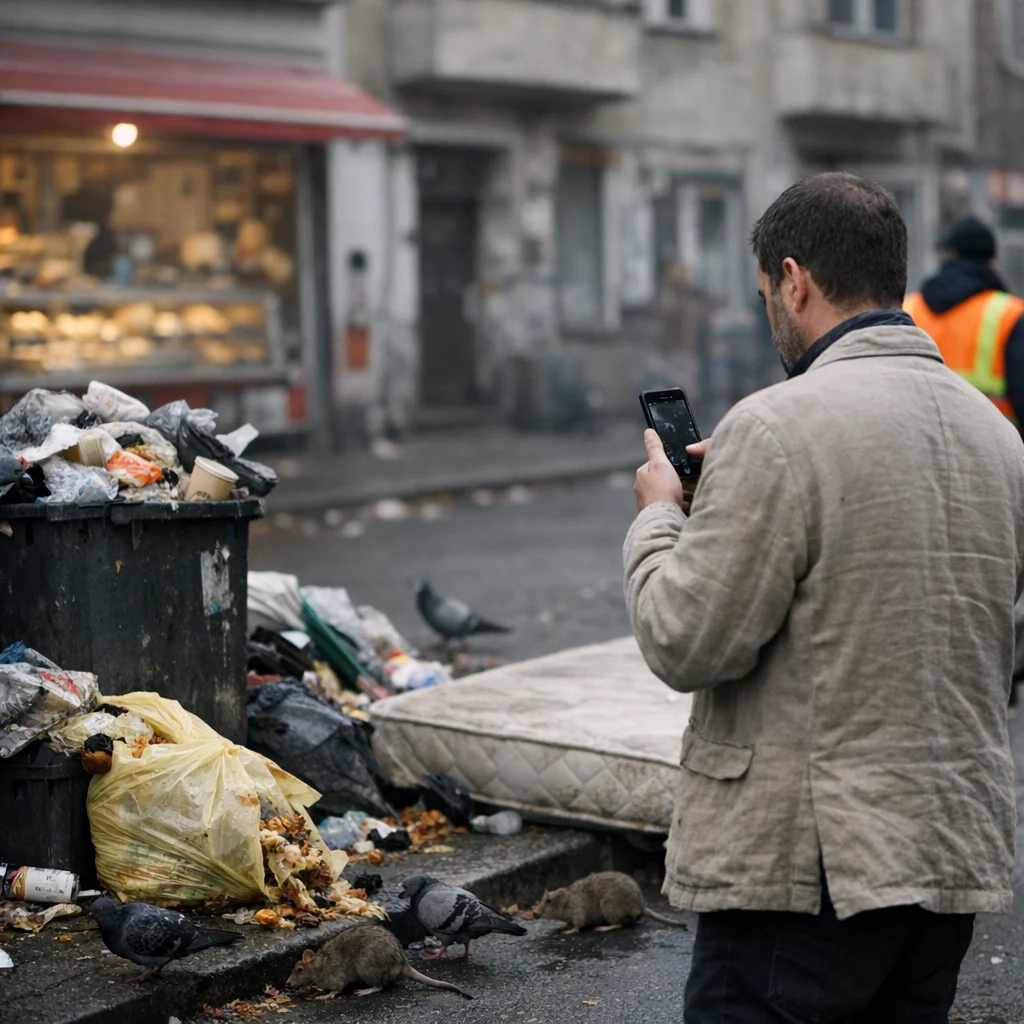
Wedding’s district office has discovered the oldest trick in municipal porn: make the public do the dirty work, then call it participation. The new trash-reporting app lets anyone photograph a broken bin, a burst sack, a mattress dumped like a confession, and fling the evidence into the administrative swamp. On paper, it is modern cleanliness. In practice, it is a free labor scheme with a cheerful icon.
The app’s real achievement is not sanitation. It is ritual. The neighborhood has been handed a little altar where the app-user can kneel beside the stinking container, angle the phone just right, and perform a private sermon on civic decay. Every upload says the same thing: look how serious I am. Look how helpless I am. Look how clean my conscience is compared with this sidewalk, which still smells like week-old kebab grease, wet cardboard, sour beer, and whatever animal has started testing the bags as a buffet.
At Leopoldplatz, the ecology of neglect is so specific it could be fingerprinted. There is the black bin with its lid hanging open like a cheap mouth. There is the yellow bag split at the seam, leaking yogurt cups, lettuce slime, and someone’s flattened delivery box into the gutter. There are the rats that arrive after dark with the confidence of landlords, and the pigeons that peck at the mess in broad daylight as if they pay rent. By 7 a.m., the curb looks less like a street than a post-binge crime scene.
One man in a spotless linen jacket, the kind of resident who says “community” with the same tone others reserve for leather upholstery, stood over a pile of refuse and tapped his screen with devotional disgust. He had already posted the same complaint to three neighborhood groups, then refreshed the app to check whether his outrage had been processed properly. He said the system made him feel “finally heard,” which is exactly the kind of thing people say when they want their helplessness to sound like leadership.
Nearby, Mehmet Yildiz, who runs a bakery that has outlived reform, redevelopment, and several generations of imported concern, was less impressed. He pointed at the curb where a torn mattress had been sitting since the night before, the stuffing damp, the springs exposed like bad teeth. “The city loves a form,” he said. “A form is cheaper than a worker, and cleaner than an apology.” Then he went back inside to pull trays from the oven while the street outside continued its slow biodegradation.
The district office, of course, speaks in the tender prose of cowardice. Reports are being “forwarded to the relevant teams.” Response times are being “optimized.” Friction between residents and services is being “reduced.” It is the same predatory innocence every municipality uses while outsourcing civic labor to people with phones and no leverage. The officials keep their hands spotless by turning residents into volunteer snitches for the state’s own incompetence, then acting grateful when the paperwork arrives with a photo attached.
And the beneficiaries are obvious if you bother to look past the nice fonts. The app flatters the app-using professional who likes to think outrage is a form of property. It flatters the inherited-money local who can stage concern between Pilates and a consult on “urban quality of life.” It flatters the performative activist whose politics stop at documentation and whose courage dies at the bin. Even the contractor benefits: one more round of outsourced cleanup, one more invoice, one more chance for the city to pretend it has managed decay instead of merely scheduling it.
Meanwhile, the fluorescent-vested workers continue their solemn public theater, moving through the district with the grave expression of men paid to witness the obvious and not quite touch it. Sometimes they collect the pile. Sometimes they don’t. Sometimes they seem to arrive after the smell has already won, which may be the most honest municipal policy in Berlin: let rot mature until it becomes impossible to deny, then call the cleanup a success.
For now, the app produces screenshots, complaint threads, and the warm narcotic of self-approval. Wedding gets to preserve its filth, the district office gets to preserve its innocence, and the citizen gets the exquisite little thrill of pressing send while standing beside a bin that still overflows like a municipal joke with no punchline. In this neighborhood, even disgust has been gentrified into an unpaid administrative hobby.