Darkroom Diplomacy Breaks Down After GHB-Sincere Consent Workshop Ends in Passive-Aggressive Whispering
Wedding’s night pilgrims attempt to codify etiquette in the one room designed for miscommunication. Results include laminated rules, bruised egos, and an interpretive “no” delivered via shoulder tap.
Nightlife Protocol & Public Embarrassment Reporter
Field notes from Wedding’s velvet arbitration court
At roughly the hour when public transportation stops believing in you, a cohort of Wedding night travelers tried to civilize the uncivilizable: darkroom etiquette, formalized. Not “be decent.” Not “read the room.” Actual rules—workshopped, debated, and, in a move both heroic and cursed, briefly written down.
The effort began as a “quick consent refresher” led by a guy whose lanyard suggested nonprofit competence but whose pupils suggested a deeply democratic relationship with GHB. His plan was simple:
- establish clear signals,
- reduce misunderstandings,
- keep everyone safe,
- and (this was implied) help everyone get what they came for without causing a Constitutional Court case.
Within minutes, it became what Berlin does to all sincerity: a committee.
A room built for implication meets Berliners built for debate
Witnesses described an immediate clash between two competing doctrines:
- The Minimalist School (“Don’t be a creep; everything else is ambiance.”)
- The Full-Policy Maximalists (“We need a framework, a process, and ideally an appeals pathway.”)
If you’ve ever read Wittgenstein on language games, you know the problem: we cannot speak of what we most aggressively try to speak of—except here the silence also has body heat.
One attendee, a man in all black with the serene confidence of someone who has never faced consequences, argued that etiquette in such spaces is “pure tacit knowledge.” Another person—face stern, fan clacking like a judge’s gavel—insisted tacit knowledge is just privilege with better PR.
Somewhere near the end of the first discussion circle, a Turkish auntie-type (nobody knew if she was staff, a regular, or simply the neighborhood’s moral immune system) walked through with the calm authority of a bakery manager dealing with a line at noon. She took one look at the workshop, sighed, and offered the night’s most effective harm-reduction advice: “Drink water. And stop turning everything into school.”
The sticker economy of purity
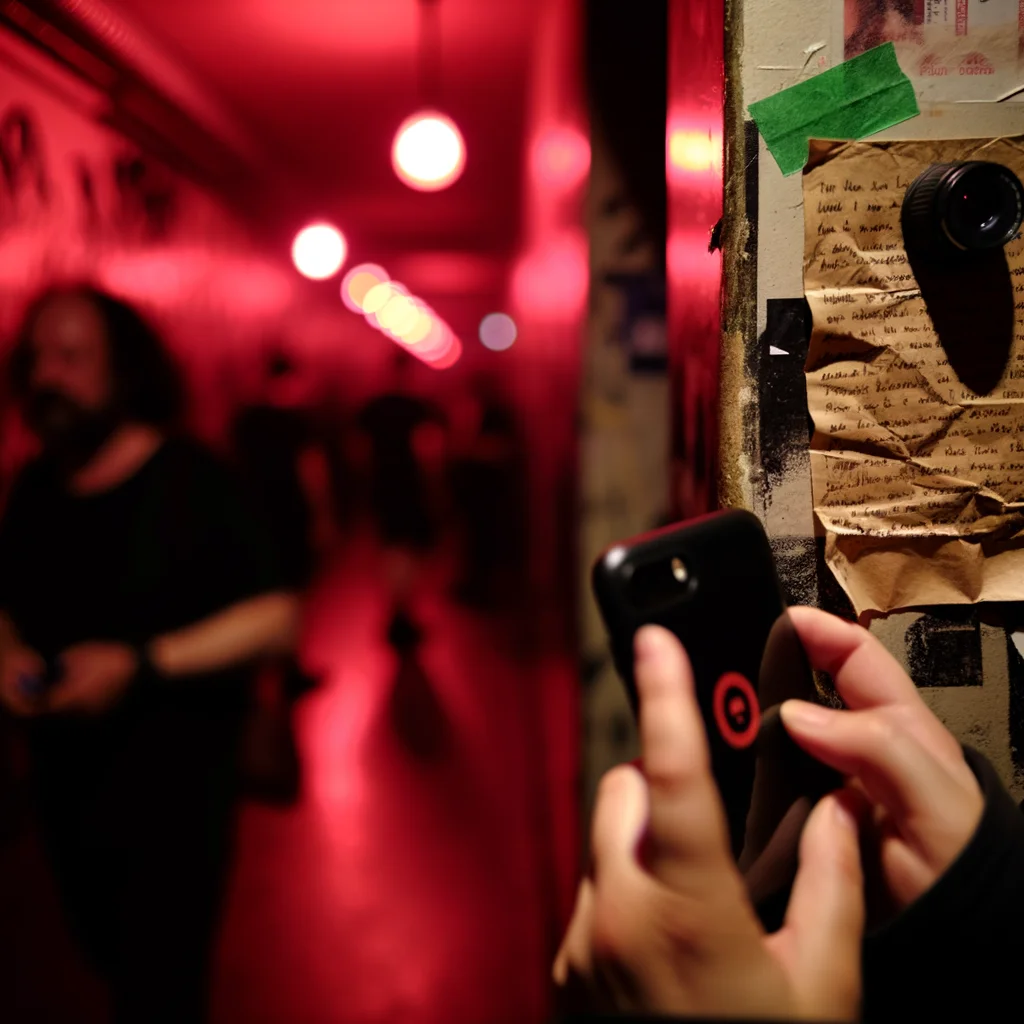
The venue still enforced the phone-camera sticker ritual, because nothing says “mystery” like letting a stranger seal your technology like evidence.
Naturally, this triggered a micro-sociology lecture on surveillance, as if Foucault hadn’t suffered enough. A guest claimed stickers are “disciplinary aesthetics.” Another claimed they’re “a trust exercise.” A third, visibly stressed, muttered that he’d rather be filmed than forced into one more penetrating conversation about “community values.”
In Wedding, even your lens gets covered before you do.
When signals become performance art
A new set of proposed signals was trialed:
- one shoulder tap for “no,”
- two for “check in,”
- three for “please stop philosophizing,”
- and an experimental finger snap that was described as “a hard boundary, softly delivered.”
Unfortunately, the shoulder taps became their own choreography. Some taps were too tender. Some were too stiff. Some felt like HR reaching into your soul with clean hands.
And yes, in at least one case, a tap intended as “no” was received as “try again, but with more confidence.”
Berliners: world leaders in interpretive dance; spiritual illiterates in basic clarity.
About Blank enters the story like a subplot nobody requested
As the workshop melted into regular night business, About Blank got name-checked as a comparative case study—because Berliners cannot just live; they must cite.
“About Blank has better norms,” claimed one self-appointed etiquette cartographer, moments before vanishing into a conversation that began with consent language and ended with a whispered negotiation about a scarf. You could call it an encounter. You could call it “deep community engagement.” Either way, the entire argument proved what Adorno warned us about: the culture industry will sell you liberation and invoice you for the follow-up feelings.
Meanwhile, in the hallway: logistics and longing
In Wedding, the hallway is where real policy gets enforced—by exhaustion. A revolving door of people coming from Golden Gate “just to say hi for five minutes” turned into a six-hour layover that included:
- outfit anxiety,
- stamp-protecting behavior normally reserved for inheritance,
- and a quiet crisis when someone lost their wristband and briefly lost their personality.
A couple of newcomers tried to “network” their way into the darkroom like it was a startup mixer. Nobody stopped them. Everybody hated them.
The postmortem nobody wanted but everyone got
By the end of the night, the consent workshop’s legacy wasn’t the rulebook. It was the emotionally exhausted recognition that Berlin’s favorite kink isn’t leather—it’s procedure.
Yes, boundaries matter. Yes, communication matters. But Wedding nightlife also runs on myth, suggestion, and the delicate social craft of knowing when to approach and when to disappear. If you insist on turning every encounter into a moderated seminar, don’t be surprised when the only thing that gets really close is disappointment.
Still, a fragile consensus emerged, spoken quietly like a prayer you don’t fully believe:
If you must enter the darkroom, enter with humility. If you must speak, speak plainly. And if you must moralize, at least do it with mint gum—because some truths are hard to swallow, even when everyone’s pretending they’re fine.