Dog Waste Fines, Paid in QR Shame
A new cleanup campaign promises civic responsibility, but the real action is the public scoring system that lets neighbors perform outrage without ever touching a bag.
Civic Hypocrisy & Neighborhood Compliance Reporter
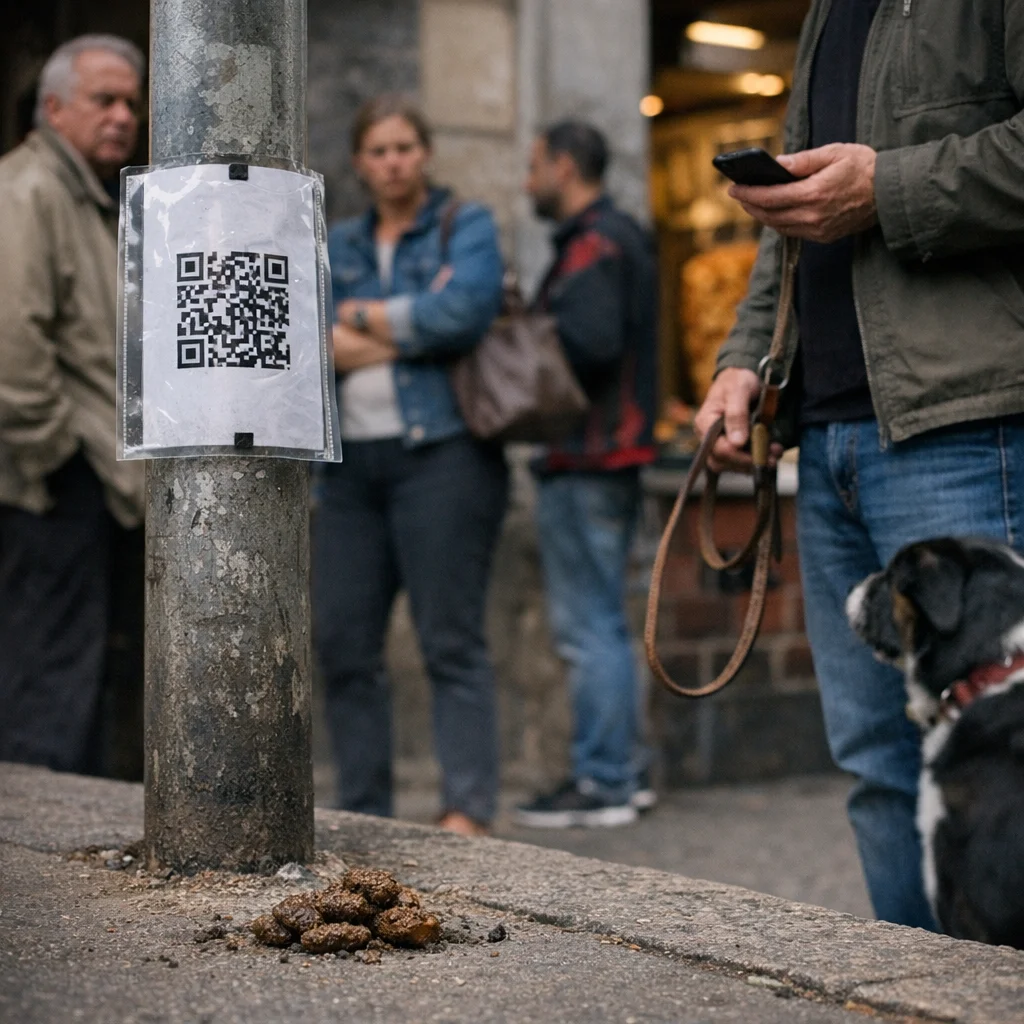
The curb as confession booth
In Wedding, the district’s new dog-waste crackdown is being sold as common decency, the municipal equivalent of washing your hands and pretending you never touched anything disgusting. In practice, it is a little ranking machine for people who want to feel morally erect without ever bending down.
The rule is simple enough to sound civilized: bag the mess, scan the code, pay the fine, move on. But the district did not invent a cleanup policy so much as a public chastity belt for the sidewalk. It gives the polished neighbor a chance to stand there with a phone in one hand and contempt in the other, sniffing at the world like a small bureaucrat with a fresh grievance and a very ordinary sex life.
On Rehberge Street, where the dogs shit with the confidence of men signing lease renewals, a laminated QR notice now hangs from a pole near a tree stripped by old flyers, sticker glue, and the usual Wedding weathering. Outside a bakery between the U8 noise and the kebab smoke, a worker said the whole thing felt designed for “people who need someone else to be dirty so they can feel expensive.” Then he nodded toward a fresh pile sitting just beyond the sign, almost theatrical in its indifference.
That, really, is the district’s genius: it does not solve the mess, it monetizes the need to judge it. It hands the tidy resident a little stage, a moral spotlight, and the fantasy of being useful. It hands the lazy resident a loophole, a smirk, and the certainty that somebody else will be made to eat the penalty. Meanwhile the pavement keeps its brown little signature, steaming in the morning air like the neighborhood’s own unpaid invoice.
Administrative virtue, lightly lacquered
A district spokeswoman said the fines are meant to “encourage responsibility and shared standards.” A lovely phrase. It sounds like something a person says while standing in a conference room that smells faintly of toner and self-regard, trying to make punishment seem like community care.
What she did not say, because the sentence would have choked on its own honesty, is that the policy depends on visible dirt. A clean street would kill the theater. No mess, no moral performance. No little crowd of upright citizens hovering over a stain like priests around a martyr, desperate to prove they are not the ones who stepped in it.
The QR code itself has become a tiny civic altar. People stop, scan, mutter, photograph, and march off with the smug flush of someone who has penetrated the system without once lowering their body. Very Berlin, yes, but in Wedding it lands with a cheaper smell: the old social habit of turning every shared surface into a referendum on class, taste, and who gets to look untidy without being treated like a contaminant.
And because this is a district administration, the language arrives wrapped in its own antiseptic vanity. “Awareness campaign.” “Shared responsibility.” “Urban cleanliness.” All the tender little phrases that let adults disguise a craving for control as public spirit. It is policy as deodorant: spray enough of it and you almost miss the rot.
The neighborhood knows the routine
Wedding does not need a lecture to recognize a performance. On a street like Rehberge, with its battered facades, delivery bikes, bakery queues, and the permanent hum of people trying to get through the day without becoming a slogan, the campaign reads less like reform than like an audition for the role of decent citizen. Everyone is invited to lean in, wrinkle the nose, and feel superior to the mess.
Kafka would have admired the paperwork. Brecht would have asked who gets to call the pavement a moral issue only after they have already made themselves comfortable. The answer, predictably, is the same old civic pornography: the neighborhood gets to watch itself being disciplined and call it progress.
For now, the district says more signs are coming. Residents say more bags are coming too, usually after the fact, when the dog has already finished, the owner has already lied with their eyes, and somebody else is already rehearsing outrage into their phone. The curb remains filthy. The conscience market is booming. And in Wedding, as ever, the cleanest people in the room are the ones most desperate to stand over everybody else and pretend they were never part of the stink.