Earthset’s First Video Is Great — If You’re an Astronomer, a PR Team, or a Man Who Thinks Panic Is a Content Category
Berlin’s newly “captured” end-of-the-world footage doesn’t prove the sky is falling so much as which institutions were ready with lighting, captions, and a sponsorship pitch.
Gentrification Symptoms & Pretend-Creative Economy Reporter
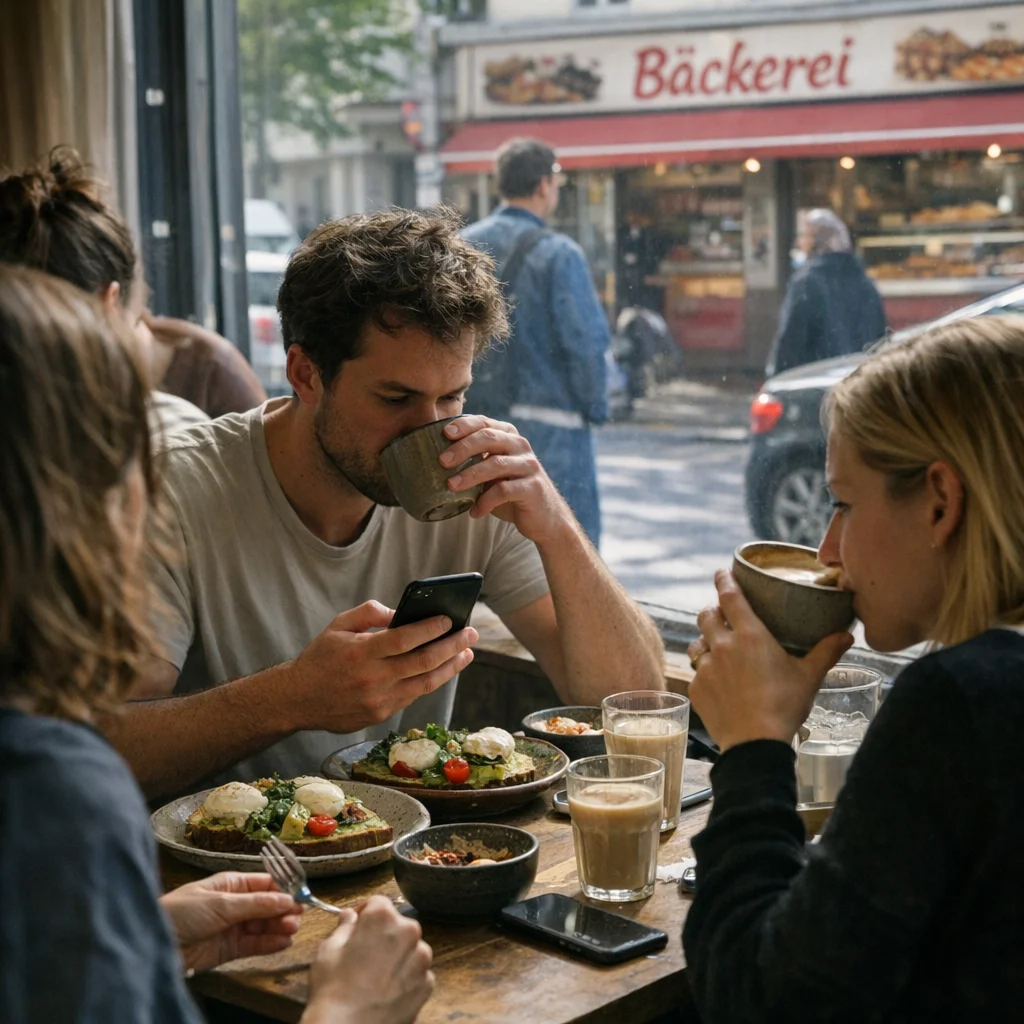
The sky didn’t fall. The branding arrived first.
At a packed Sunday brunch on Müllerstraße, the first course arrived with two things Wedding has learned to expect: saffron hollandaise and institutional denial. The room, a former Turkish grocery reassembled as a “neighborhood kitchen” with pendant lights and two fern plants pretending to be conscience, was full of people who came late, spoke in soft workshop language, and acted as if they had personally rescued Berlin by ordering poached eggs.
This is the class that moves into a district with tote bags, vocabulary, and a nervous little appetite for conquest. They do not announce themselves as colonizers; they call it “supporting local concepts.” They do not take over streets; they “help activate underused ground floors.” They do not displace people; they “contribute to a vibrant mix.” Every phrase is a condom for the truth.
The owner, Deniz Aydin, said business had doubled since the street got its first juice bar and its third “slow dining” concept, a phrase so polished it should come with a notarized lie detector. Nearby, a new brunch place called Müller & Miso was already advertising “community mornings” in a font that looked hand-drawn by someone who has never once waited for a bus in winter. Another café, Kiez & Crumb, offered “radical hospitality,” which in practice meant €19 toast and a room full of people who need to believe they are morally nude while fully dressed in inherited taste.
“People want to feel like they are saving the neighborhood while eating avocado from a ceramic bowl,” Aydin said. “They come hungry for eggs and leave full of themselves.”
That is the actual product here: not brunch, but self-forgiveness. The meal is just the garnish on a small empire of reassurance. Freelancers pretend they have offices. Couples pretend they have futures. One man in an art-school scarf explained that brunch is “democratic,” which is exquisite coming from someone paying luxury-rent prices for scrambled eggs and performing inclusion like foreplay. The whole room had the damp, overperfumed confidence of people who think being mildly left-wing is the same as not being dangerous.
The district office is “monitoring,” which in Berlin means performing paperwork at the scene of the theft.
The district office says it is “monitoring the spread of brunch concepts,” a phrase that belongs in a museum of administrative impotence. In Berlin, to monitor is to stand near an open wound with a clipboard and a municipal smile. Residents say the office has been “in conversation” with landlords and business owners, which is another way of saying everybody important is already speaking the same language: growth, activation, vibrancy, potential. The vocabulary is coordinated. The damage is not accidental.
A local butcher near the U-Bahn, whose shop is now shadowed by a place that serves kimchi scrambled eggs and calls its staff “hosts,” called the situation “a bad joke with good lighting.” He added that the people taking photos of their food “look like they’re being blackmailed by their own lifestyle.” He was being generous. They look like tenants in the final phase of consent.
Meanwhile, the district office’s favorite sentence — “We take concerns seriously” — hangs over Müllerstraße like cheap deodorant over a sweat stain. The landlords, naturally, prefer “neighborhood development.” The café entrepreneurs prefer “care.” The developers prefer silence, which is the cleanest language of all.
What gets renovated first is never the building.
The old places sold bread, coffee, and silence before noon. The new places sell belonging with a side of foam and a tiny sexual charge of moral superiority: a wink, a smile, a menu promising intimacy with the city while erasing the people who still live in it. Every brunch room in Wedding now feels like a private audition for innocence. The customers don’t just want breakfast; they want to be seen consuming the neighborhood without having to smell its history.
Even the real-estate language has become a sort of seduction routine. “Transitional” means expensive people are being bred for the area before the old ones are pushed out. “Up-and-coming” means a pensioner’s landlord has discovered enthusiasm. “Untapped potential” means a family business is about to be turned into a concept store with a plant wall and a cashier who says “hey, love” like a policy.
Walter Benjamin wrote about the city as a machine for memory; in Wedding, memory is now plated, filtered, and sold back by people who call themselves “community-minded” while tipping like auditors. The old social contract was blunt, cheap, and honest. This one is a frosted lie with a QR code.
And so the neighborhood keeps getting brunchified: one Turkish bakery becomes an oat-milk temple, one Späti becomes a “curated pantry,” one more pair of matching tote bags arrives to discover the area’s “energy” as if it were an untouched body. The district office will continue to monitor. The landlords will continue to smile. The café owners will continue to speak in the language of healing while cashing the check from eviction by ambience.
The rest of us can keep pretending this is about breakfast. But everyone involved already knows the real menu: a neighborhood slowly undressed, then eaten politely by people who insist they are only here for the eggs.