Economist Calls for Tuition Fees — Wedding Entrepreneurs Start Selling 'ECTS Licenses' for Café Chairs
What began as an op‑ed becomes a neighborhood business model: pay per plug, bid for a quiet table, and trade solidarity receipts in the marketplace of moral outrage.
By Lena Veneer
Gentrification & Cultural Displacement Correspondent
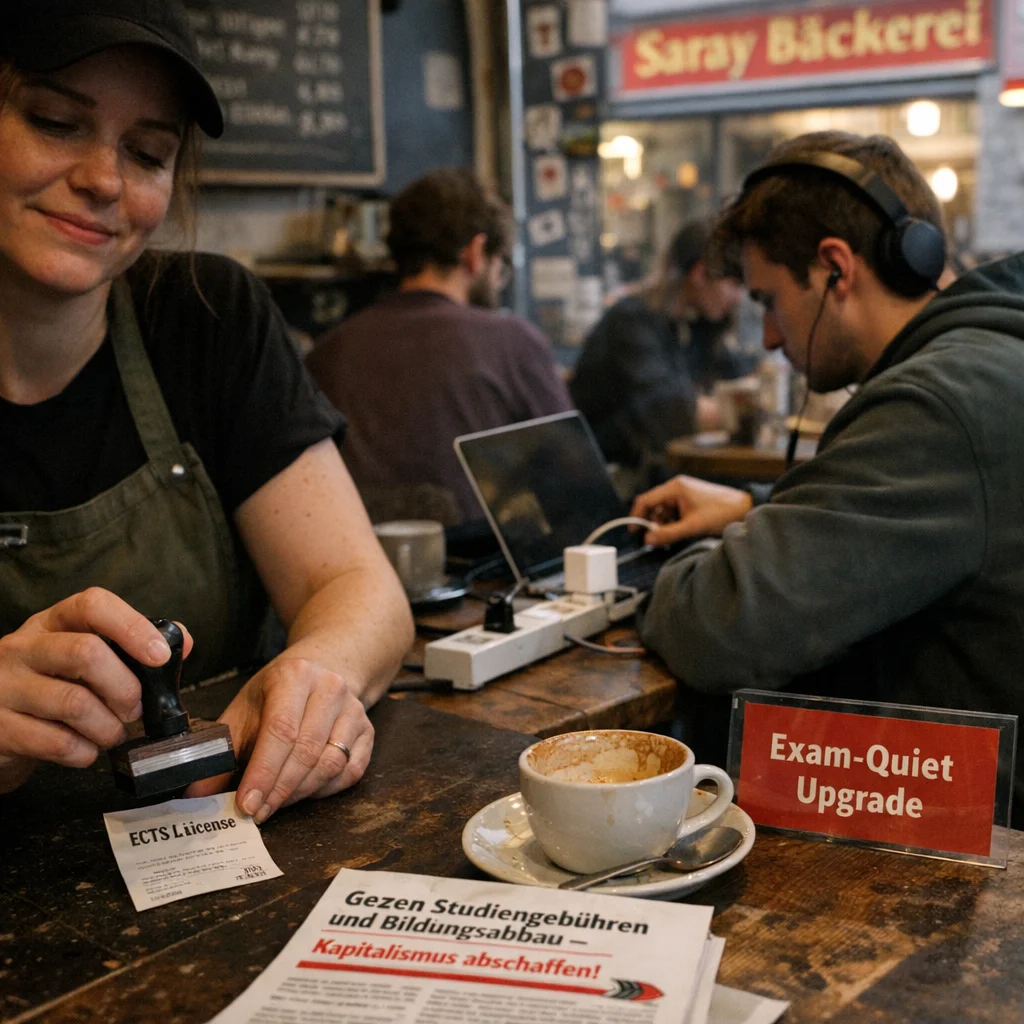
After an economist urged tuition fees — "Kunden oder Kommilitonen? Ökonom fordert Studiengebühren, Linke hält dagegen" — three cafés in Wedding quietly turned his op‑ed into a business model this week, charging students by the minute for what used to be free: a table, a power socket and the moral comfort of being seen to study.
What began Monday as an experiment at Café Miro near Leopoldplatz has already spread to two adjoining corners. For €0.75 per "ECTS‑hour" customers may plug in, log on and claim one of the café's laminated "ECTS Licenses." For €5, patrons get an "exam‑quiet upgrade" — a velvet panel placed behind their heads and a signed receipt that guarantees no one will interrupt you to ask for an extension on Kant. A €12 monthly subscription promises a guaranteed seat during peak hours and access to the backdoor power strip.
"We didn't invent tuition, we just merchandised misery," said Aylin Kaya, owner of Café Miro. "Students were already paying with their dignity for seats here. At least now the price is transparent." Kaya demonstrated the new receipt system: a cashier stamps a small paper with a code and the barista tucks a paper clip into a ledger. "It's micro‑commerce, micro‑ethics, same as everything else in the Kiez."
Local left activists were faster to name the offense than the entrepreneurs were to print loyalty cards. "This is the literal privatization of public education — one plug at a time," said Hakan Yildiz, spokesperson for the local Linke chapter. "They're turning comrades into customers. We'll be organising a solidarity bench with free multi‑sockets on Friday." Yildiz accused the cafés of "cultural extraction" and promised a pop‑up where attendees may donate receipts back to the community.
Bezirksamt Mitte declined to order an immediate shutdown but said consumer protection is monitoring the model. "Charging for ancillary services is permitted, but it must not be deceptive," said a spokesperson. Officials will examine whether the ECTS branding infringes academic trademarks and whether vending electricity constitutes a regulated trade.
Students reacted with a mixture of sarcasm and resigned compliance: some buy the hour, others trade solidarity receipts on a second‑hand Facebook group. One Philosophy student posted: "I paid €2.25 to be left alone to read Kant. My categorical imperative now has a surcharge."
The experiment has already produced predictable results: a shiny new line on the balance sheet, a leftist leaflet with an image of Bourdieu holding a power strip, and a district office email thread that will likely finish bureaucratically and unsatisfyingly. Inspectors are due next week; meanwhile the cafés plan to roll out tiered silence packages and a premium that guarantees no one will ask to share your charger — a backdoor arrangement some call pragmatic, others call obscene.
Either way, Wedding has found a new revenue stream: selling the illusion of academic focus, one socket at a time. Bourdieu would have called it cultural capital electrified; Kant would probably have asked for his Wi‑Fi password and a receipt.