‘Emergency Exit’ for the Demo Crowd
Wedding’s protest circuit has found a perfect compromise between outrage and careerism: loud enough to feel brave, polite enough to keep the grant money flowing.
Civic Hypocrisy & Neighborhood Compliance Reporter
The protest as a wellness product
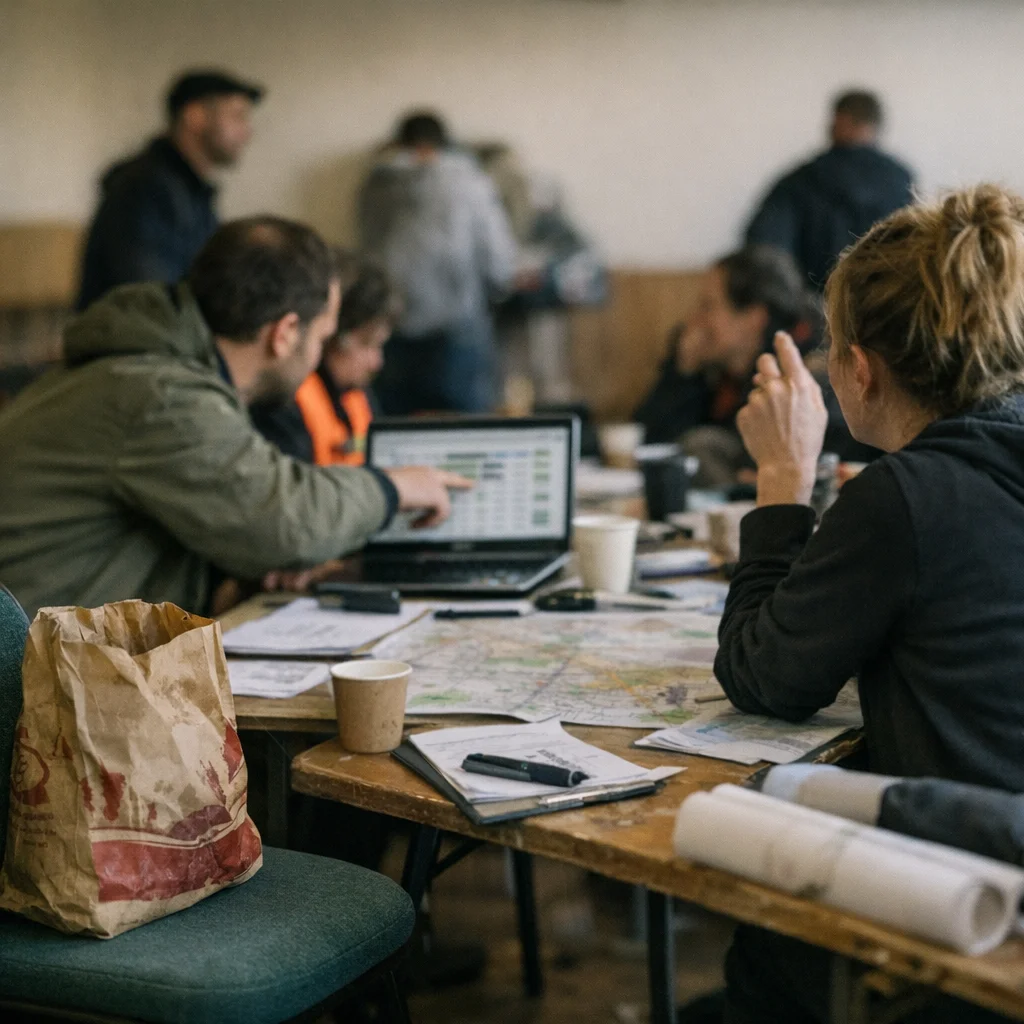
At a rented events hall off Müllerstraße, just far enough from Leopoldplatz to keep the smell of actual life at a tasteful distance, Wedding’s protest professionals spent Saturday morning doing what they do best: staging fury with the efficiency of people who bill by the hour. The room had the usual ingredients: former student radicals with the haunted eyes of converted accountants, NGO lifers in black trousers that still tried to suggest danger, municipal “dialogue” staff carrying the soft, bloodless confidence of people who have never been shouted at by anyone poorer than them, and a couple of newly arrived activists still under the charming delusion that sincerity is a political strategy.
First came the slogans, then the logistics, then the little bureaucratic caresses that keep dissent from ever touching the floor. A facilitator from a “neighborhood participation” project clicked through a deck about route safety, de-escalation protocols, and the preferred public tone, which turned out to be angry in a grant-compliant way. Someone from a climate coalition wanted more “edge,” meaning more posture. Someone else from a labor initiative demanded a “safer container,” meaning fewer surprises, fewer risks, and preferably no one who might ruin the vibe by sounding human.
By 11:30 the entire thing had the emotional density of a Senate workshop with a drum circle attached.
The grant language of moral hunger
The room spoke in the dialect of public funding: “stakeholder engagement,” “community resilience,” “visible amplification,” “low-threshold access,” “process orientation,” “intersectional safety,” “capacity building.” Every phrase arrived wearing deodorant. Nobody said they wanted to look brave; they said they wanted to “create a stronger narrative.” Nobody said they feared irrelevance; they said they needed “better outreach.” It was as if the old language of politics had been scrubbed clean by a municipal janitor and left to dry on a radiator in an office on Müllerstraße.
A woman with a severe bob and the exhausted glow of someone who has made a career out of being morally available to committees explained that the march needed to feel “confrontational but manageable.” She wore silver rings, practical boots, and a jacket that looked deliberately lived-in, the sort of outfit that says I reject bourgeois comfort while quietly demanding to be seated near it. Across the table, a man with a carefully unshaven jaw and a tote bag from a left bookshop nodded with the hungry solemnity of someone trying to be desired by history.
That was the real subtext of the room: not politics, but courtship. Everyone wanted to appear hard while remaining employable. Everyone wanted to be seen as dangerous without risking the social perks of being around danger. The radical vocabulary was doing the same work as expensive skincare: concealing damage, promising youth, and begging not to be touched too roughly.
Brecht with a printer budget
“We need to keep it confrontational, but in a way the district can support,” said Nadine Berg, who works for a neighborhood dialogue project and asked not to be named because her employer likes its rebellion pre-approved and laminated. “If people feel too much, they stop showing up. If they feel too little, they stop donating.”
There it was, the whole ideology in one polished sentence: outrage as retention strategy. The old appetite for risk has been replaced by a curated inconvenience, like a Fassbinder set redesigned by a municipal communications team. Everyone wants the heat, none of them wants the smoke on their clothes. They want to look like they’ve spent the night on the barricades while still making it home in time to answer emails and moisturize the face that will someday explain the struggle on a panel.
The irony is that the loudest anti-system people in the room were often the most committed to system maintenance. The NGO veterans knew how to turn anger into application language. The municipal staff knew how to translate rage into “dialogue formats” and “participation pathways,” which is just bureaucracy with a conscience and a better haircut. The ex-radicals knew that principle is expensive and bad for the back. Even the younger organizers had learned the new trick: say the right thing with enough grim sensuality to sound dangerous, then pass around the QR code for the mailing list like it was an after-hours room key.
The body of the movement
One organizer, sweating through a linen shirt that looked costly enough to finance a small work stoppage, insisted the goal was to “keep the pressure on.” In practice, that meant a route with no embarrassing corners, a speech list with no unruly mouths, and a safety team positioned like a nervous conscience around every possible bad optic. Their wardrobing was almost comically disciplined: black, blacker black, and the occasional carefully distressed jacket chosen to imply that comfort had been renounced, not merely purchased in a more expensive district.
The bodies in the room did a lot of the talking. A clenched jaw here, a wrist flick there, a hand resting too long on a laptop as if the device might kiss back. The organizers kept adjusting scarves, collars, and the angle of their shoulders, each one trying to appear more uncompromising than the next without ever looking like they’d missed lunch in a way that might lower their social rank. Their politics had the faint eroticism of people who want to be admired for suffering but only if the suffering is photogenic and does not interfere with their sleep schedule.
And yet the hierarchy was obvious. The people with the best German and the cleanest outrage got to speak first. The people with the most polished trauma got to name the tone. The people with the most precarious status got instructed to be grateful for “inclusion” while carrying the folding chairs.
Outside, a Turkish bakery on the corner kept selling sesame rings to people who would later describe the neighborhood as “in transition” with the smug, anesthetized expression of someone asking for oat milk and absolution at the same time. Inside, the movement kept flattering itself that it was building pressure from below, when in fact it was mostly building a reputation management system for middle-class conscience.
The emergency exit, always visible
By late afternoon, the group had agreed on a march theme, a media line, and a list of values no one decent could object to without being made to look like a villain. The first police liaison call was already booked. So was the debrief. The only thing still unresolved was whether the outrage should look spontaneous or merely very well managed.
That is the moral genius of Wedding’s protest circuit: it knows exactly where the emergency exit is, and it has the indecency to call that survival. The room leaves with its tote bags, its moral posture, its grant vocabulary, and its small private fantasies of importance intact. Nothing breaks except the illusion that any of this was ever meant to.