ER Speed Date: Who Gets Triage First?
Berlin’s emergency rooms are packed with people treating triage like a first date, a status audition, and a free confessional while doctors sort real danger from dramatic thirst.
Administrative Grief Correspondent
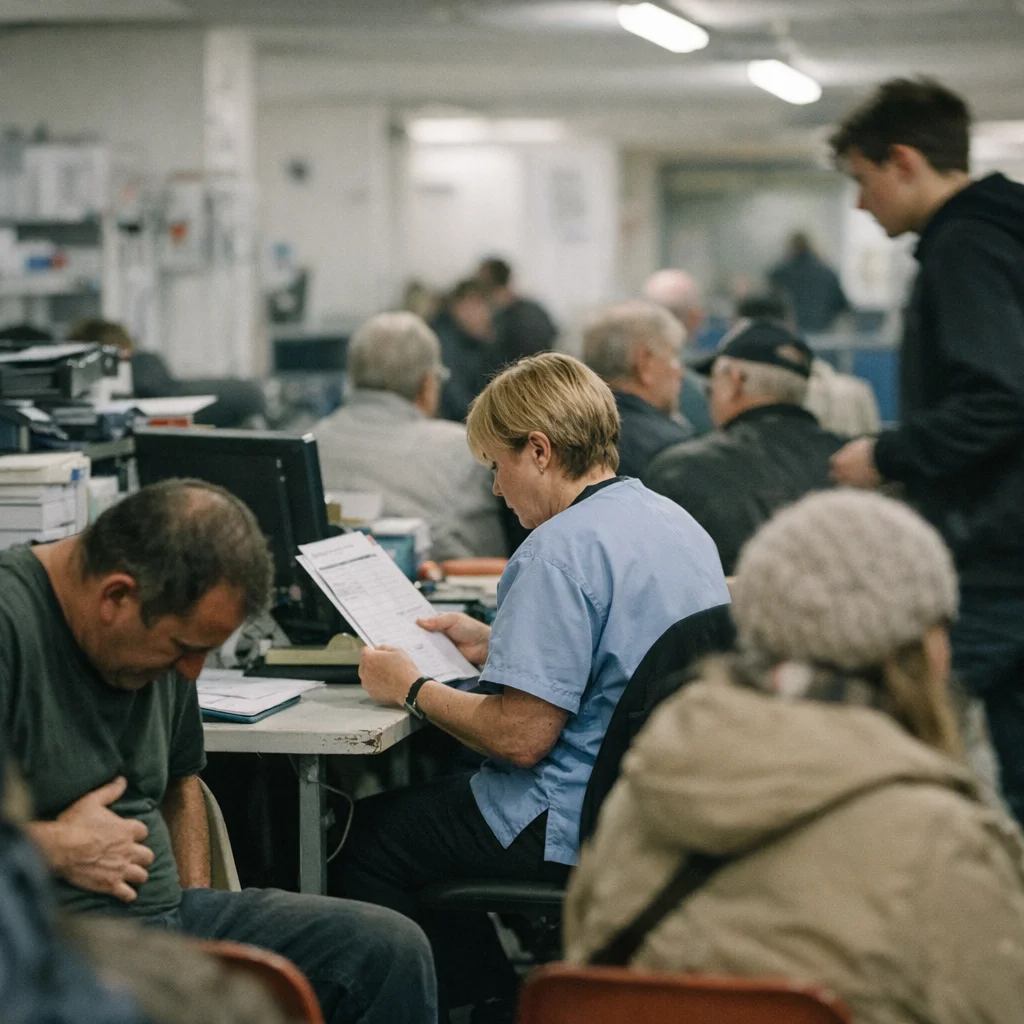
Berlin’s emergency rooms are packed again, and the line outside the Rettungsstelle at the Virchow campus looks less like medicine than a municipal meat market with better lighting. By midmorning, people were already presenting themselves with migraines, panic, chest pain, a rash, a torn ligament, and the kind of emotional collapse usually reserved for bad hookups and worse tax returns. The Bundestag is set to vote on a reform of emergency care on Thursday, but in Wedding and beyond the system is already running its own obscene audition: who gets admitted, who gets handled, who gets left cooling in the chair while someone louder gets the first touch.
That is the real triage fantasy now. Nobody says it out loud, but everybody behaves as if the emergency room were a speed date with a licensed groper at the end of it: show enough distress, angle the right way, make your need look flattering, and maybe the institution will choose you before it chooses the next body in the queue. The sick come in hoping for treatment. The entitled come in hoping for attention. The administrators come in hoping the paperwork can do the touching so nobody has to admit how degraded the whole ritual already is.
At one entrance, a man in his twenties clutched his stomach and apologized for taking up space, which probably made him more triage-worthy than half the city. Behind him stood a woman in a wool coat who said she had come because her general practitioner was “too booked” and she wanted “someone to really look at me.” In any other district, that might sound like a complaint. In Berlin, under fluorescent lights and budget discipline, it landed like a résumé line. Nearby, a startup founder with red eyes insisted he had “a medical urgency and a narrative burden,” which is exactly what happens when a city raises people on self-branding and then acts shocked when they present their suffering like a pitch deck.
“The public thinks the waiting room is a place where need speaks for itself,” said Dr. Lena Mertens, an emergency physician who requested anonymity because management treats every honest sentence like a staffing problem. “It’s not. It’s an auction with blood pressure cuffs. Everyone is trying to be selected without looking desperate, and the people in charge are pretending that makes it orderly.”
That is Berlin’s class arrangement in miniature. The long-time Wedding residents arrive already humiliated by the fact that they have to be there at all: Turkish grandmothers with knees worn down by decades of work, delivery riders with wrists held together by tape, pensioners who have learned the city will let them ache politely until they stop being convenient. They sit still. They do not perform. They know the game is rigged and therefore save their energy for surviving it. Then come the newcomers, pacing the corridor like they are waiting to be chosen in some grotesque little intimacy pageant. The expat crowd brings earbuds and self-importance. The wellness crowd brings concern language and the delicate panic of people who have never had to be ordinary in public. The reform crowd brings charts.
And the reform is where the real indecency lives. Officials keep talking about “steering patients to the right level of care,” which is bureaucratic speech for deciding who is worth touching and who can be kept waiting until their need becomes less embarrassing for the budget. Insurers call it efficiency. Ministry people call it modernization. Hospital managers call it throughput, as if a sick body were a pipe and not a person trying not to fall apart in a corridor.
Meanwhile, the waiting room keeps doing what the system has trained it to do: turn distress into courtship behavior. A man with a swollen ankle keeps repositioning himself so the desk can see how much it hurts. A woman with a fever rehearses the phrase “it’s probably nothing” because modesty still passes for credibility in this country. Two teenagers arrive together, one pale and one furious, each trying to prove they are the more urgent case without saying so directly. Even the silence has competition in it. Even the coughing sounds like a bid.
The hospitals say the overload is not just winter flu and bad luck. It is also the collapse of every place people used to go before the city decided the emergency room could absorb all the damage: no appointments, no therapists with openings, no neighborhood care that still remembers your name, no primary system sturdy enough to catch the fall before it becomes a spectacle. So people come to the ER wanting relief, yes, but also wanting validation, urgency, absolution, and the fantasy that someone official will finally choose them with conviction. They arrive half-broken and leave with a wristband, a number, and the degrading lesson that public care is not a romance and never was. It is closer to being appraised under bright lights by people who have learned to ration tenderness like a scarce drug.
The reform may change the forms. It will not change the appetite of a city that treats attention like a scarce lover and access like a privilege earned by looking sick enough, needy enough, or important enough. In Wedding, as in the rest of Berlin, the promise of care ends exactly where the hand reaches out, hesitates, and decides which body gets handled first.