Ex-DDR Man Still Won't Come After 37 Years
While politicians and schoolkids celebrate the peaceful revolution at official events, the Neubrandenburg native tells onlookers the Wende delivered empty promises that never quite delivered satisfaction.
Morning Economy & Cultural Friction Reporter
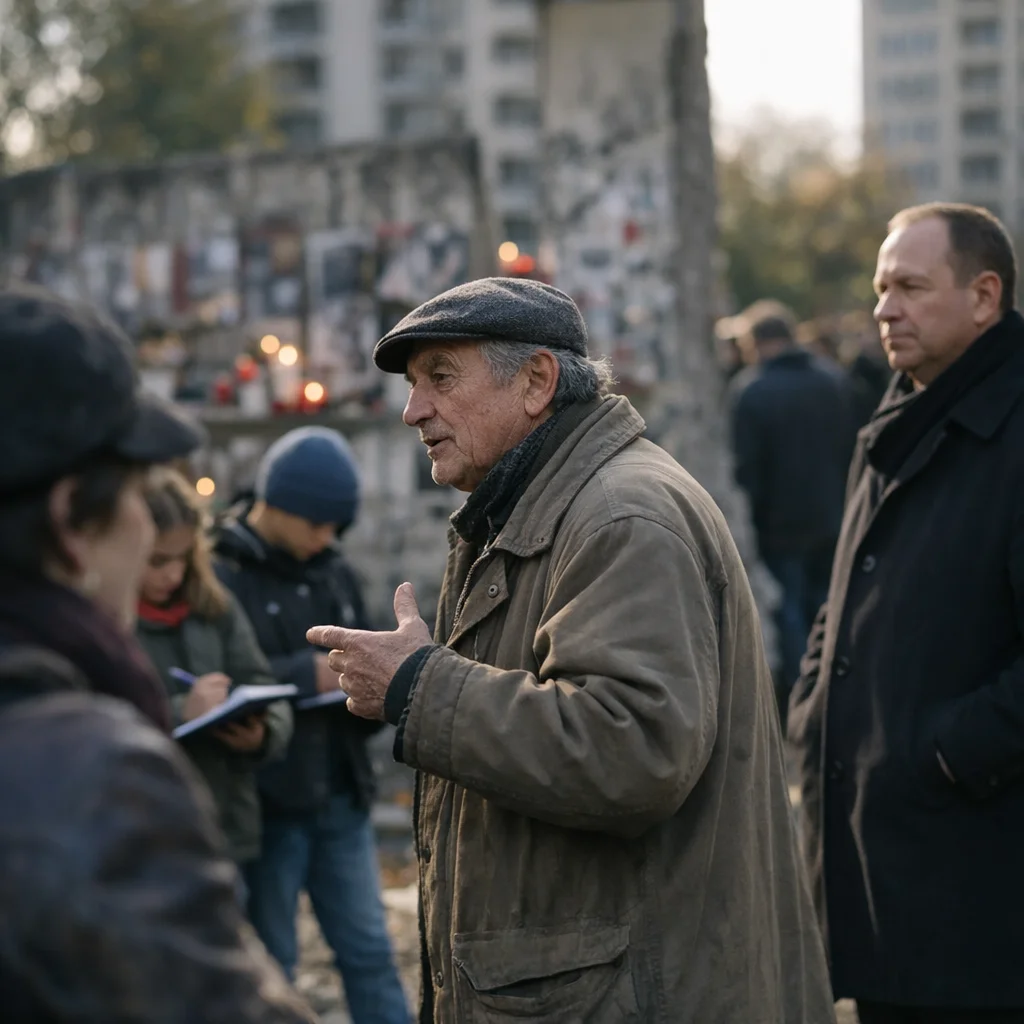
At Berlin’s 37th Mauerfall commemoration, the stage was arranged for the usual civic massage: candles, school choirs, and a row of officials trying to look humble while standing under banners paid for by the same state that has spent three decades congratulating itself for surviving its own amnesia. Then a former East German man from Neubrandenburg, posted at the edge of the crowd like a man who had already been processed by history and found the service lacking, said the part the ceremony could not absorb: the Wende came with promises, and the promises did not exactly keep their end of the bargain.
He was not there to vandalize the event. He was there to embarrass it. While students rehearsed the approved sentences about freedom, opportunity, and a future finally unbuttoned, a district official from Mitte stood beside a spotless exhibition panel and repeated the holy trinity of reunification marketing — democracy, prosperity, open horizons — as if saying it with a microphone made it true. The line landed with the soft thud of every public apology delivered by people who have never had to live with the invoice.
The man, identified by organizers only as a former DDR citizen after he declined to give his full name and be drafted into another round of official usefulness, told listeners that reunification had been sold like a promotion and delivered like a downgrade with better packaging. In his telling, the West arrived not as salvation but as a salesman with a tie, a smile, and a contract no one in Neubrandenburg had been allowed to read.
“It was advertised like a new life,” he said. “For some people it was a promotion. For the rest of us it was a bill with better branding.”
That line moved faster than the speeches because it was the first thing in the square that did not smell like committee air. Around him, the ceremony’s professional mourners — the civic class that lives off commemorations the way other people live off rent supplements — kept nodding through the usual pageant of redeemed dictatorship, as if the collapse of one state had automatically certified the moral innocence of the next. A pair of district employees in matching coats hovered near the memorial display, checking phones and pretending not to hear the man say what every official event in this country spends money not to say.
A spokeswoman for the commemoration committee said the program was intended to honor peaceful change and “the courage of ordinary people,” though she admitted some visitors came for a more complicated accounting. That accounting was visible by the edge of the square: the students taking notes because they had been assigned memory; the politicians taking photos because they had been assigned relevance; and the former East German man, standing there with the posture of someone who had learned that freedom can be very generous to the people who owned it first.
A teacher from Wedding, who brought her class after a lesson on dictatorship and resistance, said the ceremony felt different once the speeches ran into an actual witness. “The official version always sounds clean,” she said. “Then one person says what happened to housing, work, pensions, and dignity, and suddenly everyone looks like they’ve just been caught adjusting their tie in the mirror.”
By early afternoon, the man’s comments had done what official remembrance rarely manages: they made a room full of satisfied adults defend a revolution they had turned into a civic perfume. The program was set to continue next year, with more candles, more schoolchildren, and likely more speeches from people who mistake applause for proof. The Neubrandenburg man said he might come back too.
“Maybe the promises will show up by then,” he said. “I’d like to see who’s still clapping when they do.”