Four AM Alchemy: How Wedding’s Wellness Influencers Turn Grief into Cold-Pressed Juice
A local guide to breathwork with a payment plan, matcha in mason jars, and the slow gentrification of spiritual crisis into content.
Wellness Performance Correspondent
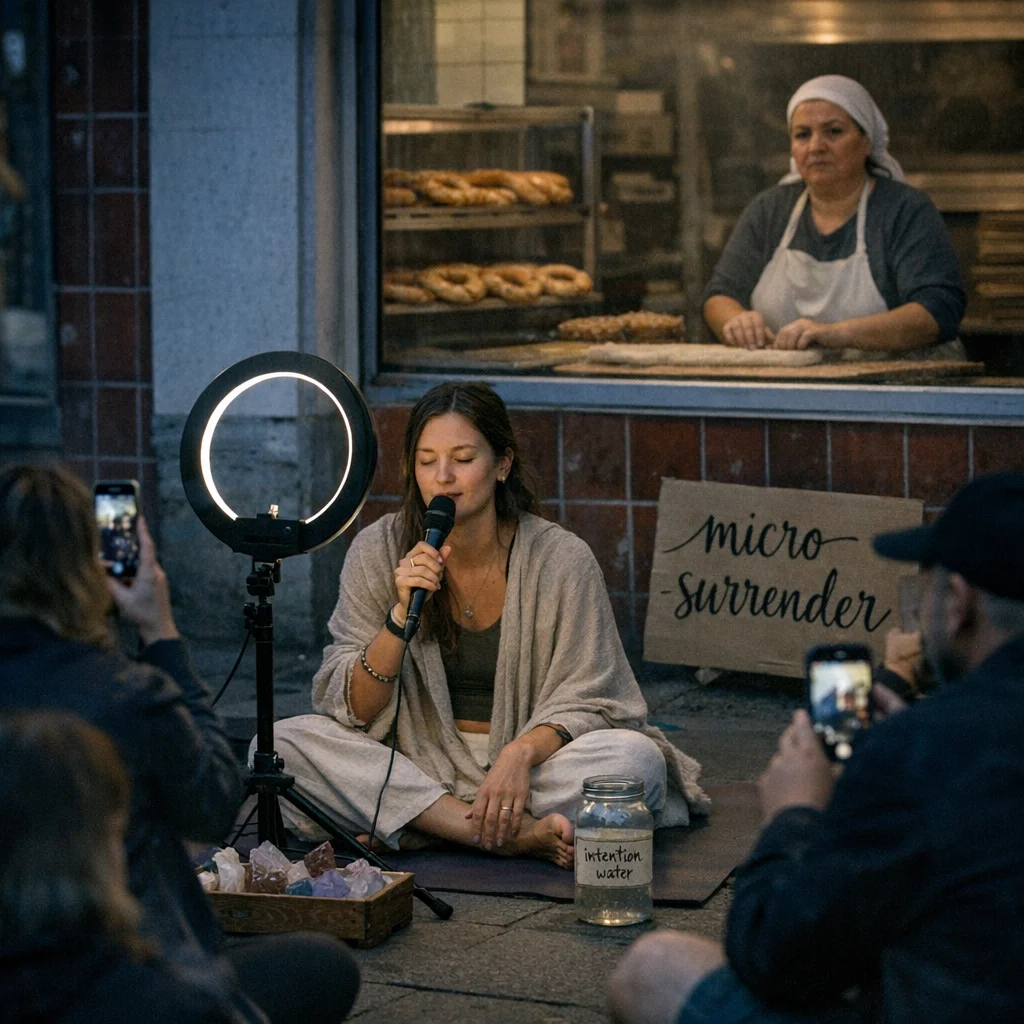
At 4 a.m., before the tram has decided whether it’s late or existential, an altar is set up on the sidewalk: a ring light, a hand-lettered sign that reads "micro-surrender," and a crate of ethically sourced sage that smells faintly of indigestion. The altar is righteous, portable, and—critically—Instagrammable.
This is Wedding's newest export: performative wellness. It arrives in three forms: low-budget ritual, mid-range subscription, and premium retreat disguised as civic improvement. It looks like an earnest yoga pose on a cobblestone street and sounds like an ASMR video made by someone who once studied philosophy for eight semesters and now sells breathwork for 45 euros an hour.
The product is authenticity
Influencers—self-titled "somatic facilitators"—have converted everything from empty storefronts to ex-döner counters into temples. One recent pop-up on a side street advertised a "grounding session with lemon water" in front of a Turkish bakery. The owner, who runs a simit stand out back, stayed put, rolling pastry as a woman in a flowing blouse explained how to "let go." A tourist with excellent posture filmed both of them. The shot made the facilitator look transcendent and the bakery look like quaint set dressing.
Their instruction is consistent: breathe deeply, feel your feelings, and then buy the three-month accountability bundle. The bundle includes a personalized affirmation, two class passes, a tote bag, and access to a Slack where nobody posts unless paid to mourn collectively.
Content before care
Everyone involved knows the grammar of the thing: good light, complementary fonts, and a before/after carousel that promises measurable interior renovation. The metric is engagement, not relief. A session’s success is judged by how many people comment "so emotional 😭" under a sponsored post. If the tears are real, that's incidental. If they’re strategically timed for the 30-second reel, all the better.
This is a Debordian spectacle (an Easter egg for the self-consciously literate): disappointment is now something to witness, monetize, and hashtag. Walter Benjamin’s flâneur would have loved it—except now the flâneur is live-streaming his own melancholy while selling guided meditations.
Who benefits, who pays
The facilitators are mostly new to the neighborhood—people who moved for "community" and stayed for lower rents and available façades. They’re earnest, underfunded, and excellent at turning a midlife identity crisis into an Instagram series. They rent the storefronts for three months, call each pop-up "research," and leave when the rent jumps or the next festival needs a themed installation.
Longtime residents—the Turkish families, the pensioners, the folks who measure time by the smell of fresh bread—get the short end of the lit candle. A grandmother who has fed three generations from a neighborhood bakery watches as an altar appears across the street for two weeks, offering "energetic clearing" for 35 euros. The grandmother charges 1.50 euros for a simit and looks like realism in a soft cardigan.
The language of healing is a convertible
The rhetoric is borrowed from philosophy, wellness tropes, and whatever academic essay happened to be fashionable during someone’s degree. You'll hear "embodiment," "presence," and occasional references to Foucault in the same breath as product placement. "We’re just offering tools for authentic living," they say, while enabling recurring payments and shipping crystals.
Sometimes the language gets hilariously highbrow. One pop-up advertised "a Heideggerian guided descent into Being (BYO notebook)." The crowd loved the sound of it and took photos of their notebooks mid-emptiness. A Proustian madeleine moment now includes oat milk and a QR code.
The economy of surrender
It’s not malicious—more a civic metabolism. Old structures are inefficient; new ones are lean, monetized, and optimized for content. A Späti is replaced by a juice bar that offers "intention shots." A döner shop becomes a breathwork studio that hosts grief circles on Thursdays. Both models promise salvation in different currencies: one in calories, the other in likes.
There is, however, a hard-to-swallow truth: spiritual services are being priced beyond the earning capacity of many locals. When the facilitator says "open your heart," they mean open your wallet. When the therapist says "lean into discomfort," they mean the discomfort of another month's rent.
Small resistances, stiff applause
Some Wedding residents resist with quiet satire. A damar music teacher organizes a "realness hour" where people can sit with unpaid bills and be listened to for free. It’s messy, loud, and impossible to monetize—therefore it rarely trends.
Other pushback is performative in its own right: a local Kreuzberg transplant staged a "sound bath" with a malfunctioning speaker and charged for entry so people could complain about the acoustics in a way that read like authenticity. It worked. They sold out.
What to do next
If you live here and feel uneasy, you’re either being colonized by commerce or you're part of the colonization plan, and there’s no shame in either—it’s capitalism’s cardio. Practical options: keep patronizing the places that actually feed people (literally and figuratively), reclaim public benches for collective noise-making, and remember that not every feeling needs a facilitator with a brand kit.
If you’re an influencer: try offering something practical once in a while. Teach a class on fixing a leaky faucet. Penetrate the bureaucracy with a toolkit. It’s a deeper kind of engagement and—bonus—not hard to swallow.
Wedding has always been a collage—layers of labor, language, and love. The new gloss might look nice in a photograph. But a photo only captures light. The work of a neighborhood is quieter, slower, and usually unpaid.
So take the breathwork. Take the juice. Take the photo. But if you’re really seeking change, start by listening to the simit seller. Sometimes the wisdom you need is cheaper than a monthly subscription and considerably more filling.
(Also: don’t leave your crystals near radiators.)