Futures Traders Drop Climate Funds, Add “Carbon-Neutral” Night at Kitkat: Same Drugs, Different Spreadsheet
As Wall Street cools on climate investing, Wedding’s ESG crowd proves you can still feel virtuous while sweating on synthetic leather under LED trees.
Späti Macroeconomics & Local Delusion Reporter
Capitalism Finally Learns the Weather Is a Liability
Wall Street is reportedly walking back its climate enthusiasm, which is brave: few industries have the moral courage to admit, “Actually, the ocean can take care of itself.”
In Berlin, this has been received as a spiritual calling—like a brief, confusing message from Marx’s ghost that simply reads: sell. And in Wedding, where moral positions are often rented month-to-month, the response has been immediate and sticky.
The Great Pivot: From “Save the Earth” to “Save My Portfolio”
Last year, a rotating cast of asset-management interns and “impact founders” treated climate finance like a hot new kink: consensual, talky, and performed mainly for other people. Now the mood has shifted. ESG, once whispered like an intimate promise in a coworking kitchen, is being put back in the drawer with quinoa-based skincare.
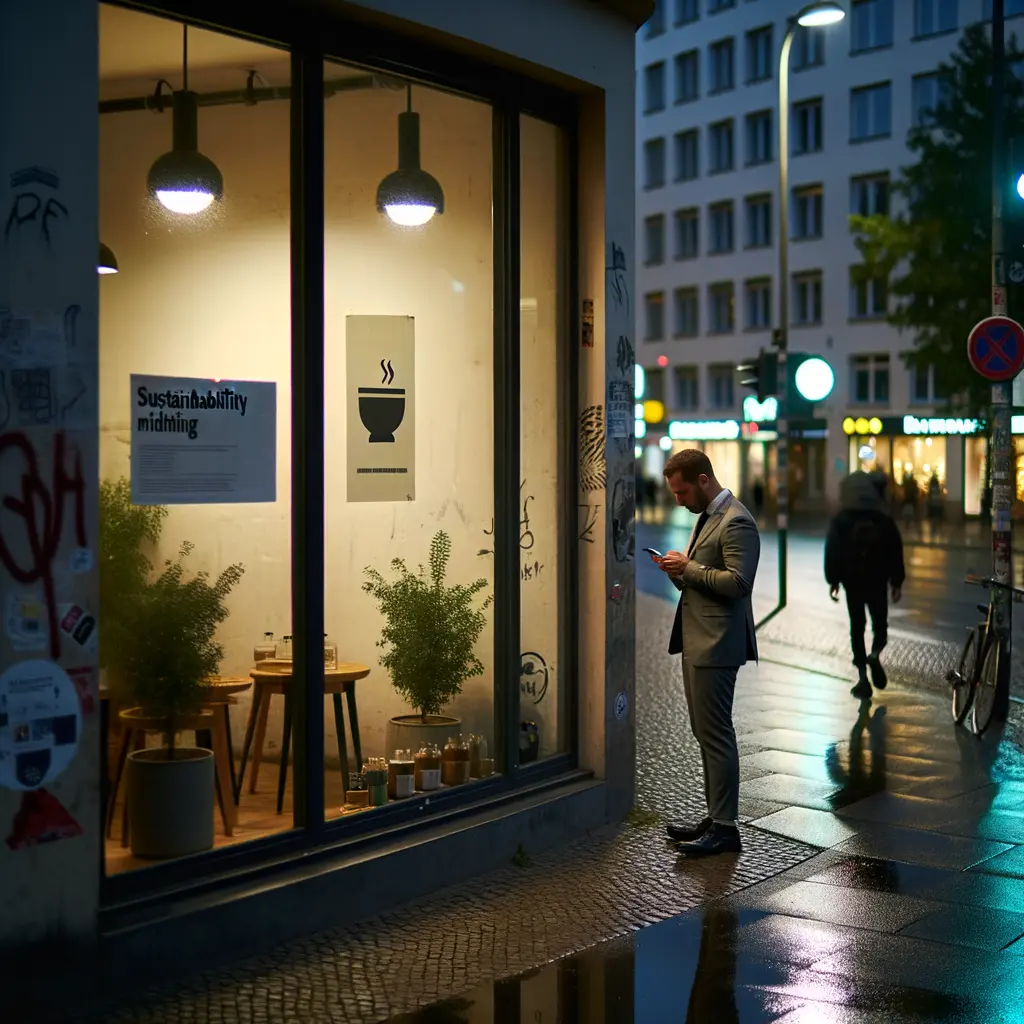
At a café off Wedding’s busy strip—half coffee bar, half meeting room, half unlicensed confessional—one investor summarized the new ethos between sips of ethically sourced espresso:
“I still care about the planet. I just can’t stomach underperformance.”
Hard to swallow, sure. But Berlin has practice.
Wedding’s Local Translation: If You Can’t Fix It, Monetize It
In practical terms, this has produced a very Wedding-specific form of climate abandonment:
- A Turkish-owned greengrocer quietly replaced “regional” signage with “whatever isn’t rotting,” achieving an honesty Berlin considers revolutionary.
- A backyard upcycling studio switched from repairing old furniture to “curating vintage decay,” charging triple for scratches with a narrative.
- Multiple tenants who used to argue for heat pumps have now argued for “heat pumps… but only if it’s subsidized and doesn’t make a sound.”
No one wants to do the work of planetary rescue. They want to be seen holding the clipboard.
Meanwhile, at Kitkat: ESG Goes to the Darkroom
Predictably, the nightlife industry responded with innovation—the kind that looks profound at 4 a.m. and becomes mortifying by lunch.
Kitkat promoted a special night described by organizers as “carbon-neutral sensuality,” an idea that penetrated Berlin’s collective brain with frightening ease. Guests were encouraged to:
- arrive by public transit (or a taxi shared with six strangers and one emotion),
- “offset their emissions” via a QR donation, and
- dance under a decorative potted ficus dubbed “Gaia.”
Nobody confirmed whether the ficus survived.
At the door, one bouncer reportedly rejected a finance bro in sustainable sneakers because “the look is too interested in the future,” which in Berlin is basically porn.
Görlitzer Park Remains the Only Market That Doesn’t Lie
While climate capital retreats into “responsible ambiguity,” Görlitzer Park continues functioning as Berlin’s most transparent exchange: cash for chemicals, no virtue premiums, no quarterly sustainability report. You buy what you buy. Nobody pitches it as world-saving.
A Wall Street-style rethink would only be honest here:
“We used to believe in green. Now we’re diversifying into denial.”
That’s not policy; that’s just adulthood.
Walter Benjamin Would Hate This, Which Means It’s Definitely Happening
Somewhere in Wedding, an arts grant proposal is being drafted right now comparing ESG to Baudrillard’s simulacra: a copy of morality with no original attached. Investors can back away from climate change, but the brand will live on—like a remix that outlasts the song it ruined.
Berlin will keep holding panels about saving the world while actively arranging a world that needs saving. That’s the whole cultural product: a city that can turn collapse into a lineup.
Wall Street turned its back on climate.
Wedding simply adjusted its posture—then charged admission.