Golden Suit, Sweat Foot: Skarsgård Breaks Men’s Dress Code
Alexander Skarsgård keeps showing up in outfits that look expensive, cocky, and faintly damp, forcing fashion men to defend their rules like priests guarding a collapsing altar.
Gentrification & Small-Time Power Correspondent
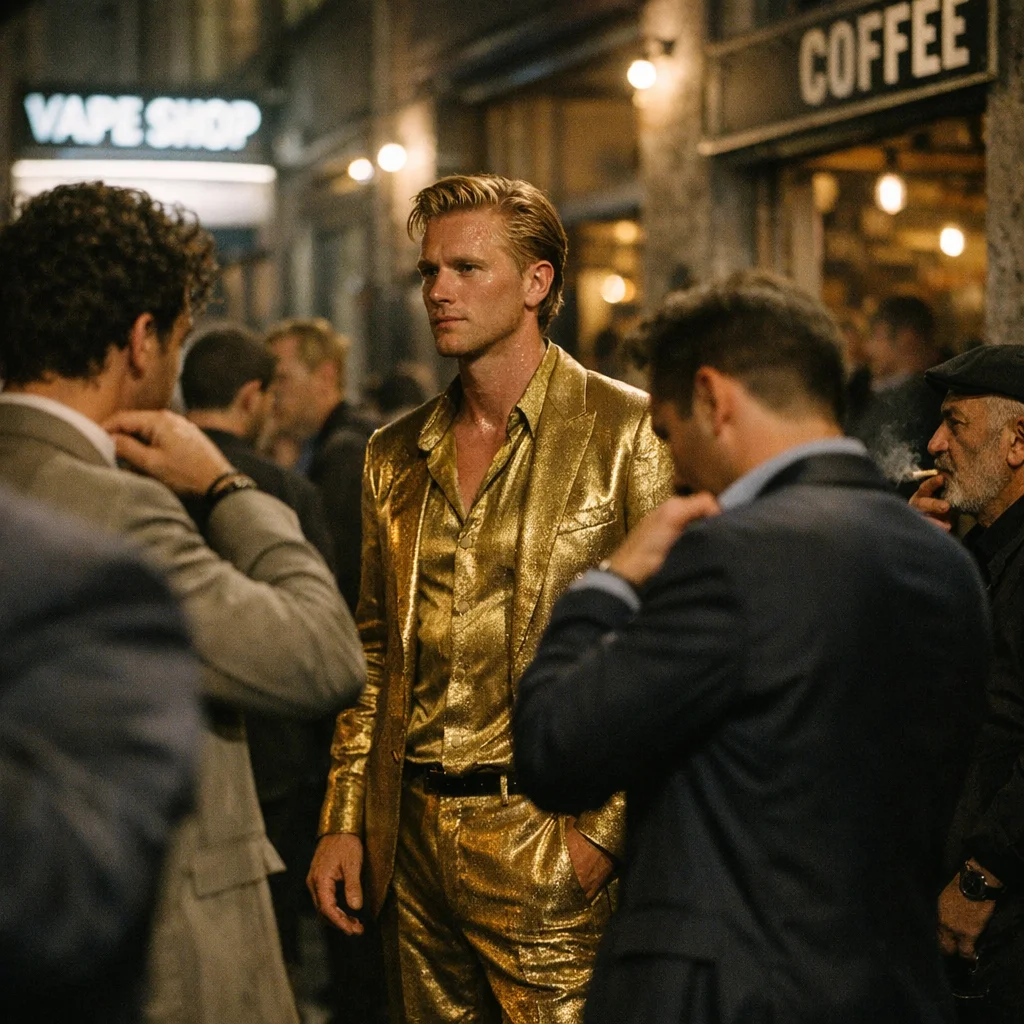
Alexander Skarsgård’s gold suit had the kind of fit that makes men in Wedding remember they have bodies and immediately resent the fact. At a launch party inside a renovated factory by the canal, the usual coalition of Berlin’s creative middle managers — startup men with sad wrists, fashion freelancers on deadline, brand consultants who talk about “edge” the way priests talk about grace — watched him arrive in something expensive, predatory, and faintly sweaty, as if the fabric had been tailored to the exact circumference of his confidence and then tightened one inch too far on purpose.
That is the real service the room was paying for. Not style. Not taste. A public demonstration of who gets to be held together by a costume and who has to keep adjusting himself all night like a man trying not to split open. The gold suit did not merely fit Skarsgård; it took him in. It sat on him like an entitlement with seams. Every time he moved, the room got a fresh reminder that in this city masculinity is sold as a wellness product, rented by the hour, and rebranded as “effortless” after three layers of deodorant and panic.
By the time the first photos hit phones, half the men in the room were touching their collars with the haunted concentration of people checking whether the evening had already exposed them. The other half were pretending not to care while caring so hard they could have cracked enamel. That is the local dress code for the male creative class: one part irony, one part debt, one part armpit-level fear. They dress like they are above desire, then spend the whole night looking like they have been priced out of it. Skarsgård, who wears clothes as if he is testing what they will allow, made the whole ritual look flimsy. He did not accessorize the room. He entered it and pressed every soft thing into shape.
“They sell you manhood here like it comes in sizes,” said Cem Aydin, who runs a nearby menswear repair shop and requested anonymity because he had once sold a startup founder a belt that could not survive a squat. “Then this guy shows up in gold and looks like he has never needed permission from a seam, a banker, or a man with a podcast.”
Aydin pointed toward the factory entrance, where a line of men in expensive neutrals kept drifting into the doorway to be seen without admitting they wanted to be seen. “That’s the problem,” he said. “They want the suit to hold them in. They want the silhouette to do the work. Then somebody comes in wearing something that should be illegal in daylight and suddenly everybody’s posture collapses.”
Outside, beneath a vape shop sign and the glow of an English-language café menu, the commentary got even more instructive. An expat designer said Skarsgård had “freed the male silhouette,” which is what people say when they are too ashamed to say they want to be desired and too vain to say they want to be handled by the room. A local resident waiting for the M13 shrugged and called it by its plain name: “He looks like a man who got dressed by power and did not apologize for the grip.”
That was why the fashion men were unsettled. Not because the suit was loud. Berlin can tolerate loud if it is underfunded and self-aware. They were upset because the look worked as domination. It made their house rules sound like housework. It made restraint look like a flaccid moral preference. It made the district’s young creative class — those exhausted missionaries of understated luxury, forever insisting that the correct amount of attraction is none at all — seem less like arbiters of taste than men who had paid a premium to keep their own desire at a safe bureaucratic distance.
The city’s male peacocks split quickly into camps. The old guard called it vulgar, as if they had not spent ten years monetizing vulgarity under better lighting. The new guard called it subversive, which is what rich men say when they are relieved somebody else has agreed to perform appetite in public. Both groups were lying. What they meant was simpler and more humiliating: he wore the thing like he deserved the room, and they did not. He let the suit sit on him like an arrangement of power, while they stood around trying to negotiate with their reflections.
By midnight, a few of the most doctrinaire dressers had loosened their ties in the bathroom mirror and stared at themselves with the defeated tenderness of men realizing their own uniform was a costume with a shorter shelf life. One brand consultant posted a black-and-white photo of himself looking severe in the corner of the venue, as if severity were a form of resistance and not just a way to hide the fact that he had been outshone by a man in gold. Another deleted two Instagram stories after noticing his shirt had started to cling in the underarms. The sweat did what the styling could not: it told the truth about who was carrying the evening and who was being carried by it.
The tailor, still smoking outside the venue after everyone else had gone back to pretending to be indifferent, said he expected more orders for gold thread, narrow waists, and jackets cut “tight enough to promise control, loose enough to survive the night.” He smiled when he said it, the smile of a man who knows the city’s favorite lie is that a suit is just a suit. In Berlin, it is usually a contract. Sometimes it is a confession. And if the fit is good enough, it can make a whole room look like it has been waiting to be taken in hand.