Gucci Communist Ruin Walk on Karl-Marx-Allee
The boulevard sells rebellion in slabs of stone while the façades crack, the fountain stays missing, and the UNESCO fantasy keeps waiting for its better-paid alibi.
Administrative Grief Correspondent
Karl-Marx-Allee’s great promise has always been the same one offered by every polished predator in Berlin: stand very still, look historical, and let the right people run a hand over the surface while calling it preservation. The boulevard was built to prove socialism could go monumental without blushing. Now it is being admired by the sort of men who say “material integrity” with one breath and “premium location” with the next, as if the street were a body they had already paid to inspect.
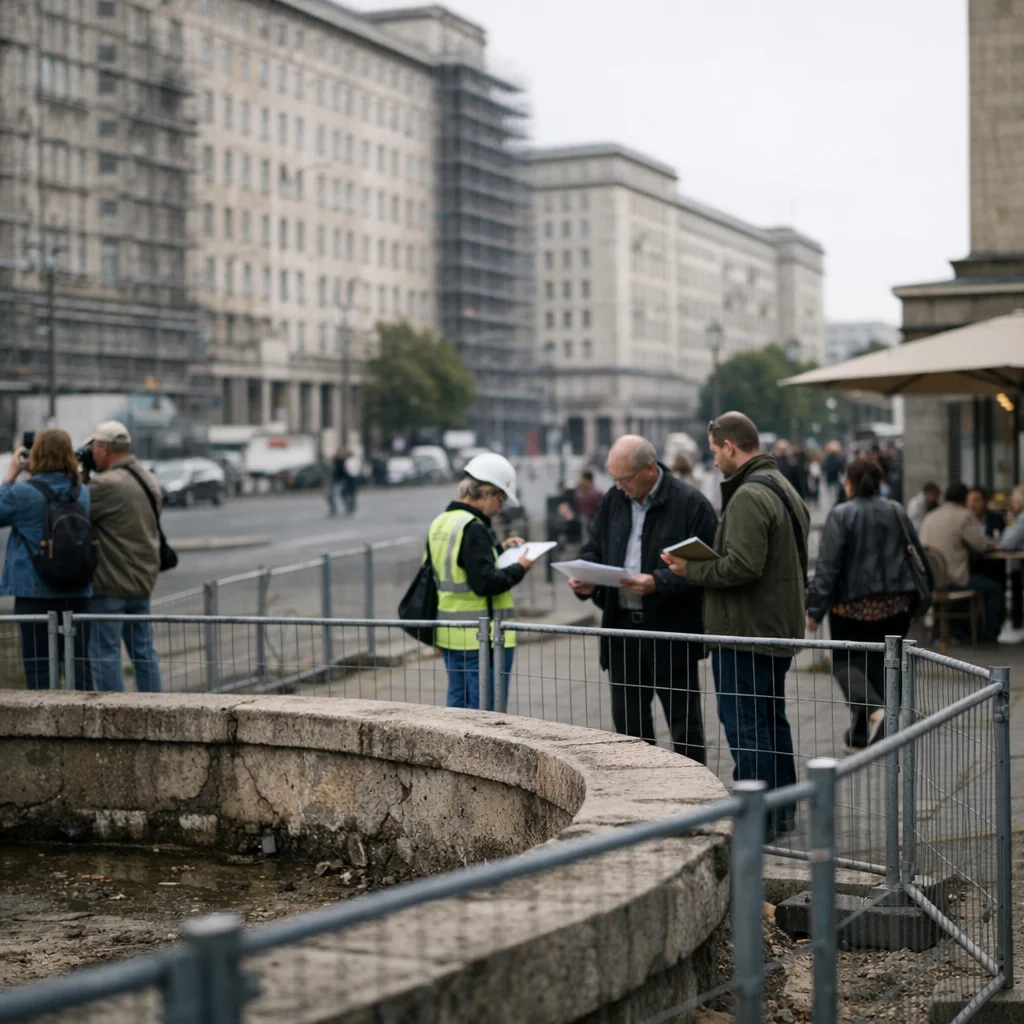
On a gray morning this week, restoration workers, tour guides, heritage officials, and two branding consultants in matching dark coats moved along the avenue with the grave concentration of people handling a valuable torso they do not intend to understand. The façades still hold themselves upright, but the missing fountain has become the city’s clearest admission: a decorative cavity where civic confidence should be. Visitors stopped to photograph the empty basin as if it were a heroic wound, while the guides explained the avenue’s “socialist dignity” in the same tone used to describe a suite with excellent lighting and discreet entry.
A district heritage official, Monika Reuter, said the goal was to keep the boulevard “authentic” while restoring its “public face.” That phrasing would be almost tender if it did not sound so much like the bureaucratic version of a man promising respect while already reaching for the zipper. “We are preserving a masterpiece, not a memory museum,” she said beside a temporary fence that made the whole scene feel like a supervised undressing. “Every crack gets treated, every missing piece documented.”
That is the city’s favorite posture: hands busy, conscience clean, and the invoice hidden under the mattress. Karl-Marx-Allee has become Berlin’s favorite seduction of responsibility: the administration keeps stroking the stone, whispering about UNESCO, and hoping history will split the bill after the lights go down. The boulevard is handled the way every overconfident institution handles a body it wants to display without ever having to service it properly: public admiration up front, private neglect in the back room, and a lot of language about care to cover the smell of delay.
At street level, the transactions are less elegant and more honest. Heritage tourists want revolutionary grandeur without the inconvenience of revolution, or even a working drainage system. New residents want a working-class legend they can rent by the month and leave before the pipes complain. Restaurant owners want the boulevard’s socialist massing but softened with candlelight, a neater wine list, and enough velvet to make the old architecture feel consenting. Near Frankfurter Tor, one café manager said business improves whenever visitors call the avenue “iconic” in English and “authentic” in the same sentence, which is usually how colonization sounds after a second oat-milk cappuccino and a long look at itself in the glass.
The branding consultants were harder to read because they never stop smiling when the money is near. One of them, who declined to give a name because the city is apparently still paying them to be mysterious, said the street needed “a clearer narrative arc.” That is consultant speech for make the monument easier to consume and harder to blame. The boulevard does not need a narrative arc. It needs the missing fountain back, the cracked skin repaired, and the officials to admit that “activation” is just maintenance in lipstick.
Not everyone is indulging the performance. Erdal Yilmaz, who has run a convenience shop nearby for more than two decades, pointed at the chipped plaster and said the avenue is being treated like “a museum with expensive legs.” Then he laughed once, without much joy. “They love the story,” he said. “They do not love the upkeep.”
That is the arrangement in full: the city wants the prestige without the labor, the heritage office wants the applause without the bill, and the consultants want to be present for the unveiling while staying far away when the thing starts to sag. UNESCO hovers above it all like a stern old patron who likes the look of discipline and never asks who paid for the outfit. Until the missing fountain is restored and the façades stop shedding their expensive skin, Karl-Marx-Allee will remain what the city has made of it: a socialist monument dressed for bourgeois appetite, kept upright by paperwork, and repeatedly handled by institutions that prefer the idea of the street to the cost of keeping it satisfied.