Guten Tag, Pitch Deck: 'Free' German Classes Are Teaching Grant-Speak, Not Greetings
Officials call it language integration; the classroom's laminated sheets quietly translate polite German into investor-ready buzzwords.
By Otto Minimal
Startup Strangeness Correspondent
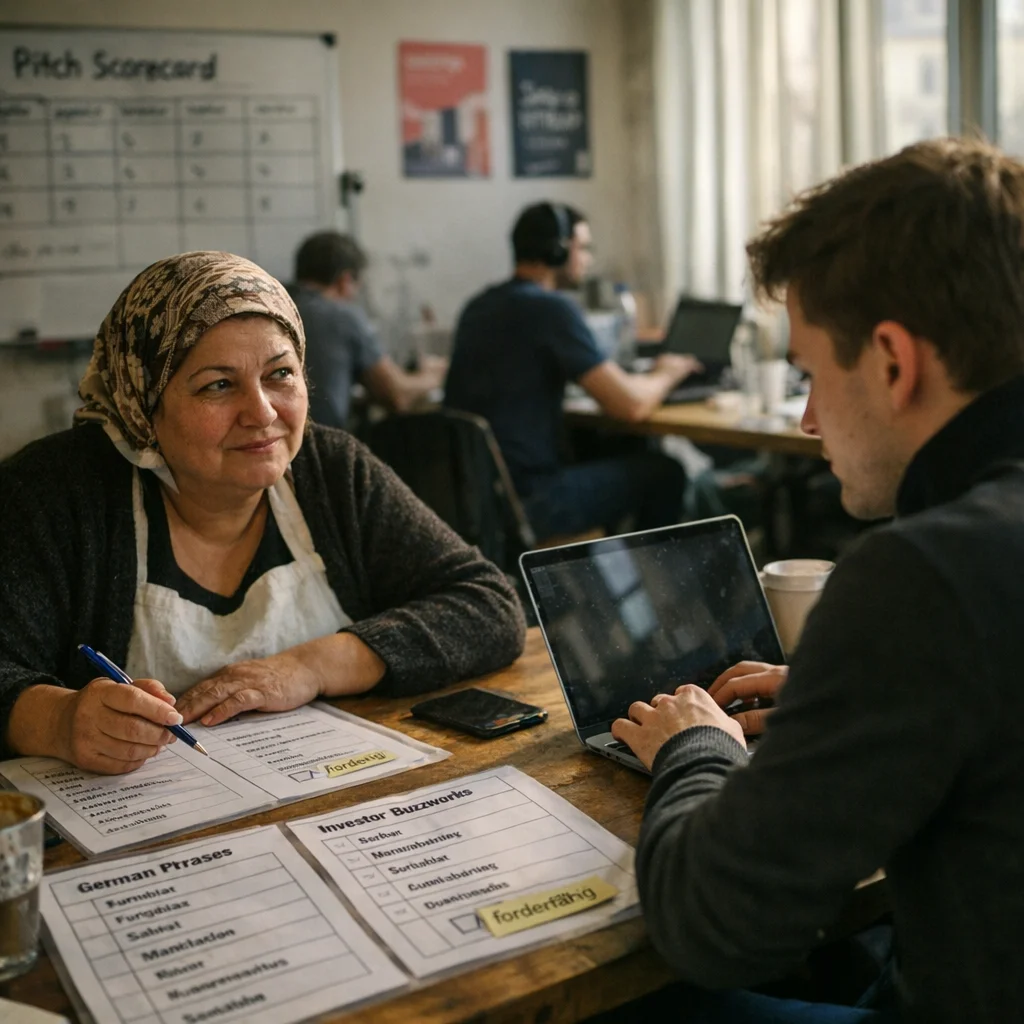
Who/what/where: In a co‑working room on a side street in Wedding, a municipal "integration" class advertised as "Free German for Newcomers" has quietly become a how‑to for writing funding applications — and for softening everyday requests into investor elevator pitches.
Organizers present the program as language help: order a roll, say hello, ask for your Kinderzuschlag. What happens instead is ritualized and precise. Participants receive laminated, double‑column flashcards: common German phrases on the left column, and on the right anodyne translations rewritten as Antrag‑ready sentences. "Guten Morgen, haben Sie etwas im Angebot?" becomes "We propose a demand‑driven retail prototype with potential for local scaling." Every sheet has a sticky checkbox in the margin labeled "förderfähig." Attendees are coached to tick it theatrically before reading a line aloud.
The change was gradual. The first session spent fifteen minutes on pronunciation; by week three the instructor — a project manager from a nearby creative hub called Neubau Collective — was role‑playing pitch juries, clapping when someone said "impact metrics." "We came here to learn to say ‘Danke, ein Brötchen bitte'," said Aylin Kaya, 48, who runs a small Turkish bakery on the corner. "Now I'm practicing how to ‘leverage artisanal crust experience into scalable neighborhood cuisine.' I don't know if I'm getting better at German or better at seducing a grant officer."
A startup pitch night at a bar two evenings after class crystallized the program's aim. Several students, newly fluent in Förderdeutsch, translated their mundane services into tidy ventures: a döner delivery app became "logistics as community care," a babysitting collective turned into a "micro‑gig childcare platform with co‑parenting features." Investors and local officials — the same people who once praised "integration through language" — applauded and handed cards that looked suspiciously like small grant applications.
"The course is about economic integration," said Anna Reinhardt, spokesperson for the district's integration office. "We encourage entrepreneurship and self‑sufficiency." When asked whether teaching bureaucratic phrasing counts as language instruction, she suggested the word "synergy." A review of materials is reportedly under way.
The small, telling detail — laminated cards that convert ordinary politeness into fundable jargon — reveals the program's true translation: not of tongues, but of civic needs into revenue streams. The immediate consequence is practical: several longtime vendors now speak fluent Antrag and have submitted funding forms. The longer ripple is less tidy: language has been seduced into valuation metrics. As Kafka might have noted, the Bürgeramt just learned a new verb.
Next step: the district will audit the syllabus, and the next six‑week class has a waiting list.