Handschlag auf Raten, bitte
Germany’s Mittelstand has learned to call debt “stability” right up until the bills ask for interest like a hostage note.
By Otto Minimal
Startup Strangeness Correspondent
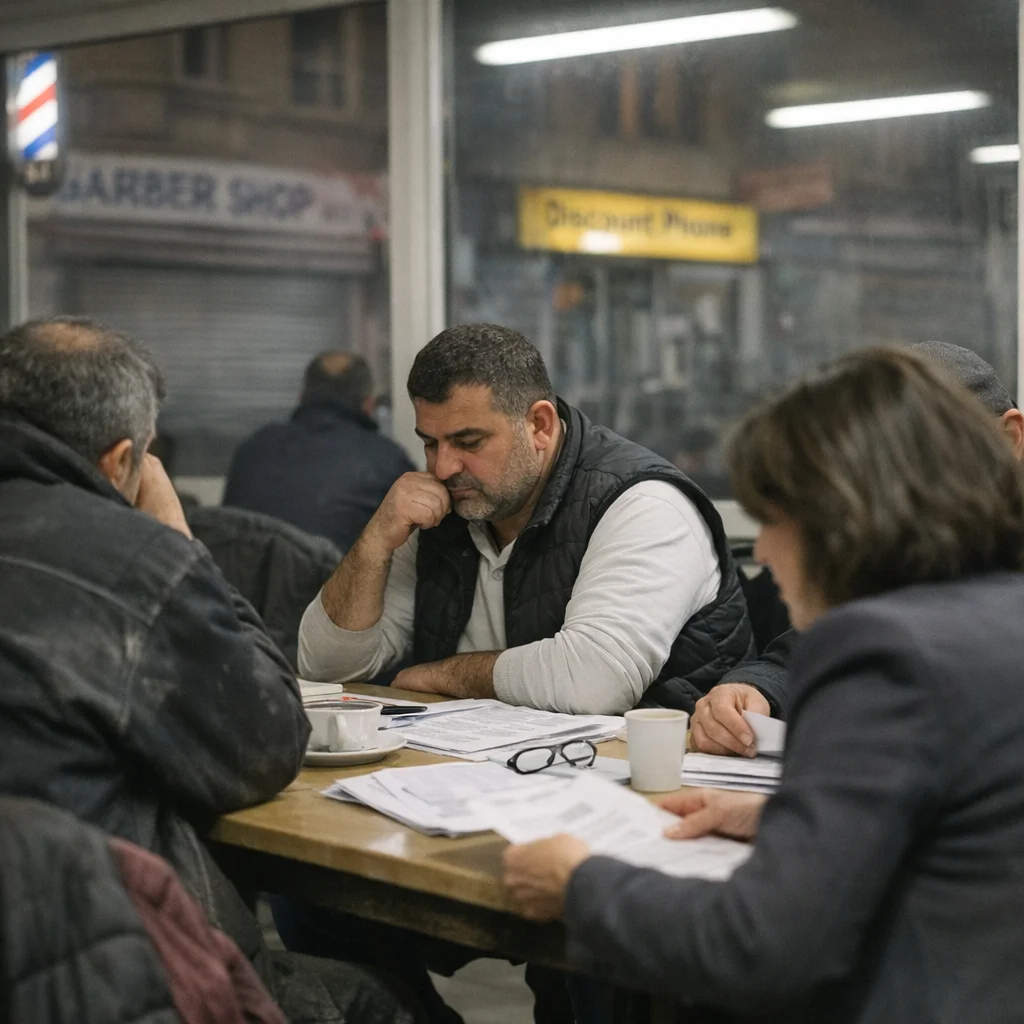
The room smelled like toner and surrender
Mortgage season in Wedding arrived this week wearing a clean shirt and a dead-eyed smile. In a small hall near Leopoldplatz, between a Turkish bakery that still smells faintly of sesame and old fryer grease and a shuttered storefront advertising günstige Büroflächen no one can afford, owners of corner bakeries, metal shops, repair yards, and family warehouses sat under fluorescent lights and tried to discuss refinancing as if they were discussing the weather. By the end, several had learned the same insulting fact: they were not captains of industry, only tenants of their own optimism, paying interest on their own self-respect.
Outside, Wedding did what Wedding does: delivery bikes slalomed past discount tobacconists, a barber shop with a laminated poster for “premium fades,” a mobile phone store with half the lights dead, and the usual rent-pressure comedy where every second shutter has a handwritten sign promising “new concept” next season. Inside, the local business association had arranged the evening like a municipal exorcism for people who still believe clean shoes can preserve solvency.
The usual suspects, in their small bureaucratic costumes
The gathering was organized by a business association that speaks in the soft, lubricated voice of men who say “location factor” when they mean “we’d like public subsidies without public scrutiny.” Their chair, Herr R., arrived with a smile that looked ironed on and kept saying “We’re all in the same boat” in the tone of a ferry captain who has already sold your life jacket.
The district economic officer, Frau S., showed up with the expression of someone sent to translate misery into grant-language. She said “resilience,” “support architecture,” and “stakeholder dialogue” the way other people say “don’t worry” while already measuring the floor for blood. Her speech habits were pure administrative morphine: each sentence padded with passive voice so nobody could tell who was doing the cutting. She praised “local embeddedness” while staring at the room like a procurement checklist that had learned to breathe.
The bank advisor, meanwhile, was the evening’s main piece of polite rot: a smooth-faced man in a blue suit, cufflinks like tiny handcuffs, who kept leaning forward with the hungry intimacy of a dentist who enjoys the drill. He had the exact voice of someone trained to say “breathing room” until the phrase feels like a joke about suffocation. Every time he said “flexibility,” it sounded less like finance than a cheap seduction attempt delivered by a man who has already taken your coat.
The euphemisms got looser as the room got poorer
“Let’s not call it a crisis,” the bank advisor said, with that showroom smile people use when they are about to put the knife in gently. “We prefer to frame this as a phase of adjustment.”
Adjustment. In Wedding, where a workshop owner is deciding whether to sell a machine, delay wages, or extend credit to customers who already treat him like a coupon kiosk, “adjustment” is just debt wearing perfume. It is the financial equivalent of a bad lover promising to go slow while already fumbling for your wallet.
Mehmet Yilmaz, who owns a metal parts workshop and asked for anonymity because his son told him he had become “financially embarrassing,” laughed at the word so hard he nearly choked on his tea. “They say restructuring like it’s a facelift,” he said. “But it’s just a better mask for the same ugly face. I’m paying three banks and one spreadsheet to keep pretending I own a business and not a long, expensive panic attack.”
A bakery owner in the second row, flour still ghosting her sleeves, muttered that her lender had called her loan “well-positioned” two weeks before asking for fresh collateral. “Well-positioned,” she repeated, rolling her eyes so hard it looked like a medical event. “That’s what they call you when they want you naked but polite.”
The room, which had been performing civic decorum with the discipline of a church in fiscal decline, gave her the meanest laugh of the night: not joy, exactly, but recognition with its clothes half off.
Everyone in the room was complicit, just in different currencies
What made the evening obscene was not the debt itself. It was the choreography. These owners still perform obedience like a family religion: invoices filed in order, taxes paid before the holidays, workers treated badly only when stress gets affectionate and the boss starts mistaking cruelty for leadership. They complain about bureaucracy while worshipping it. They denounce the bank while begging it to keep them respectable one more quarter. They want to be seen as pillars, but the pillars are held together with borrowed glue and the same cheap nationalism that tells them suffering is noble as long as it comes with a stamp.
That is the Wedding version of middle-class dignity: a chipped sign in the window, a cash register that jams, a landlord who raises rent by email, and a shop owner insisting he is “holding the line” while quietly passing the bill to workers, relatives, and anyone else he can still lean on without collapsing. The neighborhood is full of these miniature empires, all of them sweating through their collars and pretending the humiliation is temporary, all of them one bad month away from being repossessed by reality.
The district office loves this arrangement because it lets public failure look like personal responsibility. The business association loves it because it can host panels and call that advocacy. The bank loves it because every “solution” keeps the debtor breathing just long enough to keep paying for the privilege of being slowly strangled.
The meeting ended with the room still on the hook
By the time the session ended, a mechanic and a café supplier were arguing over whether to sell equipment, delay salaries, or extend credit to customers who already look at them like creditors. The association promised follow-up appointments. The district office promised “additional pathways.” The bank promised options, which is what predators call the menu before the bill arrives.
Everyone nodded. Everyone took the handouts. Everyone left with their dignity already thinly sliced and folded into a folder marked next steps.
Outside, Wedding kept eating itself in small, practical bites: a bakery closing at 6, a barber sweeping hair into the gutter, a courier checking his phone under a dead sign, a storefront pretending to be vacant because vacancy is cheaper than honesty. Next month, the same room will fill again with the same careful men and tired women, all of them told once more that independence is only a loan with better branding.