Hijab Optional, Judgment Mandatory
A new Wedding culture war pretends to defend women’s freedom by loudly inspecting how much skin they have courageously failed to show.
By Mert Inkblot
Imported Outrage & Kiez Satirist
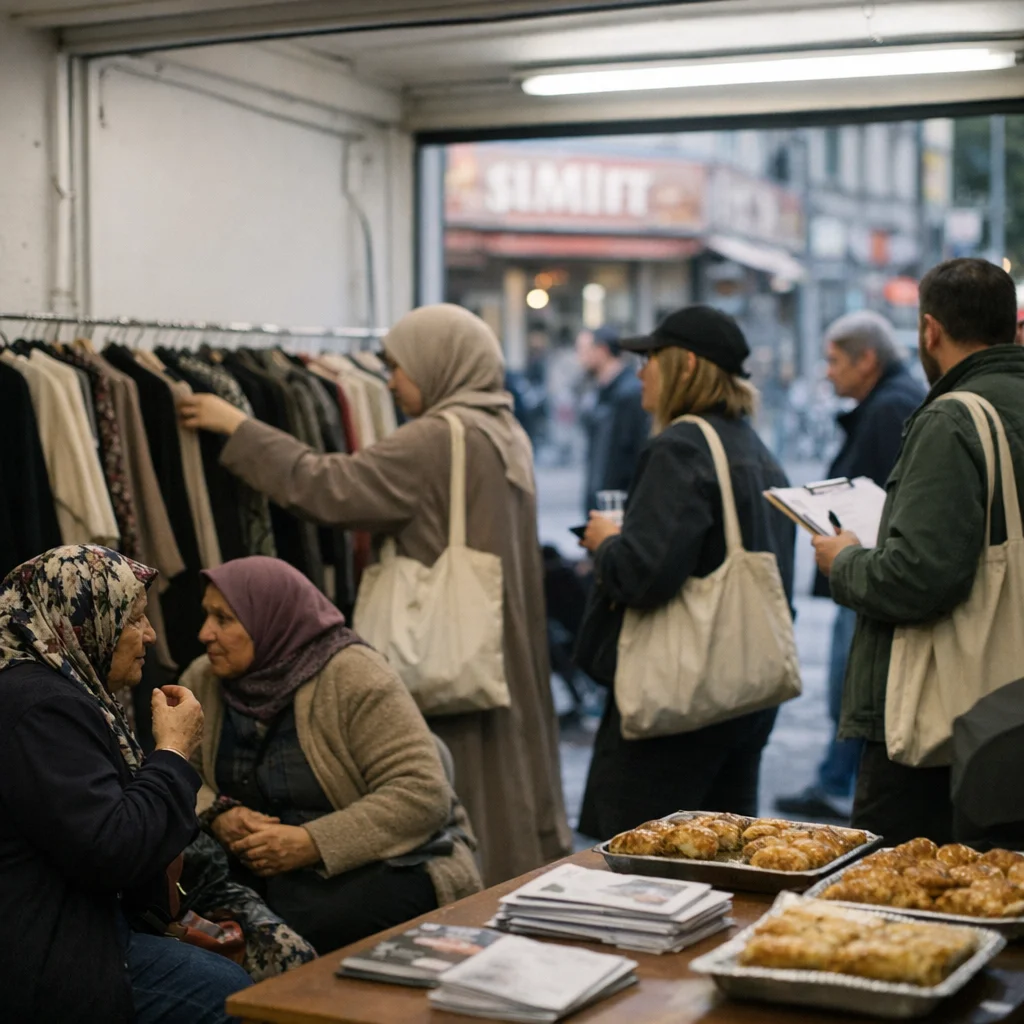
In Wedding, the latest culture war arrived dressed like a respectable blouse and smelling faintly of instant coffee, damp wool, and institutional self-regard. A weeklong series of panels, pop-up racks, and dead-eyed “community conversations” about modest fashion unfolded in a converted storefront near Leopoldplatz, where women were invited to browse clothes while a small army of civic voyeurs circled them with the same intensity men usually reserve for football scores or unpaid parking tickets.
The room had all the charm of a rent review and all the warmth of a waiting area. Racks of long coats and loose dresses stood under fluorescent light beside half-empty paper cups, flyers nobody wanted, and a tray of supermarket pastries slowly drying into evidence. Outside, Müllerstraße carried on with its usual Wedding soundtrack: tram squeal, kebab smoke, scooter exhaust, someone shouting into a phone as if the pavement owed him an apology. Inside, the event’s energy was less “dialogue” than a polished little humiliation ritual with tote bags.
The fighting, such as it was, split along the usual Berlin fault line: right-wing men furious that women insist on inhabiting public space without asking permission from the local museum of male panic; progressive men furious that anyone might notice how eagerly they perform tolerance while staring just as hard. Both camps worship the same altar. One calls it tradition, the other calls it agency. Both use women like props, then look offended when the prop speaks.
A man in a neat linen shirt kept nodding so aggressively at the moderator that his beard seemed to be campaigning for office. Another, older and red-faced, declared himself “concerned about patriarchal pressure” while repeatedly asking whether the sleeves were “opt-in” enough, which is the sort of sentence that should get a person gently escorted out of adulthood. A district volunteer with a clipboard and a martyr’s expression kept rearranging name tags that nobody needed, as if bureaucracy could be applied like lip gloss and make the whole mess presentable.
“Everyone here wants to rescue us,” said Aylin Demir, who runs a small clothing shop on Müllerstraße and asked not to be named like a case study. “Some want to save us from religion. Some want to save us from men. Some want to save us from fabric. None of them can save themselves from talking.”
That was the real performance: not modesty, not liberation, but the sacred Berlin habit of turning other people’s lives into a seminar so the organizers can feel tender and superior in the same breath. The district office, sensing blood in the water and grant money in the air, issued a statement praising “plural expressions of identity” and “safe spaces for nuanced dialogue,” which is bureaucratese for lighting a scented candle beside a knife fight and calling it mediation. A spokesperson insisted the borough supports “all women’s choices,” provided those choices arrive with the proper paperwork, the correct vocabulary, and the kind of visual hygiene that flatters committee photos.
And because this is Wedding, the hypocrisy had local texture. Turkish aunties from around Seestraße were treated like living exhibits by people who would never survive five minutes being stared at in return. Teenagers from the neighborhood drifted in and out, half curious, half amused, while a pair of art-school men in identical black trousers hovered near the rack of long skirts as though they were about to discover a new pronoun through upholstery. Somewhere in the back, a woman in gold hoops and a leather jacket laughed once, sharply, at a moderator’s earnest question and made the entire room feel briefly, mercifully human.
The irony is that Wedding already contains the thing all these polished little scolds keep pretending to invent: ordinary coexistence without a sermon attached. Turkish bakeries, mosque-goers, goths, delivery riders, old men with immaculate tailoring, women in hijab, women in none of it, and people too tired to care have been sharing these sidewalks for decades. Nobody needs a municipal intimacy expert to explain their own street back to them. But Berlin cannot resist the chance to turn a neighborhood into a laboratory and then congratulate itself for not dropping the scalpel.
So every hemline becomes a referendum, every scarf a thesis, every raised eyebrow a tiny administrative fondling disguised as concern. The final event is scheduled for next week. Organizers say it will “deepen the conversation.” In practice, it will likely produce the same thing: more men leaning forward to explain women’s freedom to them, more officials pretending that public inspection is care, and more exhausted women standing in fluorescent light while the city masturbates its conscience in a clipboard.