Homeowners Demand Democracy, Then Call Security
A new wave of tenants’ and owners’ meetings in Wedding is discovering that everyone loves participation right up until the vote threatens their parking space, balcony rules, or racist fantasy of “shared values.”.
Civic Hypocrisy & Neighborhood Compliance Reporter
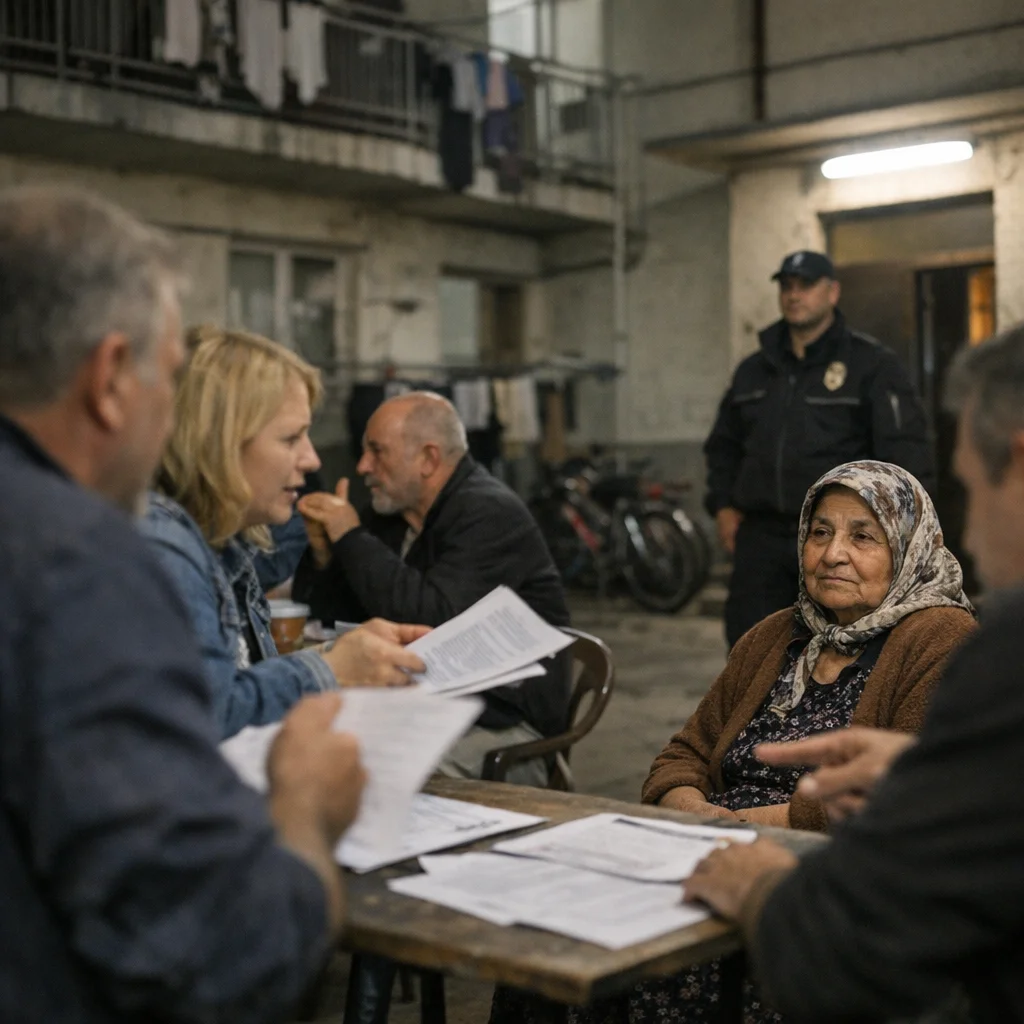
Homeowners associations and tenant advisory groups in Wedding spent the week holding emergency meetings about participation, then using the last ten minutes to decide who should be escorted out by security and who merely deserved the cold stare reserved for the untidy poor.
It started, as these things always do, with a laminated agenda, a tray of stale biscuits, and a promise of openness delivered in the dry voice of someone who calls exclusion “structure” because it sounds less like what it is. It ended with a man in a cashmere hoodie asking whether the neighboring family’s shoes in the hallway were a “fire risk,” then leaning back as if he had just performed civic surgery. A retired architect with the face of a closed bank demanded a vote on whether balconies should be allowed to “hang so emotionally.” Democracy, as ever in this city, was invited in only after it had been frisked.
At a residents’ assembly on Müllerstraße, one owner said the building needed “more dialogue” before announcing that he had already drafted a rule about guests staying after 10 p.m. unless they were “house-trained.” He said it with the serene confidence of a man who has never been told no by anyone without a lease. A Turkish grandmother from the second floor, who has lived in the block longer than the elevator has worked, reportedly asked whether her grandson’s bicycle now counted as an ideological threat or merely another excuse for the courtyard men to feel taller than they are. The room laughed in the way people do when they know the joke is aimed at the throat.
“We are not against community,” said Katharina Voss, chair of one owners’ group that rents its meeting room from a co-working space with a kombucha tap and stools too expensive to admit they are stools. “We are against disorder, ambiguity, and people who treat shared space like a personal opera.” It was the kind of sentence that smells faintly of expensive detergent and moral panic. She then moved the discussion to “reasonable enforcement,” which in Berlin usually means the moment a person discovers that a guard can be hired faster than a conscience and costs less than shame.
The district office said it had received a spike in complaints about noise, laundry, and hallway storage, but also about “tone,” which is the modern word for class war when it is dressed for brunch. One official described the meetings as “procedurally sound,” a phrase that in this city can cover anything from civic engagement to a soft coup in a stairwell. The police said they had not intervened, though several residents requested “preemptive support” after a vote on guest registration turned into a small psycho-drama worthy of Chekhov with better shoes and worse motives.
The real performance, of course, was not the rules but the righteousness. The left-wing renters wanted horizontal process until someone mentioned cleaning the stairwell, at which point solidarity became a decorative theory. The right-leaning owners wanted order, but only the kind that would let them call it culture while they checked who was speaking too loudly, standing too close, or looking insufficiently German for the current mood. Everyone claimed to care about fairness while circling the same grievance like wolves in a Bauhaus courtyard, sniffing for weakness, leg room, and whatever private scandal might make the next vote feel clean.
There was also the familiar Berlin trick of turning exclusion into virtue. Call it safety, call it civility, call it neighborhood peace, and suddenly the same old appetite for control walks around in a linen shirt pretending to be enlightenment. The language is always tenderest when it is laundering something ugly: a race-coded fantasy of order, the fetish of property, the erotic little thrill of deciding who belongs in the hall and who can wait outside like luggage no one promised to carry.
By late evening, one group had passed a proposal for “respectful conduct” and immediately used it to discipline the loudest neighbor, who was not invited to the next meeting. Another association scheduled a vote on whether security should be present at future assemblies. In Wedding, that is what participation looks like now: a velvet revolution with a clipboard, where everyone wants democracy until it gets too close to the door and starts asking for the key.